

Synthesis of Nanoscale Materials and Structures 261
CVD methods have been adapted to make 1-D nanotubes and
nanowires. Catalyst nanoparticles are used to promote nucleation. To make carbon nanotubes, for example, a combination of
carboncontaining gasses, such as methane (CH 4 ) and/or carbon
mono xide (CO 2 ), are reacted in the presence of Iron (Fe), Cobalt
(Co), and Nickel (Ni) catalysts at 1100°C. Decomposition of the
gasses releases free carbon atoms that condense on the substrate
with its array of catalyst particles, from which the carbon nanotubes
grow. In an alternative process, an arc is generated between two electrodes, one of which is carbon. The arc creates high temperatures,
causing the vaporization of the carbon electrodes into a plasma.
The arc is typically operated in a gas environment, such as nitrogen
or helium, and is generated by an electrical current passing through
the electrodes, which causes the ionization of gas atoms. The ion
beam produced is directed to a substrate carrying the Co, Fe, or Ni
catalyst particles from which the carbon nanotubes grow.
Nanowires of other materials such as silicon (Si) or germanium (Ge)
are grown by vapor-liquid-solid (VLS) methods. Typically a catalyst
seed (gold, for example) is deposited on a substrate. Subsequently a
vapor phase with the desired composition is brought in contact with
the seed at a controlled temperature. The vapor diffuses into the catalyst, changing its composition and lowering its melting point until
it melts. The liquid surface has a large coefficient of accommodation and therefore acts as a preferred site for absorption of the gas
vapor. The liquid becomes supersaturated and a solid nanowire or
“whisker” then grows from it with a diameter equal to the diameter
of the catalyst seed. Nanowires with a diameter around 10 nm and a
length of 1 micron can be grown in this way.
We have just encountered two ways of making layers of nano thickness: sol-gel methods and the method of Langmuir-Blodgett films.
There are others, described in the following subsections.
foil beating
Gilding is the art of applying gold leaf to a surface. It was known to
the ancients, is mentioned in the Old Testament, and was described
by Herodotus in 420 BC. Gold is an expensive material; there are
obvious incentives to use as little of it as possible. Gold leaf is made
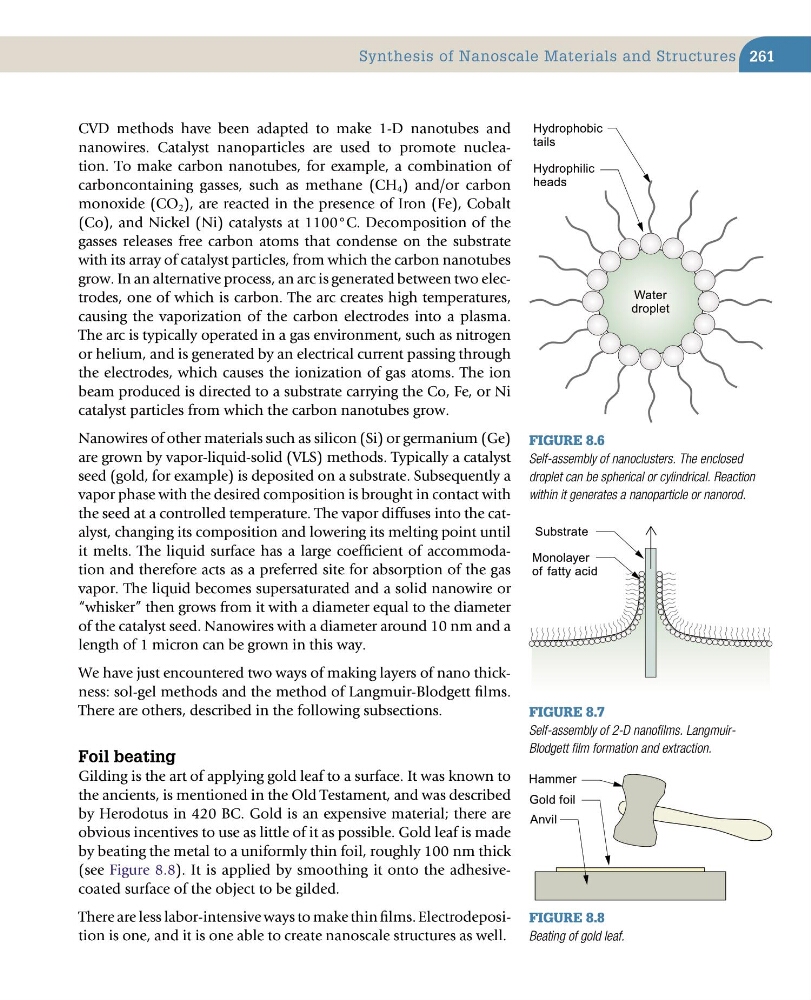
by beating the metal to a uniformly thin foil, roughly 100 nm thick
(see Figure 8.8). It is applied by smoothing it onto the adhesivecoated surface of the object to be gilded.
There are less labor-intensive ways to make thin films. Electrodeposition is one, and it is one able to create nanoscale structures as well.
Figure 8.6
Self-assembly of nanoclusters. The enclosed
droplet can be spherical or cylindrical. Reaction
within it generates a nanoparticle or nanorod.
Water
droplet
Hydrophobic
tails
Hydrophilic
heads
Figure 8.7
Self-assembly of 2-D nanofilms. LangmuirBlodgett film formation and extraction.
Substrate
Monolayer
of fatty acid
Figure 8.8
Beating of gold leaf.
Anvil
Gold foil
Hammer
CVD methods have been adapted to make 1-D nanotubes and
nanowires. Catalyst nanoparticles are used to promote nucleation. To make carbon nanotubes, for example, a combination of
carboncontaining gasses, such as methane (CH 4 ) and/or carbon
mono xide (CO 2 ), are reacted in the presence of Iron (Fe), Cobalt
(Co), and Nickel (Ni) catalysts at 1100°C. Decomposition of the
gasses releases free carbon atoms that condense on the substrate
with its array of catalyst particles, from which the carbon nanotubes
grow. In an alternative process, an arc is generated between two electrodes, one of which is carbon. The arc creates high temperatures,
causing the vaporization of the carbon electrodes into a plasma.
The arc is typically operated in a gas environment, such as nitrogen
or helium, and is generated by an electrical current passing through
the electrodes, which causes the ionization of gas atoms. The ion
beam produced is directed to a substrate carrying the Co, Fe, or Ni
catalyst particles from which the carbon nanotubes grow.
Nanowires of other materials such as silicon (Si) or germanium (Ge)
are grown by vapor-liquid-solid (VLS) methods. Typically a catalyst
seed (gold, for example) is deposited on a substrate. Subsequently a
vapor phase with the desired composition is brought in contact with
the seed at a controlled temperature. The vapor diffuses into the catalyst, changing its composition and lowering its melting point until
it melts. The liquid surface has a large coefficient of accommodation and therefore acts as a preferred site for absorption of the gas
vapor. The liquid becomes supersaturated and a solid nanowire or
“whisker” then grows from it with a diameter equal to the diameter
of the catalyst seed. Nanowires with a diameter around 10 nm and a
length of 1 micron can be grown in this way.
We have just encountered two ways of making layers of nano thickness: sol-gel methods and the method of Langmuir-Blodgett films.
There are others, described in the following subsections.
foil beating
Gilding is the art of applying gold leaf to a surface. It was known to
the ancients, is mentioned in the Old Testament, and was described
by Herodotus in 420 BC. Gold is an expensive material; there are
obvious incentives to use as little of it as possible. Gold leaf is made
by beating the metal to a uniformly thin foil, roughly 100 nm thick
(see Figure 8.8). It is applied by smoothing it onto the adhesivecoated surface of the object to be gilded.
There are less labor-intensive ways to make thin films. Electrodeposition is one, and it is one able to create nanoscale structures as well.
Figure 8.6
Self-assembly of nanoclusters. The enclosed
droplet can be spherical or cylindrical. Reaction
within it generates a nanoparticle or nanorod.
Water
droplet
Hydrophobic
tails
Hydrophilic
heads
Figure 8.7
Self-assembly of 2-D nanofilms. LangmuirBlodgett film formation and extraction.
Substrate
Monolayer
of fatty acid
Figure 8.8
Beating of gold leaf.
Anvil
Gold foil
Hammer