

chapter 8 nanomaterials: Synthesis and characterization
260
disassembly) of DNA that passes genetic information from cell to
cell, instructing them how to self-assemble. Surely we, as designers
and engineers, could use this path, too.
We are only just beginning to exploit its potential. The idea is to
create the conditions under which atoms or molecules will selfassemble into useful structures, driven by the minimization of
their energy. The great advantage of self-assembly is that the system
converges to a specific configuration without the need for further
control. Typically, the aggregates formed by self-assembly tend to
be bonded by relatively weak bonds with binding energies only a
few times larger than kT, the thermal energy per atom.
1 The selfassembling molecules form micelles. Micelles are aggregates of
amphiphilic molecules—molecules with one end that is soluble
in water and the other end that rejects it. These aggregates form
spontaneously at a size that depends on the concentration of the
amphiphilic molecules in solution. The center of the micelles acts
as a chamber for chemical reactions and thus dictates the size of the
nanoparticles created (see Figure 8.6).
Self-assembly of 2-D nanofilms is made possible by using the
wonderfully named Langmuir-Blodgett technique (see Figure 8.7).
A monolayer of a fatty acid is created on the surface of water into
which a substrate has been placed. Fatty acid molecules have a
hydrophilic part and a hydrophobic part. The polar part locks into
the water, whereas the nonpolar part rejects it. The fatty acid selfspreads across the water surface as a monolayer; any other arrangement would bury one or another end of molecules where they did
not want to be. The substrate is slowly withdrawn from the water.
The monolayer sticks to it and is transferred from the water surface
to the substrate. The process allows the fabrication of single monolayers of materials as well as thicker films by repeatedly dipping
and withdrawal.
Methods for Making 1-d and 2-d nanomaterials
The production route for 1-D rodlike nanomaterials by liquid-phase
methods is similar to that for the production of nanoparticles. Self
assembly methods use the highly anisotropic bonding nature of
asymmetric molecules to cause them to self-assemble into tubes
rather than spheres, forming cylindrical micelles. The amphiphilic
molecules are then removed with an appropriate solvent or by calcining to obtain individual nanowires.
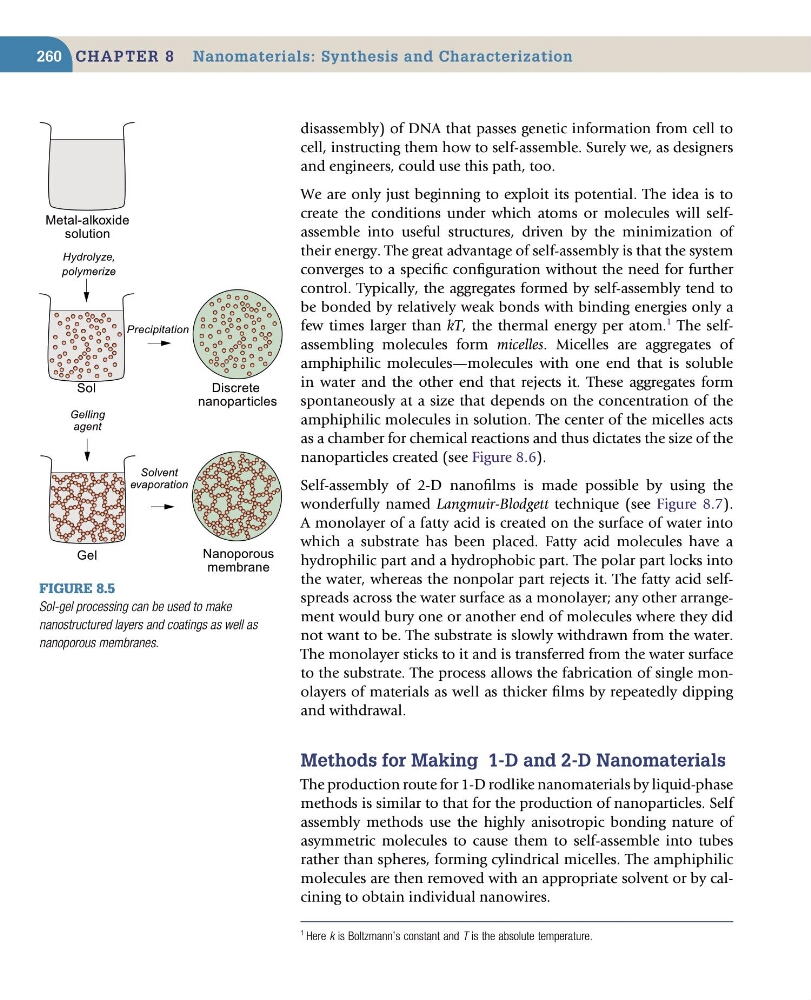
Figure 8.5
Sol-gel processing can be used to make
nanostructured layers and coatings as well as
nanoporous membranes.
Metal-alkoxide
solution
Sol
Discrete
nanoparticles
Nanoporous
membrane
Gel
Hydrolyze,
polymerize
Gelling
agent
Solvent
evaporation
Precipitation
1 Here k is Boltzmann’s constant and T is the absolute temperature.
260
disassembly) of DNA that passes genetic information from cell to
cell, instructing them how to self-assemble. Surely we, as designers
and engineers, could use this path, too.
We are only just beginning to exploit its potential. The idea is to
create the conditions under which atoms or molecules will selfassemble into useful structures, driven by the minimization of
their energy. The great advantage of self-assembly is that the system
converges to a specific configuration without the need for further
control. Typically, the aggregates formed by self-assembly tend to
be bonded by relatively weak bonds with binding energies only a
few times larger than kT, the thermal energy per atom.
1 The selfassembling molecules form micelles. Micelles are aggregates of
amphiphilic molecules—molecules with one end that is soluble
in water and the other end that rejects it. These aggregates form
spontaneously at a size that depends on the concentration of the
amphiphilic molecules in solution. The center of the micelles acts
as a chamber for chemical reactions and thus dictates the size of the
nanoparticles created (see Figure 8.6).
Self-assembly of 2-D nanofilms is made possible by using the
wonderfully named Langmuir-Blodgett technique (see Figure 8.7).
A monolayer of a fatty acid is created on the surface of water into
which a substrate has been placed. Fatty acid molecules have a
hydrophilic part and a hydrophobic part. The polar part locks into
the water, whereas the nonpolar part rejects it. The fatty acid selfspreads across the water surface as a monolayer; any other arrangement would bury one or another end of molecules where they did
not want to be. The substrate is slowly withdrawn from the water.
The monolayer sticks to it and is transferred from the water surface
to the substrate. The process allows the fabrication of single monolayers of materials as well as thicker films by repeatedly dipping
and withdrawal.
Methods for Making 1-d and 2-d nanomaterials
The production route for 1-D rodlike nanomaterials by liquid-phase
methods is similar to that for the production of nanoparticles. Self
assembly methods use the highly anisotropic bonding nature of
asymmetric molecules to cause them to self-assemble into tubes
rather than spheres, forming cylindrical micelles. The amphiphilic
molecules are then removed with an appropriate solvent or by calcining to obtain individual nanowires.
Figure 8.5
Sol-gel processing can be used to make
nanostructured layers and coatings as well as
nanoporous membranes.
Metal-alkoxide
solution
Sol
Discrete
nanoparticles
Nanoporous
membrane
Gel
Hydrolyze,
polymerize
Gelling
agent
Solvent
evaporation
Precipitation
1 Here k is Boltzmann’s constant and T is the absolute temperature.