

Synthesis of Nanoscale Materials and Structures 259
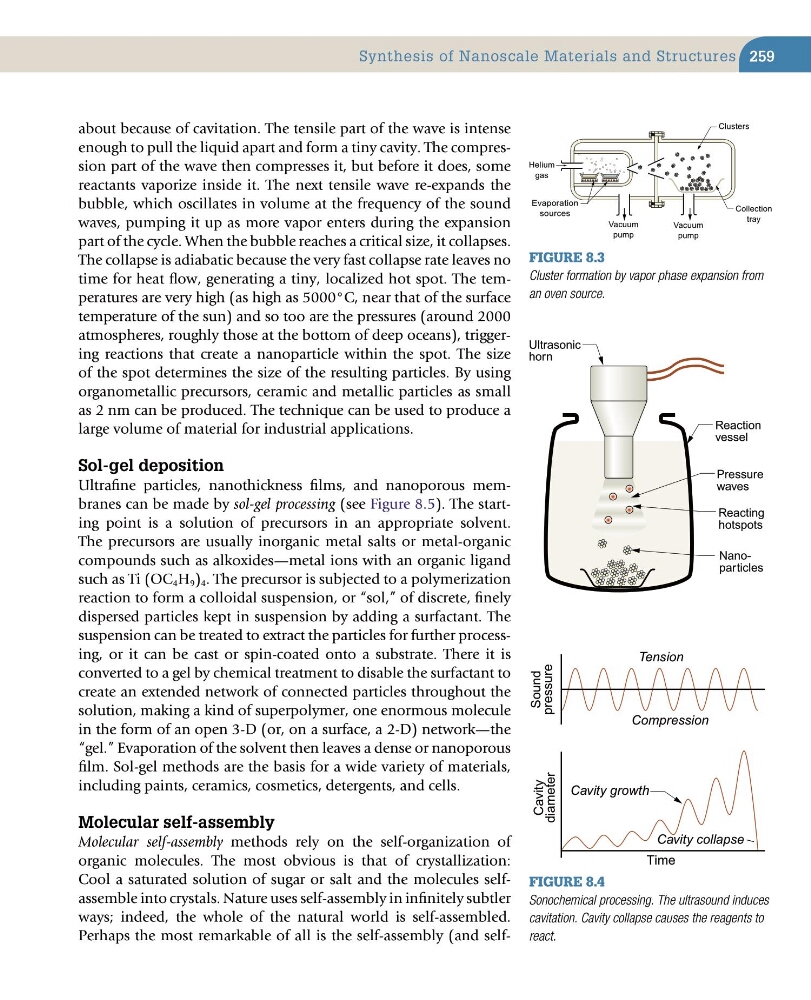
about because of cavitation. The tensile part of the wave is intense
enough to pull the liquid apart and form a tiny cavity. The compression part of the wave then compresses it, but before it does, some
reactants vaporize inside it. The next tensile wave re-expands the
bubble, which oscillates in volume at the frequency of the sound
waves, pumping it up as more vapor enters during the expansion
part of the cycle. When the bubble reaches a critical size, it collapses.
The collapse is adiabatic because the very fast collapse rate leaves no
time for heat flow, generating a tiny, localized hot spot. The temperatures are very high (as high as 5000°C, near that of the surface
temperature of the sun) and so too are the pressures (around 2000
atmospheres, roughly those at the bottom of deep oceans), triggering reactions that create a nanoparticle within the spot. The size
of the spot determines the size of the resulting particles. By using
organometallic precursors, ceramic and metallic particles as small
as 2 nm can be produced. The technique can be used to produce a
large volume of material for industrial applications.
Sol-gel deposition
Ultrafine particles, nanothickness films, and nanoporous membranes can be made by sol-gel processing (see Figure 8.5). The starting point is a solution of precursors in an appropriate solvent.
The precursors are usually inorganic metal salts or metal-organic
compounds such as alkoxides—metal ions with an organic ligand
such as Ti (OC 4 H 9 ) 4 . The precursor is subjected to a polymerization
reaction to form a colloidal suspension, or “sol,” of discrete, finely
dispersed particles kept in suspension by adding a surfactant. The
suspension can be treated to extract the particles for further processing, or it can be cast or spin-coated onto a substrate. There it is
converted to a gel by chemical treatment to disable the surfactant to
create an extended network of connected particles throughout the
solution, making a kind of superpolymer, one enormous molecule
in the form of an open 3-D (or, on a surface, a 2-D) network—the
“gel.” Evaporation of the solvent then leaves a dense or nanoporous
film. Sol-gel methods are the basis for a wide variety of materials,
including paints, ceramics, cosmetics, detergents, and cells.
Molecular self-assembly
Molecular self-assembly methods rely on the self-organization of
organic molecules. The most obvious is that of crystallization:
Cool a saturated solution of sugar or salt and the molecules selfassemble into crystals. Nature uses self-assembly in infinitely subtler
ways; indeed, the whole of the natural world is self-assembled.
Perhaps the most remarkable of all is the self-assembly (and selfFigure 8.3
Cluster formation by vapor phase expansion from
an oven source.
Clusters
Helium
gas
Vacuum
pump
Vacuum
pump
Evaporation
sources
Collection
tray
Figure 8.4
Sonochemical processing. The ultrasound induces
cavitation. Cavity collapse causes the reagents to
react.
Reaction
vessel
Pressure
waves
Nanoparticles
Reacting
hotspots
Ultrasonic
horn
Sound
pressure
Tension
Cavity collapse
Cavity growth
Compression
Cavity
diameter
Time
about because of cavitation. The tensile part of the wave is intense
enough to pull the liquid apart and form a tiny cavity. The compression part of the wave then compresses it, but before it does, some
reactants vaporize inside it. The next tensile wave re-expands the
bubble, which oscillates in volume at the frequency of the sound
waves, pumping it up as more vapor enters during the expansion
part of the cycle. When the bubble reaches a critical size, it collapses.
The collapse is adiabatic because the very fast collapse rate leaves no
time for heat flow, generating a tiny, localized hot spot. The temperatures are very high (as high as 5000°C, near that of the surface
temperature of the sun) and so too are the pressures (around 2000
atmospheres, roughly those at the bottom of deep oceans), triggering reactions that create a nanoparticle within the spot. The size
of the spot determines the size of the resulting particles. By using
organometallic precursors, ceramic and metallic particles as small
as 2 nm can be produced. The technique can be used to produce a
large volume of material for industrial applications.
Sol-gel deposition
Ultrafine particles, nanothickness films, and nanoporous membranes can be made by sol-gel processing (see Figure 8.5). The starting point is a solution of precursors in an appropriate solvent.
The precursors are usually inorganic metal salts or metal-organic
compounds such as alkoxides—metal ions with an organic ligand
such as Ti (OC 4 H 9 ) 4 . The precursor is subjected to a polymerization
reaction to form a colloidal suspension, or “sol,” of discrete, finely
dispersed particles kept in suspension by adding a surfactant. The
suspension can be treated to extract the particles for further processing, or it can be cast or spin-coated onto a substrate. There it is
converted to a gel by chemical treatment to disable the surfactant to
create an extended network of connected particles throughout the
solution, making a kind of superpolymer, one enormous molecule
in the form of an open 3-D (or, on a surface, a 2-D) network—the
“gel.” Evaporation of the solvent then leaves a dense or nanoporous
film. Sol-gel methods are the basis for a wide variety of materials,
including paints, ceramics, cosmetics, detergents, and cells.
Molecular self-assembly
Molecular self-assembly methods rely on the self-organization of
organic molecules. The most obvious is that of crystallization:
Cool a saturated solution of sugar or salt and the molecules selfassemble into crystals. Nature uses self-assembly in infinitely subtler
ways; indeed, the whole of the natural world is self-assembled.
Perhaps the most remarkable of all is the self-assembly (and selfFigure 8.3
Cluster formation by vapor phase expansion from
an oven source.
Clusters
Helium
gas
Vacuum
pump
Vacuum
pump
Evaporation
sources
Collection
tray
Figure 8.4
Sonochemical processing. The ultrasound induces
cavitation. Cavity collapse causes the reagents to
react.
Reaction
vessel
Pressure
waves
Nanoparticles
Reacting
hotspots
Ultrasonic
horn
Sound
pressure
Tension
Cavity collapse
Cavity growth
Compression
Cavity
diameter
Time