

chaPter 7 nanomaterials: Properties
242
minimized, which means that the nanoparticles should be as small
as possible while the index of refraction should remain as similar
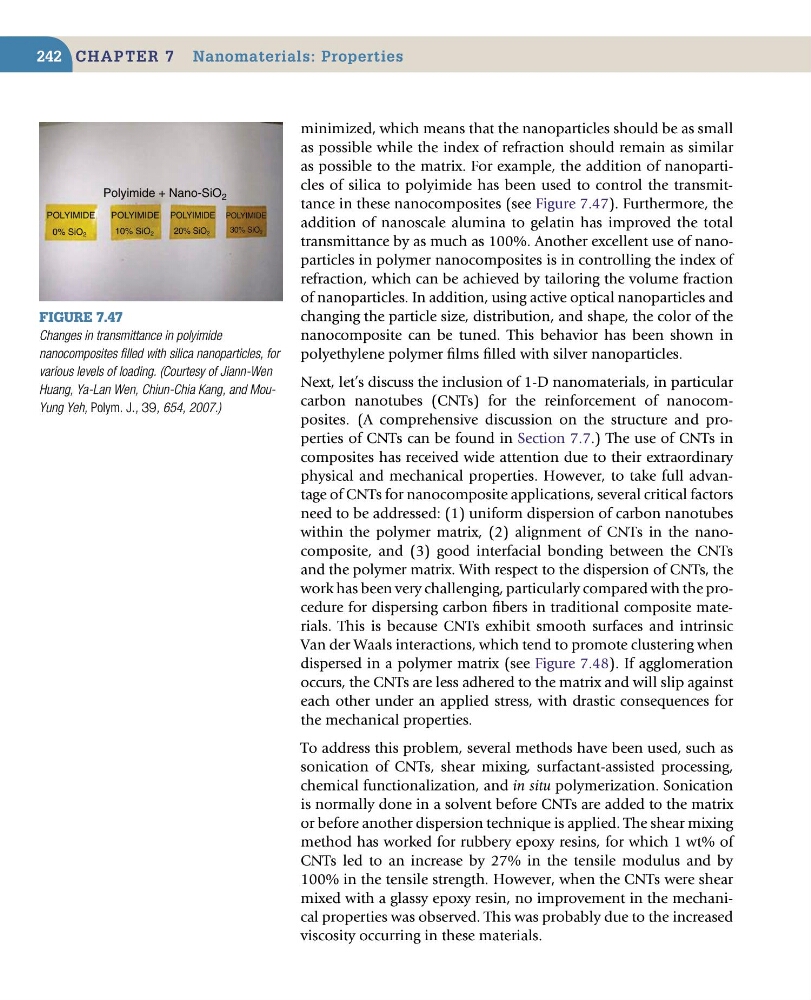
as possible to the matrix. For example, the addition of nanoparticles of silica to polyimide has been used to control the transmittance in these nanocomposites (see Figure 7.47). Furthermore, the
addition of nanoscale alumina to gelatin has improved the total
transmittance by as much as 100%. Another excellent use of nanoparticles in polymer nanocomposites is in controlling the index of
refraction, which can be achieved by tailoring the volume fraction
of nanoparticles. In addition, using active optical nanoparticles and
changing the particle size, distribution, and shape, the color of the
nanocomposite can be tuned. This behavior has been shown in
polyethylene polymer films filled with silver nanoparticles.
Next, let’s discuss the inclusion of 1-D nanomaterials, in particular
carbon nanotubes (CNTs) for the reinforcement of nanocomposites. (A comprehensive discussion on the structure and properties of CNTs can be found in Section 7.7.) The use of CNTs in
composites has received wide attention due to their extraordinary
physical and mechanical properties. However, to take full advantage of CNTs for nanocomposite applications, several critical factors
need to be addressed: (1) uniform dispersion of carbon nanotubes
within the polymer matrix, (2) alignment of CNTs in the nanocomposite, and (3) good interfacial bonding between the CNTs
and the polymer matrix. With respect to the dispersion of CNTs, the
work has been very challenging, particularly compared with the procedure for dispersing carbon fibers in traditional composite materials. This is because CNTs exhibit smooth surfaces and intrinsic
Van der Waals interactions, which tend to promote clustering when
dispersed in a polymer matrix (see Figure 7.48). If agglomeration
occurs, the CNTs are less adhered to the matrix and will slip against
each other under an applied stress, with drastic consequences for
the mechanical properties.
To address this problem, several methods have been used, such as
sonication of CNTs, shear mixing, surfactant-assisted processing,
chemical functionalization, and in situ polymerization. Sonication
is normally done in a solvent before CNTs are added to the matrix
or before another dispersion technique is applied. The shear mixing
method has worked for rubbery epoxy resins, for which 1 wt% of
CNTs led to an increase by 27% in the tensile modulus and by
100% in the tensile strength. However, when the CNTs were shear
mixed with a glassy epoxy resin, no improvement in the mechanical properties was observed. This was probably due to the increased
viscosity occurring in these materials.
Figure 7.47
Changes in transmittance in polyimide
nanocomposites filled with silica nanoparticles, for
various levels of loading. (Courtesy of Jiann-Wen
Huang, Ya-Lan Wen, Chiun-Chia Kang, and MouYung Yeh, Polym. J., 39, 654, 2007.)
Polyimide + Nano-SiO 2
POLYIMIDE
POLYIMIDE
0% SiO 2
10% SiO2
POLYIMIDE
20% SiO2
POLYIMIDE
30% SiO 2
242
minimized, which means that the nanoparticles should be as small
as possible while the index of refraction should remain as similar
as possible to the matrix. For example, the addition of nanoparticles of silica to polyimide has been used to control the transmittance in these nanocomposites (see Figure 7.47). Furthermore, the
addition of nanoscale alumina to gelatin has improved the total
transmittance by as much as 100%. Another excellent use of nanoparticles in polymer nanocomposites is in controlling the index of
refraction, which can be achieved by tailoring the volume fraction
of nanoparticles. In addition, using active optical nanoparticles and
changing the particle size, distribution, and shape, the color of the
nanocomposite can be tuned. This behavior has been shown in
polyethylene polymer films filled with silver nanoparticles.
Next, let’s discuss the inclusion of 1-D nanomaterials, in particular
carbon nanotubes (CNTs) for the reinforcement of nanocomposites. (A comprehensive discussion on the structure and properties of CNTs can be found in Section 7.7.) The use of CNTs in
composites has received wide attention due to their extraordinary
physical and mechanical properties. However, to take full advantage of CNTs for nanocomposite applications, several critical factors
need to be addressed: (1) uniform dispersion of carbon nanotubes
within the polymer matrix, (2) alignment of CNTs in the nanocomposite, and (3) good interfacial bonding between the CNTs
and the polymer matrix. With respect to the dispersion of CNTs, the
work has been very challenging, particularly compared with the procedure for dispersing carbon fibers in traditional composite materials. This is because CNTs exhibit smooth surfaces and intrinsic
Van der Waals interactions, which tend to promote clustering when
dispersed in a polymer matrix (see Figure 7.48). If agglomeration
occurs, the CNTs are less adhered to the matrix and will slip against
each other under an applied stress, with drastic consequences for
the mechanical properties.
To address this problem, several methods have been used, such as
sonication of CNTs, shear mixing, surfactant-assisted processing,
chemical functionalization, and in situ polymerization. Sonication
is normally done in a solvent before CNTs are added to the matrix
or before another dispersion technique is applied. The shear mixing
method has worked for rubbery epoxy resins, for which 1 wt% of
CNTs led to an increase by 27% in the tensile modulus and by
100% in the tensile strength. However, when the CNTs were shear
mixed with a glassy epoxy resin, no improvement in the mechanical properties was observed. This was probably due to the increased
viscosity occurring in these materials.
Figure 7.47
Changes in transmittance in polyimide
nanocomposites filled with silica nanoparticles, for
various levels of loading. (Courtesy of Jiann-Wen
Huang, Ya-Lan Wen, Chiun-Chia Kang, and MouYung Yeh, Polym. J., 39, 654, 2007.)
Polyimide + Nano-SiO 2
POLYIMIDE
POLYIMIDE
0% SiO 2
10% SiO2
POLYIMIDE
20% SiO2
POLYIMIDE
30% SiO 2