

243
Surfactant-assisted processing is another method used to disperse
CNTs. In this process, a surfactant is added to the CNTs before the
mixture is added to the polymer. In general, nanocomposites produced in this way appear to be more evenly distributed. Results
from mechanical tests indicate that polymers with the addition of
surfactants but no CNTs show a decrease in the elastic modulus
compared to the elastic modulus of the same polymer without the
surfactant. This indicates that the surfactant acts as a plasticizer. On
the other hand, when the surfactant is added along with the CNTs
to the polymer matrix, the elastic modulus can increase more than
30%, which confirms that the surfactant is acting as an efficient
dispersing agent.
Dispersion of CNTs by chemical functionalization is also another
alternative (see Figure 7.49). In this case, one of the most successful developments involves partial separation of SWCNTs from the
bundles by means of an acidic solution. This step normally cuts the
CNTs into short segments with carboxylic acid groups covalently
attached to the openings. Subsequently the SWCNTs are placed in
an organic melt, which leads to exfoliated CNTs. When MWCNTs
are used, the surface activity is typically modified by doping them
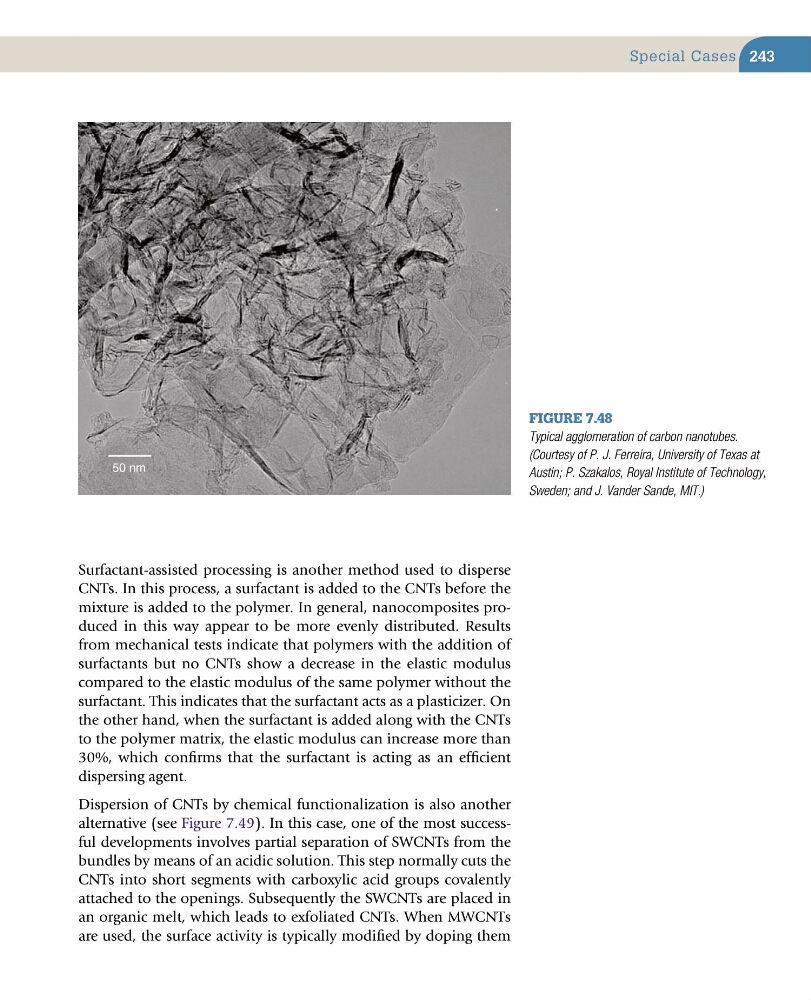
Figure 7.48
Typical agglomeration of carbon nanotubes.
(Courtesy of P. J. Ferreira, University of Texas at
Austin; P. Szakalos, Royal Institute of Technology,
Sweden; and J. Vander Sande, MIT.)
Special Cases
Surfactant-assisted processing is another method used to disperse
CNTs. In this process, a surfactant is added to the CNTs before the
mixture is added to the polymer. In general, nanocomposites produced in this way appear to be more evenly distributed. Results
from mechanical tests indicate that polymers with the addition of
surfactants but no CNTs show a decrease in the elastic modulus
compared to the elastic modulus of the same polymer without the
surfactant. This indicates that the surfactant acts as a plasticizer. On
the other hand, when the surfactant is added along with the CNTs
to the polymer matrix, the elastic modulus can increase more than
30%, which confirms that the surfactant is acting as an efficient
dispersing agent.
Dispersion of CNTs by chemical functionalization is also another
alternative (see Figure 7.49). In this case, one of the most successful developments involves partial separation of SWCNTs from the
bundles by means of an acidic solution. This step normally cuts the
CNTs into short segments with carboxylic acid groups covalently
attached to the openings. Subsequently the SWCNTs are placed in
an organic melt, which leads to exfoliated CNTs. When MWCNTs
are used, the surface activity is typically modified by doping them
Figure 7.48
Typical agglomeration of carbon nanotubes.
(Courtesy of P. J. Ferreira, University of Texas at
Austin; P. Szakalos, Royal Institute of Technology,
Sweden; and J. Vander Sande, MIT.)
Special Cases