

241
leads to strain softening before strain hardening, resulting in large
strains-to-failure.
Nanoparticles can also significantly affect Tg. Typically this occurs
because nanoparticles influence the mobility of the polymer chains
due to bonding between the particles and the polymer and bridging of the polymer chains between the particles. If the interaction
between the nanoparticles and the matrix is weak, a depression in
Tg is normally observed. However, in some cases, a critical volume
fraction of nanoparticles is required for the effect to be noticed,
as shown for alumina/PMMA nanocomposites. The Tg can also be
increased if the interaction between the matrix and the nanoparticles is strong. In fact, a 35°C increase in Tg has been observed for
a PMMA nanocomposite reinforced with calcium carbonate nanoparticles. Another benefit of using nanoparticles in polymer-matrix
nanocomposites is an enhancement in wear resistance, which has
been observed, for example, in nylon reinforced with nanoparticles
of silica.
The electrical and optical properties of polymer-matrix nanocomposites can also be improved by the addition of nanoparticles.
With respect to electrical properties, the nanoparticles seem
to act in a variety of ways. First, the smaller the nanoparticles, the
shorter the distance between the particles, provided the volume is
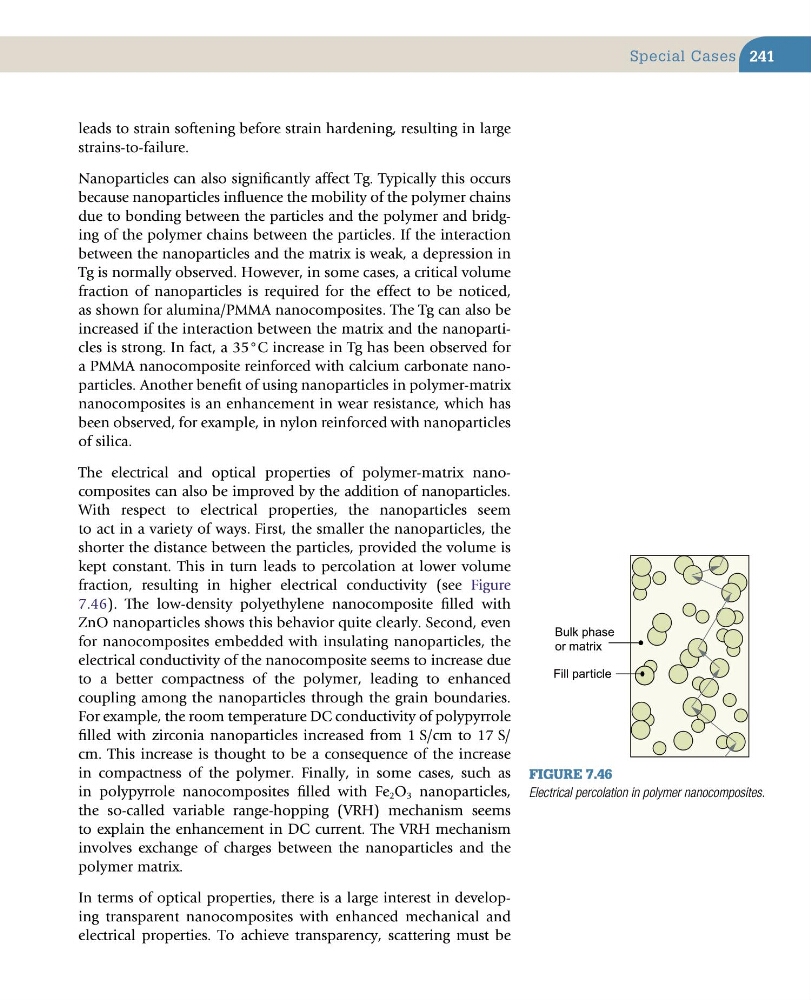
kept constant. This in turn leads to percolation at lower volume
fraction, resulting in higher electrical conductivity (see Figure
7.46). The low-density polyethylene nanocomposite filled with
ZnO nanoparticles shows this behavior quite clearly. Second, even
for nanocomposites embedded with insulating nanoparticles, the
electrical conductivity of the nanocomposite seems to increase due
to a better compactness of the polymer, leading to enhanced
coupling among the nanoparticles through the grain boundaries.
For example, the room temperature DC conductivity of polypyrrole
filled with zirconia nanoparticles increased from 1 S/cm to 17 S/
cm. This increase is thought to be a consequence of the increase
in compactness of the polymer. Finally, in some cases, such as
in polypyrrole nanocomposites filled with Fe 2 O 3 nanoparticles,
the so-called variable range-hopping (VRH) mechanism seems
to explain the enhancement in DC current. The VRH mechanism
involves exchange of charges between the nanoparticles and the
polymer matrix.
In terms of optical properties, there is a large interest in developing transparent nanocomposites with enhanced mechanical and
electrical properties. To achieve transparency, scattering must be
Figure 7.46
Electrical percolation in polymer nanocomposites.
Fill particle
Bulk phase
or matrix
Special Cases
leads to strain softening before strain hardening, resulting in large
strains-to-failure.
Nanoparticles can also significantly affect Tg. Typically this occurs
because nanoparticles influence the mobility of the polymer chains
due to bonding between the particles and the polymer and bridging of the polymer chains between the particles. If the interaction
between the nanoparticles and the matrix is weak, a depression in
Tg is normally observed. However, in some cases, a critical volume
fraction of nanoparticles is required for the effect to be noticed,
as shown for alumina/PMMA nanocomposites. The Tg can also be
increased if the interaction between the matrix and the nanoparticles is strong. In fact, a 35°C increase in Tg has been observed for
a PMMA nanocomposite reinforced with calcium carbonate nanoparticles. Another benefit of using nanoparticles in polymer-matrix
nanocomposites is an enhancement in wear resistance, which has
been observed, for example, in nylon reinforced with nanoparticles
of silica.
The electrical and optical properties of polymer-matrix nanocomposites can also be improved by the addition of nanoparticles.
With respect to electrical properties, the nanoparticles seem
to act in a variety of ways. First, the smaller the nanoparticles, the
shorter the distance between the particles, provided the volume is
kept constant. This in turn leads to percolation at lower volume
fraction, resulting in higher electrical conductivity (see Figure
7.46). The low-density polyethylene nanocomposite filled with
ZnO nanoparticles shows this behavior quite clearly. Second, even
for nanocomposites embedded with insulating nanoparticles, the
electrical conductivity of the nanocomposite seems to increase due
to a better compactness of the polymer, leading to enhanced
coupling among the nanoparticles through the grain boundaries.
For example, the room temperature DC conductivity of polypyrrole
filled with zirconia nanoparticles increased from 1 S/cm to 17 S/
cm. This increase is thought to be a consequence of the increase
in compactness of the polymer. Finally, in some cases, such as
in polypyrrole nanocomposites filled with Fe 2 O 3 nanoparticles,
the so-called variable range-hopping (VRH) mechanism seems
to explain the enhancement in DC current. The VRH mechanism
involves exchange of charges between the nanoparticles and the
polymer matrix.
In terms of optical properties, there is a large interest in developing transparent nanocomposites with enhanced mechanical and
electrical properties. To achieve transparency, scattering must be
Figure 7.46
Electrical percolation in polymer nanocomposites.
Fill particle
Bulk phase
or matrix
Special Cases