

chaPter 7 nanomaterials: Properties
240
within the matrix, has nanoscale dimensions. The small size of
this phase leads to unique properties. In addition, due to the nanoscale size of the reinforcing phase, the interface-to-volume ratio is
significantly higher than in conventional composites. As a result,
the volume fraction of the second phase can be reduced, without
degradation of the desired properties. The polymer matrix system
can be a thermoplastic, thermoset, or elastomer. A thermoplastic
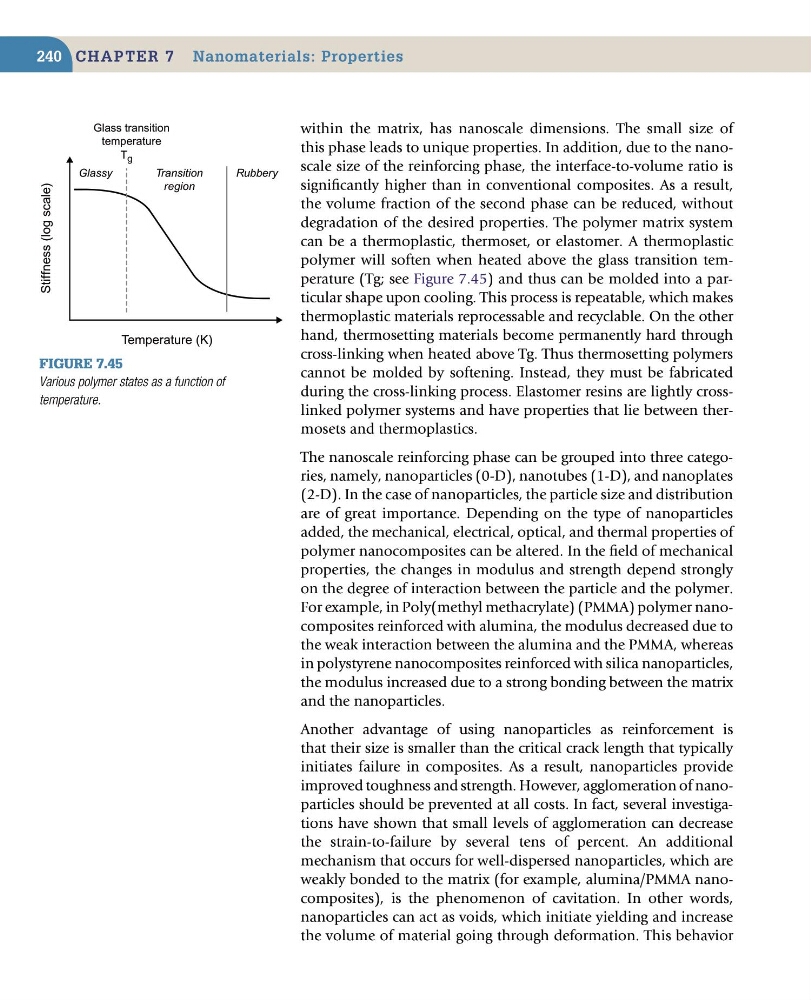
polymer will soften when heated above the glass transition temperature (Tg; see Figure 7.45) and thus can be molded into a particular shape upon cooling. This process is repeatable, which makes
thermoplastic materials reprocessable and recyclable. On the other
hand, thermosetting materials become permanently hard through
cross-linking when heated above Tg. Thus thermosetting polymers
cannot be molded by softening. Instead, they must be fabricated
during the cross-linking process. Elastomer resins are lightly crosslinked polymer systems and have properties that lie between thermosets and thermoplastics.
The nanoscale reinforcing phase can be grouped into three categories, namely, nanoparticles (0-D), nanotubes (1-D), and nanoplates
(2-D). In the case of nanoparticles, the particle size and distribution
are of great importance. Depending on the type of nanoparticles
added, the mechanical, electrical, optical, and thermal properties of
polymer nanocomposites can be altered. In the field of mechanical
properties, the changes in modulus and strength depend strongly
on the degree of interaction between the particle and the polymer.
For example, in Poly(methyl methacrylate) (PMMA) polymer nanocomposites reinforced with alumina, the modulus decreased due to
the weak interaction between the alumina and the PMMA, whereas
in polystyrene nanocomposites reinforced with silica nanoparticles,
the modulus increased due to a strong bonding between the matrix
and the nanoparticles.
Another advantage of using nanoparticles as reinforcement is
that their size is smaller than the critical crack length that typically
initiates failure in composites. As a result, nanoparticles provide
improved toughness and strength. However, agglomeration of nanoparticles should be prevented at all costs. In fact, several investigations have shown that small levels of agglomeration can decrease
the strain-to-failure by several tens of percent. An additional
mechanism that occurs for well-dispersed nanoparticles, which are
weakly bonded to the matrix (for example, alumina/PMMA nanocomposites), is the phenomenon of cavitation. In other words,
nanoparticles can act as voids, which initiate yielding and increase
the volume of material going through deformation. This behavior
Figure 7.45
Various polymer states as a function of
temperature.
Glassy
Transition
region
Rubbery
Temperature (K)
Stiffness (log scale)
T g
Glass transition
temperature
240
within the matrix, has nanoscale dimensions. The small size of
this phase leads to unique properties. In addition, due to the nanoscale size of the reinforcing phase, the interface-to-volume ratio is
significantly higher than in conventional composites. As a result,
the volume fraction of the second phase can be reduced, without
degradation of the desired properties. The polymer matrix system
can be a thermoplastic, thermoset, or elastomer. A thermoplastic
polymer will soften when heated above the glass transition temperature (Tg; see Figure 7.45) and thus can be molded into a particular shape upon cooling. This process is repeatable, which makes
thermoplastic materials reprocessable and recyclable. On the other
hand, thermosetting materials become permanently hard through
cross-linking when heated above Tg. Thus thermosetting polymers
cannot be molded by softening. Instead, they must be fabricated
during the cross-linking process. Elastomer resins are lightly crosslinked polymer systems and have properties that lie between thermosets and thermoplastics.
The nanoscale reinforcing phase can be grouped into three categories, namely, nanoparticles (0-D), nanotubes (1-D), and nanoplates
(2-D). In the case of nanoparticles, the particle size and distribution
are of great importance. Depending on the type of nanoparticles
added, the mechanical, electrical, optical, and thermal properties of
polymer nanocomposites can be altered. In the field of mechanical
properties, the changes in modulus and strength depend strongly
on the degree of interaction between the particle and the polymer.
For example, in Poly(methyl methacrylate) (PMMA) polymer nanocomposites reinforced with alumina, the modulus decreased due to
the weak interaction between the alumina and the PMMA, whereas
in polystyrene nanocomposites reinforced with silica nanoparticles,
the modulus increased due to a strong bonding between the matrix
and the nanoparticles.
Another advantage of using nanoparticles as reinforcement is
that their size is smaller than the critical crack length that typically
initiates failure in composites. As a result, nanoparticles provide
improved toughness and strength. However, agglomeration of nanoparticles should be prevented at all costs. In fact, several investigations have shown that small levels of agglomeration can decrease
the strain-to-failure by several tens of percent. An additional
mechanism that occurs for well-dispersed nanoparticles, which are
weakly bonded to the matrix (for example, alumina/PMMA nanocomposites), is the phenomenon of cavitation. In other words,
nanoparticles can act as voids, which initiate yielding and increase
the volume of material going through deformation. This behavior
Figure 7.45
Various polymer states as a function of
temperature.
Glassy
Transition
region
Rubbery
Temperature (K)
Stiffness (log scale)
T g
Glass transition
temperature