

239
Field emission is another area in which CNTs can prove particularly useful. As previously discussed, the concept of field emission
involves the application of an electrical field along the CNT axis to
induce the emission of electrons from the end of the tube. So far,
the research has been directed toward using SWCNTs and MWCNTs
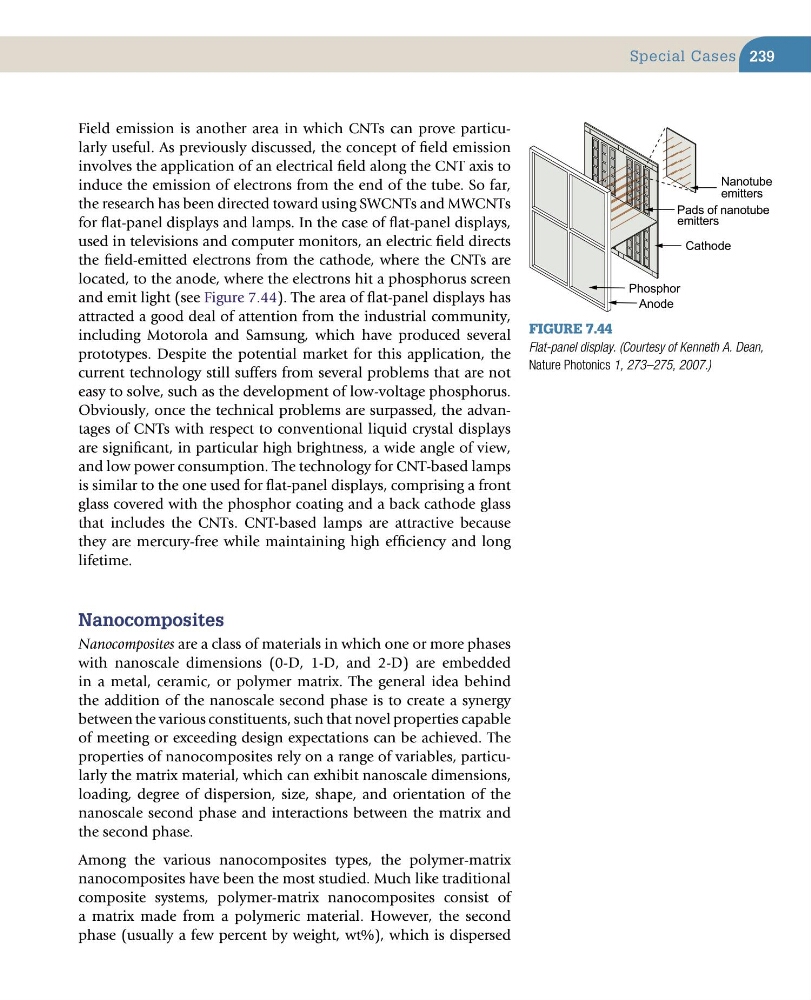
for flat-panel displays and lamps. In the case of flat-panel displays,
used in televisions and computer monitors, an electric field directs
the field-emitted electrons from the cathode, where the CNTs are
located, to the anode, where the electrons hit a phosphorus screen
and emit light (see Figure 7.44). The area of flat-panel displays has
attracted a good deal of attention from the industrial community,
including Motorola and Samsung, which have produced several
prototypes. Despite the potential market for this application, the
current technology still suffers from several problems that are not
easy to solve, such as the development of low-voltage phosphorus.
Obviously, once the technical problems are surpassed, the advantages of CNTs with respect to conventional liquid crystal displays
are significant, in particular high brightness, a wide angle of view,
and low power consumption. The technology for CNT-based lamps
is similar to the one used for flat-panel displays, comprising a front
glass covered with the phosphor coating and a back cathode glass
that includes the CNTs. CNT-based lamps are attractive because
they are mercury-free while maintaining high efficiency and long
lifetime.
nanocomposites
Nanocomposites are a class of materials in which one or more phases
with nanoscale dimensions (0-D, 1-D, and 2-D) are embedded
in a metal, ceramic, or polymer matrix. The general idea behind
the addition of the nanoscale second phase is to create a synergy
between the various constituents, such that novel properties capable
of meeting or exceeding design expectations can be achieved. The
properties of nanocomposites rely on a range of variables, particularly the matrix material, which can exhibit nanoscale dimensions,
loading, degree of dispersion, size, shape, and orientation of the
nanoscale second phase and interactions between the matrix and
the second phase.
Among the various nanocomposites types, the polymer-matrix
nanocomposites have been the most studied. Much like traditional
composite systems, polymer-matrix nanocomposites consist of
a matrix made from a polymeric material. However, the second
phase (usually a few percent by weight, wt%), which is dispersed
Figure 7.44
Flat-panel display. (Courtesy of Kenneth A. Dean,
Nature Photonics 1, 273–275, 2007.)
Nanotube
emitters
Pads of nanotube
emitters
Phosphor
Anode
Cathode
Special Cases
Field emission is another area in which CNTs can prove particularly useful. As previously discussed, the concept of field emission
involves the application of an electrical field along the CNT axis to
induce the emission of electrons from the end of the tube. So far,
the research has been directed toward using SWCNTs and MWCNTs
for flat-panel displays and lamps. In the case of flat-panel displays,
used in televisions and computer monitors, an electric field directs
the field-emitted electrons from the cathode, where the CNTs are
located, to the anode, where the electrons hit a phosphorus screen
and emit light (see Figure 7.44). The area of flat-panel displays has
attracted a good deal of attention from the industrial community,
including Motorola and Samsung, which have produced several
prototypes. Despite the potential market for this application, the
current technology still suffers from several problems that are not
easy to solve, such as the development of low-voltage phosphorus.
Obviously, once the technical problems are surpassed, the advantages of CNTs with respect to conventional liquid crystal displays
are significant, in particular high brightness, a wide angle of view,
and low power consumption. The technology for CNT-based lamps
is similar to the one used for flat-panel displays, comprising a front
glass covered with the phosphor coating and a back cathode glass
that includes the CNTs. CNT-based lamps are attractive because
they are mercury-free while maintaining high efficiency and long
lifetime.
nanocomposites
Nanocomposites are a class of materials in which one or more phases
with nanoscale dimensions (0-D, 1-D, and 2-D) are embedded
in a metal, ceramic, or polymer matrix. The general idea behind
the addition of the nanoscale second phase is to create a synergy
between the various constituents, such that novel properties capable
of meeting or exceeding design expectations can be achieved. The
properties of nanocomposites rely on a range of variables, particularly the matrix material, which can exhibit nanoscale dimensions,
loading, degree of dispersion, size, shape, and orientation of the
nanoscale second phase and interactions between the matrix and
the second phase.
Among the various nanocomposites types, the polymer-matrix
nanocomposites have been the most studied. Much like traditional
composite systems, polymer-matrix nanocomposites consist of
a matrix made from a polymeric material. However, the second
phase (usually a few percent by weight, wt%), which is dispersed
Figure 7.44
Flat-panel display. (Courtesy of Kenneth A. Dean,
Nature Photonics 1, 273–275, 2007.)
Nanotube
emitters
Pads of nanotube
emitters
Phosphor
Anode
Cathode
Special Cases