

chaPter 7 nanomaterials: Properties
238
physisorption (0.1 eV) or chemisorption (2–3 eV). Currently, the
number of hydrogen trapping sites available under normal conditions is not sufficient to fulfill the goals set by DOE.
Still in the area of fuel cells, there is currently an increasing interest in using CNTs as a support material for the catalyst nanoparticles present in the cathode and anode electrodes of a fuel cell.
At the moment, the support material is amorphous carbon. The
introduction of CNTs is expected to enhance the conductivity of
the support and reduce the mobility of the catalyst nanoparticles.
The abundant open structure of CNTs is also very appealing for the
storage of large amounts of lithium ions. Some of the CNT’s properties, such as good chemical stability, large surface area, and elastic
modulus, are important characteristics in prolonging the lifespan
of batteries based on CNTs. In general, CNTs are able to adsorb a
significant amount of lithium. However, the electrochemical performance strongly depends on the number of walls and chirality
of the CNTs.
Another area in which CNTs can potentially be of great interest
is the field of supercapacitors. This is because CNTs exhibit high
porosity, large specific surface area, high electrical conductivity,
and chemical stability. In a conventional capacitor, energy is typically stored by the transfer of electrons from one metal electrode
to another metal electrode separated by an electronically insulating material. The capacitance depends on the separation distance
and the dielectric material inserted between electrodes. In the case
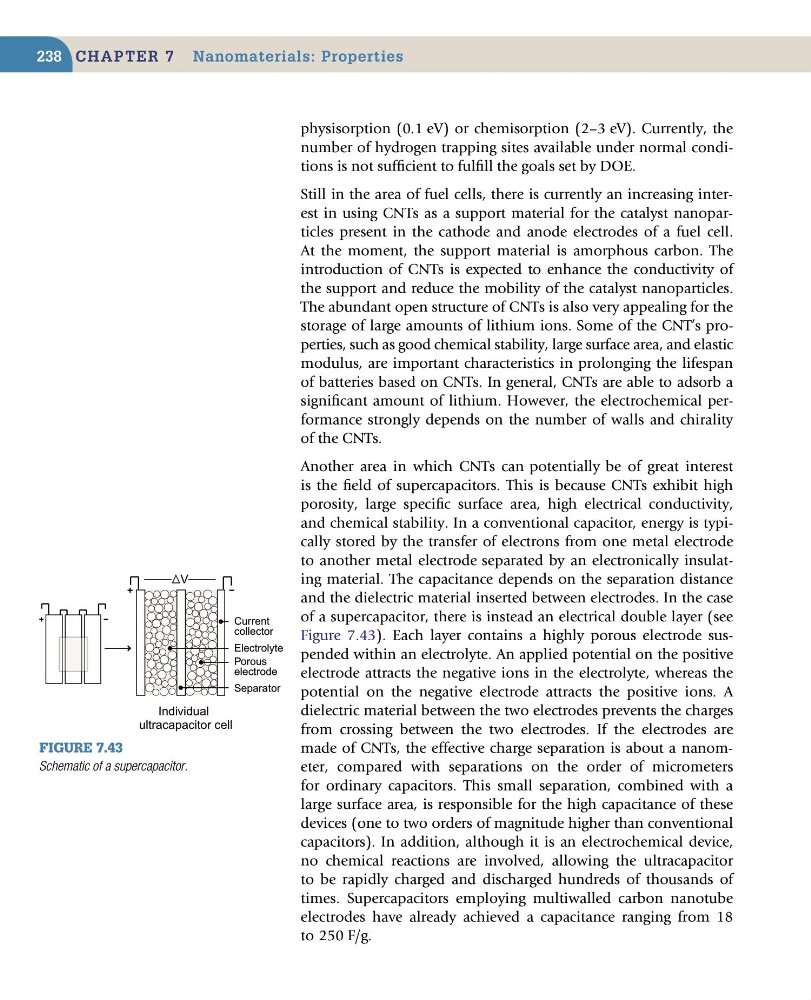
of a supercapacitor, there is instead an electrical double layer (see
Figure 7.43). Each layer contains a highly porous electrode suspended within an electrolyte. An applied potential on the positive
electrode attracts the negative ions in the electrolyte, whereas the
potential on the negative electrode attracts the positive ions. A
dielectric material between the two electrodes prevents the charges
from crossing between the two electrodes. If the electrodes are
made of CNTs, the effective charge separation is about a nanometer, compared with separations on the order of micrometers
for ordinary capacitors. This small separation, combined with a
large surface area, is responsible for the high capacitance of these
devices (one to two orders of magnitude higher than conventional
capacitors). In addition, although it is an electrochemical device,
no chemical reactions are involved, allowing the ultracapacitor
to be rapidly charged and discharged hundreds of thousands of
times. Supercapacitors employing multiwalled carbon nanotube
electrodes have already achieved a capacitance ranging from 18
to 250 F/g.
Figure 7.43
Schematic of a supercapacitor.
Current
collector
Electrolyte
Porous
electrode
Separator
V
Individual
ultracapacitor cell
238
physisorption (0.1 eV) or chemisorption (2–3 eV). Currently, the
number of hydrogen trapping sites available under normal conditions is not sufficient to fulfill the goals set by DOE.
Still in the area of fuel cells, there is currently an increasing interest in using CNTs as a support material for the catalyst nanoparticles present in the cathode and anode electrodes of a fuel cell.
At the moment, the support material is amorphous carbon. The
introduction of CNTs is expected to enhance the conductivity of
the support and reduce the mobility of the catalyst nanoparticles.
The abundant open structure of CNTs is also very appealing for the
storage of large amounts of lithium ions. Some of the CNT’s properties, such as good chemical stability, large surface area, and elastic
modulus, are important characteristics in prolonging the lifespan
of batteries based on CNTs. In general, CNTs are able to adsorb a
significant amount of lithium. However, the electrochemical performance strongly depends on the number of walls and chirality
of the CNTs.
Another area in which CNTs can potentially be of great interest
is the field of supercapacitors. This is because CNTs exhibit high
porosity, large specific surface area, high electrical conductivity,
and chemical stability. In a conventional capacitor, energy is typically stored by the transfer of electrons from one metal electrode
to another metal electrode separated by an electronically insulating material. The capacitance depends on the separation distance
and the dielectric material inserted between electrodes. In the case
of a supercapacitor, there is instead an electrical double layer (see
Figure 7.43). Each layer contains a highly porous electrode suspended within an electrolyte. An applied potential on the positive
electrode attracts the negative ions in the electrolyte, whereas the
potential on the negative electrode attracts the positive ions. A
dielectric material between the two electrodes prevents the charges
from crossing between the two electrodes. If the electrodes are
made of CNTs, the effective charge separation is about a nanometer, compared with separations on the order of micrometers
for ordinary capacitors. This small separation, combined with a
large surface area, is responsible for the high capacitance of these
devices (one to two orders of magnitude higher than conventional
capacitors). In addition, although it is an electrochemical device,
no chemical reactions are involved, allowing the ultracapacitor
to be rapidly charged and discharged hundreds of thousands of
times. Supercapacitors employing multiwalled carbon nanotube
electrodes have already achieved a capacitance ranging from 18
to 250 F/g.
Figure 7.43
Schematic of a supercapacitor.
Current
collector
Electrolyte
Porous
electrode
Separator
V
Individual
ultracapacitor cell