

chaPter 7 nanomaterials: Properties
234
The chiral type occurs when the chiral vector numbers (n, m) can
assume any integer values and the chiral angle is intermediate
between 0 and 30 (Figure 7.40). Among these three different types,
armchair SWCNTs are metals, those with n-m = k (k is an integer)
are semiconductors with a small band gap, and the remainder are
semiconductors with a band gap that is inversely proportional to
the CNT diameter.
Carbon nanotubes exhibit various unique properties, such as the
ability to withstand large stresses with little elastic deformation
(Young’s modulus = 1000 GPa), the capacity to endure enormous
tensile stresses (30 GPa), and the aptitude of exhibiting superior
current densities (10
9 A/cm
2 ) and thermal conductivity (6000 W/
mK). These two latter properties are due to the nearly 1-D electronic
structure in metallic SWNTs and multiwalled nanotubes (MWNTs),
which leads to ballistic transport, and the ease by which phonons
propagate along the nanotube, respectively.
So far, researchers around the world have been devising several
methodologies to synthesize carbon nanotubes. The most common
methods are the arc-discharge technique and chemical vapor deposition (CVD; see Section 8.1). These methods have seen significant
improvements over the years, but they still suffer from (1) low yield,
(2) very high cost, (3) difficulty in tuning the diameter of the nanotubes, and (4) difficulty in producing a single type of CNT without
impurities. Table 7.2 shows some of the advantages and disadvantages of these current methods. Although these techniques have
been the subject of considerable research, there are still many questions with respect to the processing variables that may condition the
formation and growth of CNTs. Some noteworthy parameters that
seem to affect the production of CNTs are temperature, pressure, and
the type of catalyst used. As an alternative to the methods shown in
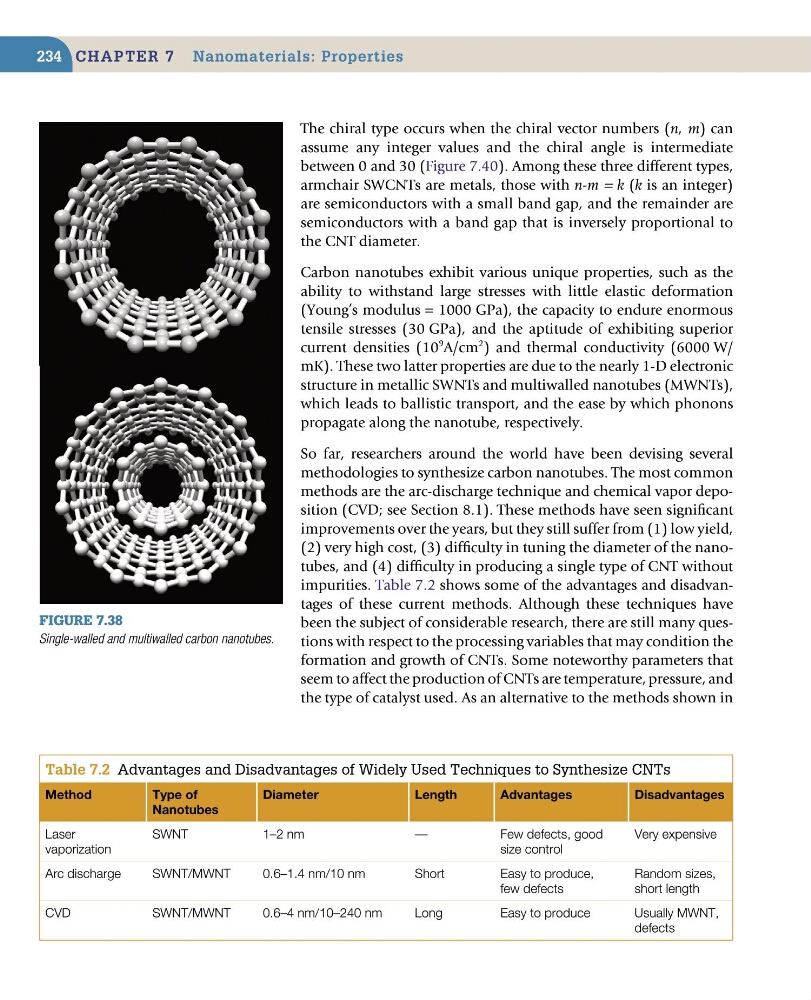
Figure 7.38
Single-walled and multiwalled carbon nanotubes.
table 7.2 Advantages and Disadvantages of Widely Used Techniques to Synthesize CNTs
Method
Type of
Nanotubes
Diameter
Length
Advantages
Disadvantages
Laser
vaporization
SWNT
1–2 nm
—
Few defects, good
size control
Very expensive
Arc discharge
SWNT/MWNT
0.6–1.4 nm/10 nm
Short
Easy to produce,
few defects
Random sizes,
short length
CVD
SWNT/MWNT
0.6–4 nm/10–240 nm
Long
Easy to produce
Usually MWNT,
defects
234
The chiral type occurs when the chiral vector numbers (n, m) can
assume any integer values and the chiral angle is intermediate
between 0 and 30 (Figure 7.40). Among these three different types,
armchair SWCNTs are metals, those with n-m = k (k is an integer)
are semiconductors with a small band gap, and the remainder are
semiconductors with a band gap that is inversely proportional to
the CNT diameter.
Carbon nanotubes exhibit various unique properties, such as the
ability to withstand large stresses with little elastic deformation
(Young’s modulus = 1000 GPa), the capacity to endure enormous
tensile stresses (30 GPa), and the aptitude of exhibiting superior
current densities (10
9 A/cm
2 ) and thermal conductivity (6000 W/
mK). These two latter properties are due to the nearly 1-D electronic
structure in metallic SWNTs and multiwalled nanotubes (MWNTs),
which leads to ballistic transport, and the ease by which phonons
propagate along the nanotube, respectively.
So far, researchers around the world have been devising several
methodologies to synthesize carbon nanotubes. The most common
methods are the arc-discharge technique and chemical vapor deposition (CVD; see Section 8.1). These methods have seen significant
improvements over the years, but they still suffer from (1) low yield,
(2) very high cost, (3) difficulty in tuning the diameter of the nanotubes, and (4) difficulty in producing a single type of CNT without
impurities. Table 7.2 shows some of the advantages and disadvantages of these current methods. Although these techniques have
been the subject of considerable research, there are still many questions with respect to the processing variables that may condition the
formation and growth of CNTs. Some noteworthy parameters that
seem to affect the production of CNTs are temperature, pressure, and
the type of catalyst used. As an alternative to the methods shown in
Figure 7.38
Single-walled and multiwalled carbon nanotubes.
table 7.2 Advantages and Disadvantages of Widely Used Techniques to Synthesize CNTs
Method
Type of
Nanotubes
Diameter
Length
Advantages
Disadvantages
Laser
vaporization
SWNT
1–2 nm
—
Few defects, good
size control
Very expensive
Arc discharge
SWNT/MWNT
0.6–1.4 nm/10 nm
Short
Easy to produce,
few defects
Random sizes,
short length
CVD
SWNT/MWNT
0.6–4 nm/10–240 nm
Long
Easy to produce
Usually MWNT,
defects