

235
Table 7.2, one other route for generating CNTs that could become
promising in the near future is the process of metal dusting. Simply,
metal dusting is the disintegration of metallic alloys by corrosion,
which is initiated by exposure of pure metals or metallic alloys to
strongly carburizing atmospheres. The result of the decomposition
is a mixture of metal particles and carbon nanostructures. The great
advantages of this catalytic route are that carbon nanotubes can be
produced at moderate temperatures (around 650–750°C) in large
volumes as well as low cost and their structure can be tailored by
the catalytic properties of the metal or alloy selected. However, this
method still requires further investigation.
Another issue that is important in the fabrication of CNTs is the
large concentration of impurities that remain embedded inside the
CNT network after processing. As a consequence, the powder needs
to be filtered to reduce the amount of impurities present. This is
normally achieved by acid oxidation, gas oxidation, or filtration.
However, these methods may dissolve some of the CNTs, cause
structural damage to CNTs, or be unable to remove large particle
aggregates. In addition, these purity-driven techniques tend to be
very expensive.
Nevertheless, due to these outstanding properties, carbon nanotubes are likely to play a vital role in various areas, such as nanocomposites, nanoelectronics, hydrogen storage, field emission
devices, and nanosensors. The area of nanocomposites is perhaps
the first area where CNTs will have a commercial impact. Due to
the outstanding modulus and tensile strength resulting from the
covalent bonds between the carbon atoms, CNTs are one of the
strongest materials known. In addition, CNTs exhibit a high aspect
ratio. Therefore, CNTs are ideal as a reinforcement phase. In recent
years, good progress has been made in developing CNT-based
nanocomposites. In fact, several investigations have shown important enhancements in mechanical, electrical, and thermal properties of nanocomposite materials. However, significant challenges
still remain—for example, tailoring the uniformity of dispersion
within the matrix, controlling the alignment of CNTs, and making
sure that there is a good interfacial bond between the CNTs and the
matrix. Furthermore, due to the high cost of CNTs, particularly of
pure SWCNTs, the addition of CNTs has been restricted to about
5% in weight.
In the area of nanoelectronics, CNTs have been sought as the new
generation of interconnect structures as well as field-effect transistors. Interconnects, which carry the electrical signals between
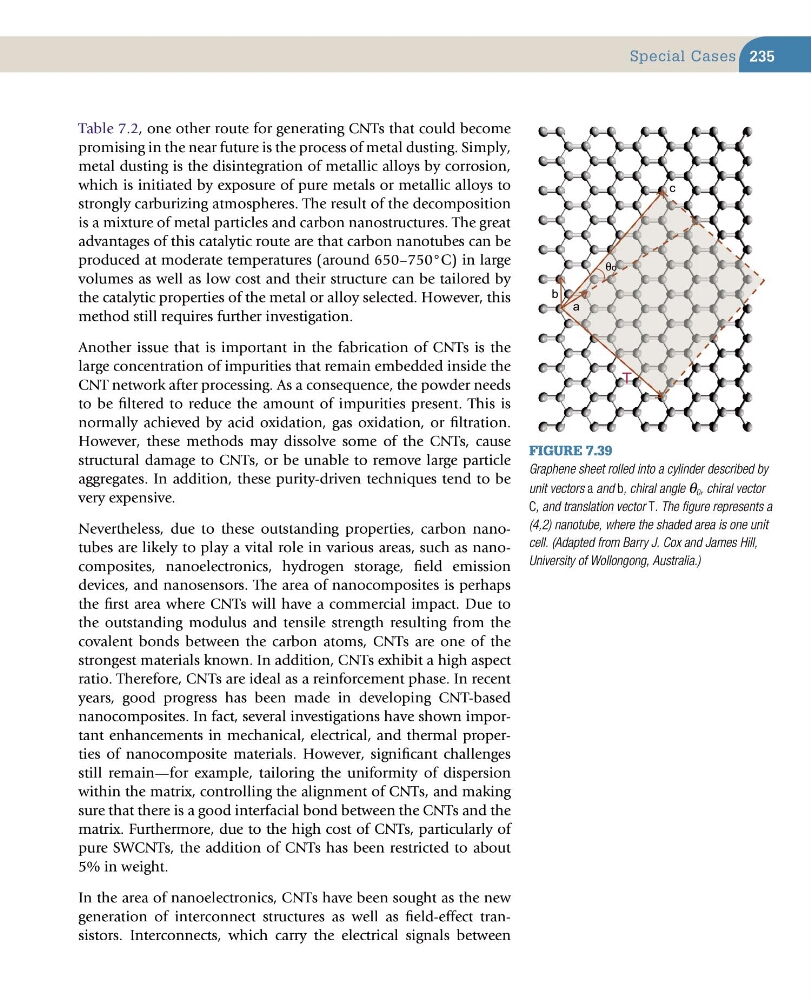
Figure 7.39
Graphene sheet rolled into a cylinder described by
unit vectors a and b, chiral angle θ 0 , chiral vector
C, and translation vector T. The figure represents a
(4,2) nanotube, where the shaded area is one unit
cell. (Adapted from Barry J. Cox and James Hill,
University of Wollongong, Australia.)
a
b
c
θo
T
Special Cases
Table 7.2, one other route for generating CNTs that could become
promising in the near future is the process of metal dusting. Simply,
metal dusting is the disintegration of metallic alloys by corrosion,
which is initiated by exposure of pure metals or metallic alloys to
strongly carburizing atmospheres. The result of the decomposition
is a mixture of metal particles and carbon nanostructures. The great
advantages of this catalytic route are that carbon nanotubes can be
produced at moderate temperatures (around 650–750°C) in large
volumes as well as low cost and their structure can be tailored by
the catalytic properties of the metal or alloy selected. However, this
method still requires further investigation.
Another issue that is important in the fabrication of CNTs is the
large concentration of impurities that remain embedded inside the
CNT network after processing. As a consequence, the powder needs
to be filtered to reduce the amount of impurities present. This is
normally achieved by acid oxidation, gas oxidation, or filtration.
However, these methods may dissolve some of the CNTs, cause
structural damage to CNTs, or be unable to remove large particle
aggregates. In addition, these purity-driven techniques tend to be
very expensive.
Nevertheless, due to these outstanding properties, carbon nanotubes are likely to play a vital role in various areas, such as nanocomposites, nanoelectronics, hydrogen storage, field emission
devices, and nanosensors. The area of nanocomposites is perhaps
the first area where CNTs will have a commercial impact. Due to
the outstanding modulus and tensile strength resulting from the
covalent bonds between the carbon atoms, CNTs are one of the
strongest materials known. In addition, CNTs exhibit a high aspect
ratio. Therefore, CNTs are ideal as a reinforcement phase. In recent
years, good progress has been made in developing CNT-based
nanocomposites. In fact, several investigations have shown important enhancements in mechanical, electrical, and thermal properties of nanocomposite materials. However, significant challenges
still remain—for example, tailoring the uniformity of dispersion
within the matrix, controlling the alignment of CNTs, and making
sure that there is a good interfacial bond between the CNTs and the
matrix. Furthermore, due to the high cost of CNTs, particularly of
pure SWCNTs, the addition of CNTs has been restricted to about
5% in weight.
In the area of nanoelectronics, CNTs have been sought as the new
generation of interconnect structures as well as field-effect transistors. Interconnects, which carry the electrical signals between
Figure 7.39
Graphene sheet rolled into a cylinder described by
unit vectors a and b, chiral angle θ 0 , chiral vector
C, and translation vector T. The figure represents a
(4,2) nanotube, where the shaded area is one unit
cell. (Adapted from Barry J. Cox and James Hill,
University of Wollongong, Australia.)
a
b
c
θo
T
Special Cases