

233
7.7 sPecial cases
carbon nanotubes
Carbon nanotubes (CNTs) were discovered in 1991 by Sumio
Ijima of the NEC laboratory in Tsukuba, Japan, during highresolution transmission electron microscopy (TEM) observation of
soot generated from the electrical discharge between two carbon
electrodes. The discovery was accidental, although it would not
have been possible without Ijima’s excellent microscopist skills
and expertise. What Ijima was, in fact, studying were C 60 molecules, also known as buckminster fullerenes, previously discovered
by Harold Kroto and Richard Smalley during the 1970s. Kroto
and Smalley found that under the right arc-discharge conditions,
carbon atoms would self-assemble spontaneously into molecules
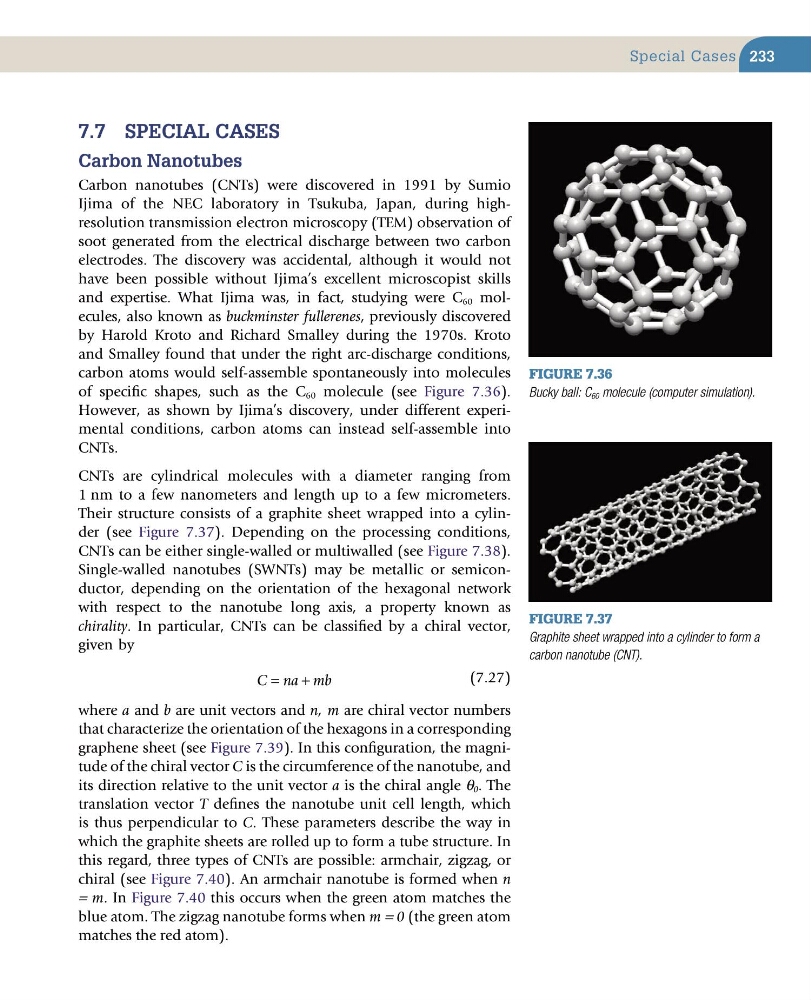
of specific shapes, such as the C 60 molecule (see Figure 7.36).
However, as shown by Ijima’s discovery, under different experimental conditions, carbon atoms can instead self-assemble into
CNTs.
CNTs are cylindrical molecules with a diameter ranging from
1 nm to a few nanometers and length up to a few micrometers.
Their structure consists of a graphite sheet wrapped into a cylinder (see Figure 7.37). Depending on the processing conditions,
CNTs can be either single-walled or multiwalled (see Figure 7.38).
Single-walled nanotubes (SWNTs) may be metallic or semiconductor, depending on the orientation of the hexagonal network
with respect to the nanotube long axis, a property known as
chirality. In particular, CNTs can be classified by a chiral vector,
given by
C na mb
= +
(7.27)
where a and b are unit vectors and n, m are chiral vector numbers
that characterize the orientation of the hexagons in a corresponding
graphene sheet (see Figure 7.39). In this configuration, the magnitude of the chiral vector C is the circumference of the nanotube, and
its direction relative to the unit vector a is the chiral angle θ 0 . The
translation vector T defines the nanotube unit cell length, which
is thus perpendicular to C. These parameters describe the way in
which the graphite sheets are rolled up to form a tube structure. In
this regard, three types of CNTs are possible: armchair, zigzag, or
chiral (see Figure 7.40). An armchair nanotube is formed when n
= m. In Figure 7.40 this occurs when the green atom matches the
blue atom. The zigzag nanotube forms when m = 0 (the green atom
matches the red atom).
Figure 7.36
Bucky ball: C 60 molecule (computer simulation).
Figure 7.37
Graphite sheet wrapped into a cylinder to form a
carbon nanotube (CNT).
Special Cases
7.7 sPecial cases
carbon nanotubes
Carbon nanotubes (CNTs) were discovered in 1991 by Sumio
Ijima of the NEC laboratory in Tsukuba, Japan, during highresolution transmission electron microscopy (TEM) observation of
soot generated from the electrical discharge between two carbon
electrodes. The discovery was accidental, although it would not
have been possible without Ijima’s excellent microscopist skills
and expertise. What Ijima was, in fact, studying were C 60 molecules, also known as buckminster fullerenes, previously discovered
by Harold Kroto and Richard Smalley during the 1970s. Kroto
and Smalley found that under the right arc-discharge conditions,
carbon atoms would self-assemble spontaneously into molecules
of specific shapes, such as the C 60 molecule (see Figure 7.36).
However, as shown by Ijima’s discovery, under different experimental conditions, carbon atoms can instead self-assemble into
CNTs.
CNTs are cylindrical molecules with a diameter ranging from
1 nm to a few nanometers and length up to a few micrometers.
Their structure consists of a graphite sheet wrapped into a cylinder (see Figure 7.37). Depending on the processing conditions,
CNTs can be either single-walled or multiwalled (see Figure 7.38).
Single-walled nanotubes (SWNTs) may be metallic or semiconductor, depending on the orientation of the hexagonal network
with respect to the nanotube long axis, a property known as
chirality. In particular, CNTs can be classified by a chiral vector,
given by
C na mb
= +
(7.27)
where a and b are unit vectors and n, m are chiral vector numbers
that characterize the orientation of the hexagons in a corresponding
graphene sheet (see Figure 7.39). In this configuration, the magnitude of the chiral vector C is the circumference of the nanotube, and
its direction relative to the unit vector a is the chiral angle θ 0 . The
translation vector T defines the nanotube unit cell length, which
is thus perpendicular to C. These parameters describe the way in
which the graphite sheets are rolled up to form a tube structure. In
this regard, three types of CNTs are possible: armchair, zigzag, or
chiral (see Figure 7.40). An armchair nanotube is formed when n
= m. In Figure 7.40 this occurs when the green atom matches the
blue atom. The zigzag nanotube forms when m = 0 (the green atom
matches the red atom).
Figure 7.36
Bucky ball: C 60 molecule (computer simulation).
Figure 7.37
Graphite sheet wrapped into a cylinder to form a
carbon nanotube (CNT).
Special Cases