

chaPter 7 nanomaterials: Properties
230
result, strong excitonic states appear in the absorption spectra of
nanomaterials at room temperature.
So far we have addressed the optical absorption of semiconductor
nanomaterials. However, as shown in Figure 7.29, optical emission
may also occur if the electron and the hole recombine, leading to
the generation of a photon. If the photon energy is within 1.8 eV
to 3.1 eV, the emitted light is in the visible range, a phenomenon
called luminescence. Because of the quantum confinement in nanomaterials, the emission of visible light that’s can be tuned by varying
the nanoscale dimensions. The typical trend is the shift of the emission peak toward shorter wavelengths (blue shift) as the size of the
nanomaterial decreases.
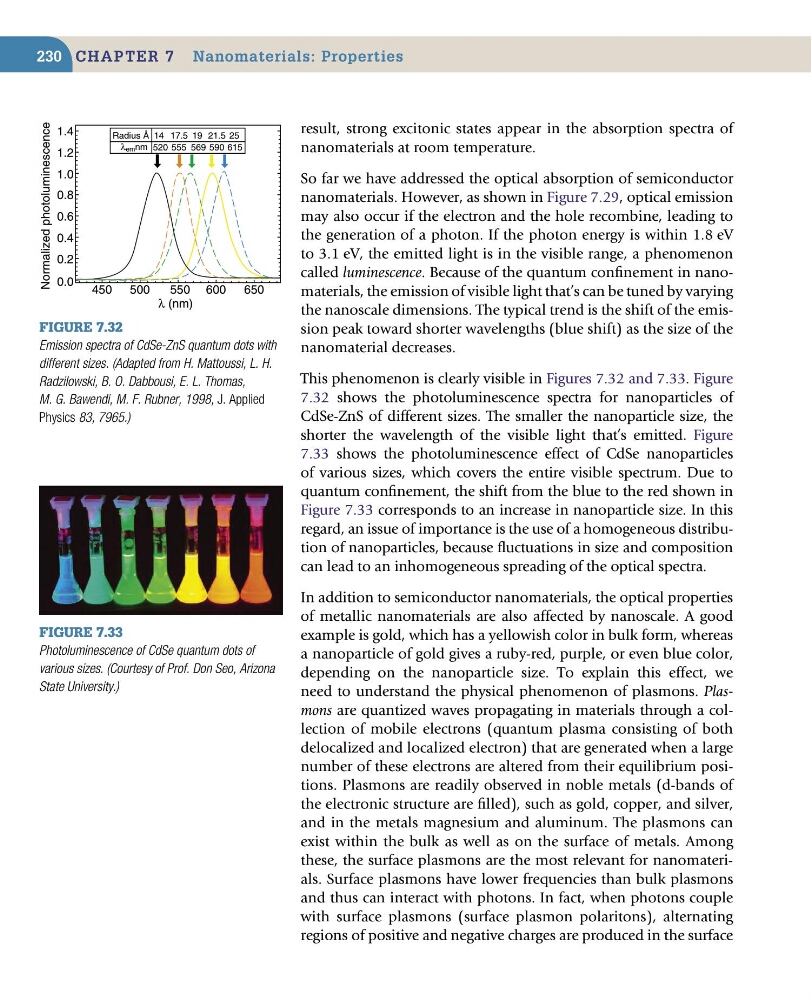
This phenomenon is clearly visible in Figures 7.32 and 7.33. Figure
7.32 shows the photoluminescence spectra for nanoparticles of
CdSe-ZnS of different sizes. The smaller the nanoparticle size, the
shorter the wavelength of the visible light that’s emitted. Figure
7.33 shows the photoluminescence effect of CdSe nanoparticles
of various sizes, which covers the entire visible spectrum. Due to
quantum confinement, the shift from the blue to the red shown in
Figure 7.33 corresponds to an increase in nanoparticle size. In this
regard, an issue of importance is the use of a homogeneous distribution of nanoparticles, because fluctuations in size and composition
can lead to an inhomogeneous spreading of the optical spectra.
In addition to semiconductor nanomaterials, the optical properties
of metallic nanomaterials are also affected by nanoscale. A good
example is gold, which has a yellowish color in bulk form, whereas
a nanoparticle of gold gives a ruby-red, purple, or even blue color,
depending on the nanoparticle size. To explain this effect, we
need to understand the physical phenomenon of plasmons. Plasmons are quantized waves propagating in materials through a collection of mobile electrons (quantum plasma consisting of both
delocalized and localized electron) that are generated when a large
number of these electrons are altered from their equilibrium positions. Plasmons are readily observed in noble metals (d-bands of
the electronic structure are filled), such as gold, copper, and silver,
and in the metals magnesium and aluminum. The plasmons can
exist within the bulk as well as on the surface of metals. Among
these, the surface plasmons are the most relevant for nanomaterials. Surface plasmons have lower frequencies than bulk plasmons
and thus can interact with photons. In fact, when photons couple
with surface plasmons (surface plasmon polaritons), alternating
regions of positive and negative charges are produced in the surface
Figure 7.32
Emission spectra of CdSe-ZnS quantum dots with
different sizes. (Adapted from H. Mattoussi, L. H.
Radzilowski, B. O. Dabbousi, E. L. Thomas,
M. G. Bawendi, M. F. Rubner, 1998, J. Applied
Physics 83, 7965.)
λ (nm)
λemnm
450
Radius Å 14
520 555 569 590 615
17.5 19 21.5 25
0.0
0.2
Normalized photoluminescence
0.4
0.6
0.8
1.0
1.2
1.4
500
550 600
650
Figure 7.33
Photoluminescence of CdSe quantum dots of
various sizes. (Courtesy of Prof. Don Seo, Arizona
State University.)
230
result, strong excitonic states appear in the absorption spectra of
nanomaterials at room temperature.
So far we have addressed the optical absorption of semiconductor
nanomaterials. However, as shown in Figure 7.29, optical emission
may also occur if the electron and the hole recombine, leading to
the generation of a photon. If the photon energy is within 1.8 eV
to 3.1 eV, the emitted light is in the visible range, a phenomenon
called luminescence. Because of the quantum confinement in nanomaterials, the emission of visible light that’s can be tuned by varying
the nanoscale dimensions. The typical trend is the shift of the emission peak toward shorter wavelengths (blue shift) as the size of the
nanomaterial decreases.
This phenomenon is clearly visible in Figures 7.32 and 7.33. Figure
7.32 shows the photoluminescence spectra for nanoparticles of
CdSe-ZnS of different sizes. The smaller the nanoparticle size, the
shorter the wavelength of the visible light that’s emitted. Figure
7.33 shows the photoluminescence effect of CdSe nanoparticles
of various sizes, which covers the entire visible spectrum. Due to
quantum confinement, the shift from the blue to the red shown in
Figure 7.33 corresponds to an increase in nanoparticle size. In this
regard, an issue of importance is the use of a homogeneous distribution of nanoparticles, because fluctuations in size and composition
can lead to an inhomogeneous spreading of the optical spectra.
In addition to semiconductor nanomaterials, the optical properties
of metallic nanomaterials are also affected by nanoscale. A good
example is gold, which has a yellowish color in bulk form, whereas
a nanoparticle of gold gives a ruby-red, purple, or even blue color,
depending on the nanoparticle size. To explain this effect, we
need to understand the physical phenomenon of plasmons. Plasmons are quantized waves propagating in materials through a collection of mobile electrons (quantum plasma consisting of both
delocalized and localized electron) that are generated when a large
number of these electrons are altered from their equilibrium positions. Plasmons are readily observed in noble metals (d-bands of
the electronic structure are filled), such as gold, copper, and silver,
and in the metals magnesium and aluminum. The plasmons can
exist within the bulk as well as on the surface of metals. Among
these, the surface plasmons are the most relevant for nanomaterials. Surface plasmons have lower frequencies than bulk plasmons
and thus can interact with photons. In fact, when photons couple
with surface plasmons (surface plasmon polaritons), alternating
regions of positive and negative charges are produced in the surface
Figure 7.32
Emission spectra of CdSe-ZnS quantum dots with
different sizes. (Adapted from H. Mattoussi, L. H.
Radzilowski, B. O. Dabbousi, E. L. Thomas,
M. G. Bawendi, M. F. Rubner, 1998, J. Applied
Physics 83, 7965.)
λ (nm)
λemnm
450
Radius Å 14
520 555 569 590 615
17.5 19 21.5 25
0.0
0.2
Normalized photoluminescence
0.4
0.6
0.8
1.0
1.2
1.4
500
550 600
650
Figure 7.33
Photoluminescence of CdSe quantum dots of
various sizes. (Courtesy of Prof. Don Seo, Arizona
State University.)