

231
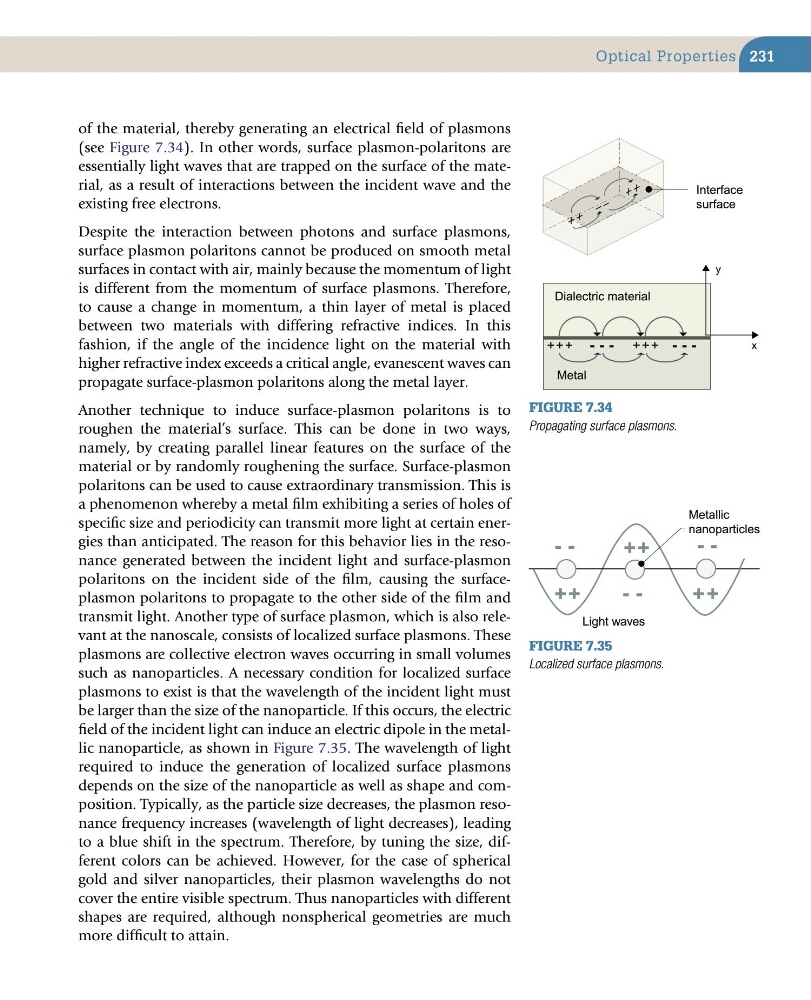
of the material, thereby generating an electrical field of plasmons
(see Figure 7.34). In other words, surface plasmon-polaritons are
essentially light waves that are trapped on the surface of the material, as a result of interactions between the incident wave and the
existing free electrons.
Despite the interaction between photons and surface plasmons,
surface plasmon polaritons cannot be produced on smooth metal
surfaces in contact with air, mainly because the momentum of light
is different from the momentum of surface plasmons. Therefore,
to cause a change in momentum, a thin layer of metal is placed
between two materials with differing refractive indices. In this
fashion, if the angle of the incidence light on the material with
higher refractive index exceeds a critical angle, evanescent waves can
propagate surface-plasmon polaritons along the metal layer.
Another technique to induce surface-plasmon polaritons is to
roughen the material’s surface. This can be done in two ways,
namely, by creating parallel linear features on the surface of the
material or by randomly roughening the surface. Surface-plasmon
polaritons can be used to cause extraordinary transmission. This is
a phenomenon whereby a metal film exhibiting a series of holes of
specific size and periodicity can transmit more light at certain energies than anticipated. The reason for this behavior lies in the resonance generated between the incident light and surface-plasmon
polaritons on the incident side of the film, causing the surfaceplasmon polaritons to propagate to the other side of the film and
transmit light. Another type of surface plasmon, which is also relevant at the nanoscale, consists of localized surface plasmons. These
plasmons are collective electron waves occurring in small volumes
such as nanoparticles. A necessary condition for localized surface
plasmons to exist is that the wavelength of the incident light must
be larger than the size of the nanoparticle. If this occurs, the electric
field of the incident light can induce an electric dipole in the metallic nanoparticle, as shown in Figure 7.35. The wavelength of light
required to induce the generation of localized surface plasmons
depends on the size of the nanoparticle as well as shape and composition. Typically, as the particle size decreases, the plasmon resonance frequency increases (wavelength of light decreases), leading
to a blue shift in the spectrum. Therefore, by tuning the size, different colors can be achieved. However, for the case of spherical
gold and silver nanoparticles, their plasmon wavelengths do not
cover the entire visible spectrum. Thus nanoparticles with different
shapes are required, although nonspherical geometries are much
more difficult to attain.
Figure 7.34
Propagating surface plasmons.
++
+
++
+
- -
-
- -
-
Dialectric material
Metal
x
y
Interface
surface
Figure 7.35
Localized surface plasmons.
++
- -
- -
++
++
- -
Light waves
Metallic
nanoparticles
Optical Properties
of the material, thereby generating an electrical field of plasmons
(see Figure 7.34). In other words, surface plasmon-polaritons are
essentially light waves that are trapped on the surface of the material, as a result of interactions between the incident wave and the
existing free electrons.
Despite the interaction between photons and surface plasmons,
surface plasmon polaritons cannot be produced on smooth metal
surfaces in contact with air, mainly because the momentum of light
is different from the momentum of surface plasmons. Therefore,
to cause a change in momentum, a thin layer of metal is placed
between two materials with differing refractive indices. In this
fashion, if the angle of the incidence light on the material with
higher refractive index exceeds a critical angle, evanescent waves can
propagate surface-plasmon polaritons along the metal layer.
Another technique to induce surface-plasmon polaritons is to
roughen the material’s surface. This can be done in two ways,
namely, by creating parallel linear features on the surface of the
material or by randomly roughening the surface. Surface-plasmon
polaritons can be used to cause extraordinary transmission. This is
a phenomenon whereby a metal film exhibiting a series of holes of
specific size and periodicity can transmit more light at certain energies than anticipated. The reason for this behavior lies in the resonance generated between the incident light and surface-plasmon
polaritons on the incident side of the film, causing the surfaceplasmon polaritons to propagate to the other side of the film and
transmit light. Another type of surface plasmon, which is also relevant at the nanoscale, consists of localized surface plasmons. These
plasmons are collective electron waves occurring in small volumes
such as nanoparticles. A necessary condition for localized surface
plasmons to exist is that the wavelength of the incident light must
be larger than the size of the nanoparticle. If this occurs, the electric
field of the incident light can induce an electric dipole in the metallic nanoparticle, as shown in Figure 7.35. The wavelength of light
required to induce the generation of localized surface plasmons
depends on the size of the nanoparticle as well as shape and composition. Typically, as the particle size decreases, the plasmon resonance frequency increases (wavelength of light decreases), leading
to a blue shift in the spectrum. Therefore, by tuning the size, different colors can be achieved. However, for the case of spherical
gold and silver nanoparticles, their plasmon wavelengths do not
cover the entire visible spectrum. Thus nanoparticles with different
shapes are required, although nonspherical geometries are much
more difficult to attain.
Figure 7.34
Propagating surface plasmons.
++
+
++
+
- -
-
- -
-
Dialectric material
Metal
x
y
Interface
surface
Figure 7.35
Localized surface plasmons.
++
- -
- -
++
++
- -
Light waves
Metallic
nanoparticles
Optical Properties