

229
nanostructure, and the influence of excitonic effects. The first two
effects were discussed in Section 6.2. As the nanomaterial changes
from 3-D to 0-D and quantum confinement is more severe, the
density of states becomes more quantized and the band gap of the
material shifts toward higher energies (shorter wavelengths). As a
result, a blue shift is expected in the absorption spectrum as the
size of the nanomaterial decreases, whereas a red shift occurs for
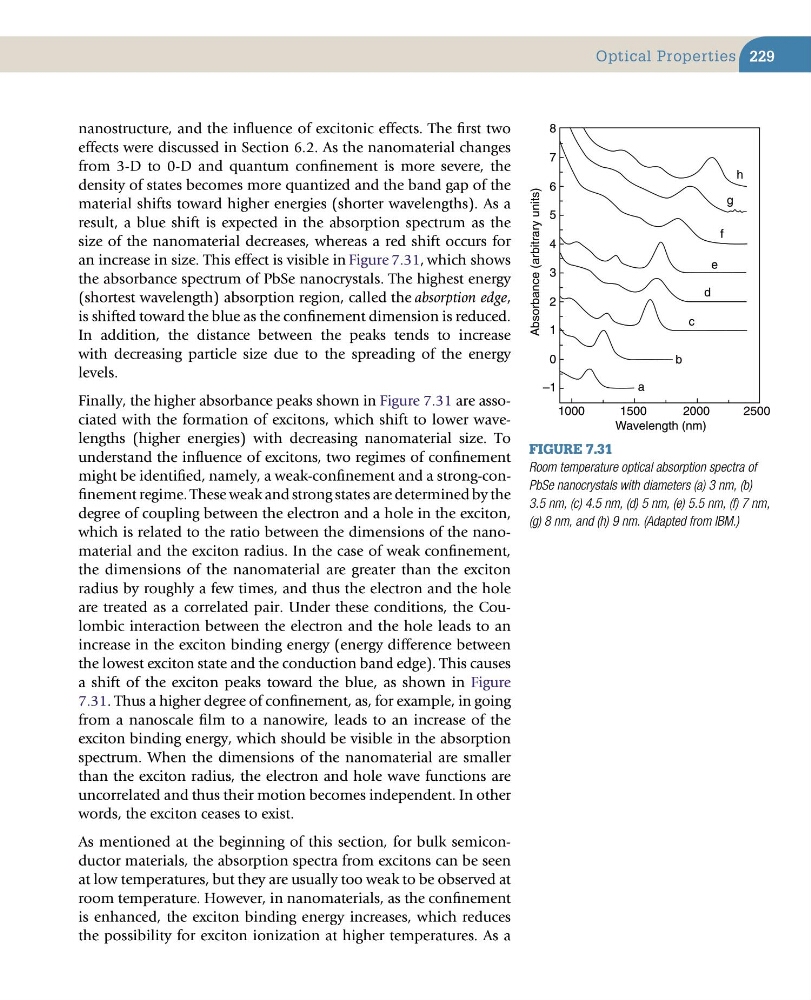
an increase in size. This effect is visible in Figure 7.31, which shows
the absorbance spectrum of PbSe nanocrystals. The highest energy
(shortest wavelength) absorption region, called the absorption edge,
is shifted toward the blue as the confinement dimension is reduced.
In addition, the distance between the peaks tends to increase
with decreasing particle size due to the spreading of the energy
levels.
Finally, the higher absorbance peaks shown in Figure 7.31 are associated with the formation of excitons, which shift to lower wavelengths (higher energies) with decreasing nanomaterial size. To
understand the influence of excitons, two regimes of confinement
might be identified, namely, a weak-confinement and a strong-confinement regime. These weak and strong states are determined by the
degree of coupling between the electron and a hole in the exciton,
which is related to the ratio between the dimensions of the nanomaterial and the exciton radius. In the case of weak confinement,
the dimensions of the nanomaterial are greater than the exciton
radius by roughly a few times, and thus the electron and the hole
are treated as a correlated pair. Under these conditions, the Coulombic interaction between the electron and the hole leads to an
increase in the exciton binding energy (energy difference between
the lowest exciton state and the conduction band edge). This causes
a shift of the exciton peaks toward the blue, as shown in Figure
7.31. Thus a higher degree of confinement, as, for example, in going
from a nanoscale film to a nanowire, leads to an increase of the
exciton binding energy, which should be visible in the absorption
spectrum. When the dimensions of the nanomaterial are smaller
than the exciton radius, the electron and hole wave functions are
uncorrelated and thus their motion becomes independent. In other
words, the exciton ceases to exist.
As mentioned at the beginning of this section, for bulk semiconductor materials, the absorption spectra from excitons can be seen
at low temperatures, but they are usually too weak to be observed at
room temperature. However, in nanomaterials, as the confinement
is enhanced, the exciton binding energy increases, which reduces
the possibility for exciton ionization at higher temperatures. As a
Figure 7.31
Room temperature optical absorption spectra of
PbSe nanocrystals with diameters (a) 3 nm, (b)
3.5 nm, (c) 4.5 nm, (d) 5 nm, (e) 5.5 nm, (f) 7 nm,
(g) 8 nm, and (h) 9 nm. (Adapted from IBM.)
Wavelength (nm)
Absorbance (arbitrary units)
1000
–1
0
1
2
3
4
5
6
7
8
1500
a
b
c
d
e
f
g
h
2000
2500
Optical Properties
nanostructure, and the influence of excitonic effects. The first two
effects were discussed in Section 6.2. As the nanomaterial changes
from 3-D to 0-D and quantum confinement is more severe, the
density of states becomes more quantized and the band gap of the
material shifts toward higher energies (shorter wavelengths). As a
result, a blue shift is expected in the absorption spectrum as the
size of the nanomaterial decreases, whereas a red shift occurs for
an increase in size. This effect is visible in Figure 7.31, which shows
the absorbance spectrum of PbSe nanocrystals. The highest energy
(shortest wavelength) absorption region, called the absorption edge,
is shifted toward the blue as the confinement dimension is reduced.
In addition, the distance between the peaks tends to increase
with decreasing particle size due to the spreading of the energy
levels.
Finally, the higher absorbance peaks shown in Figure 7.31 are associated with the formation of excitons, which shift to lower wavelengths (higher energies) with decreasing nanomaterial size. To
understand the influence of excitons, two regimes of confinement
might be identified, namely, a weak-confinement and a strong-confinement regime. These weak and strong states are determined by the
degree of coupling between the electron and a hole in the exciton,
which is related to the ratio between the dimensions of the nanomaterial and the exciton radius. In the case of weak confinement,
the dimensions of the nanomaterial are greater than the exciton
radius by roughly a few times, and thus the electron and the hole
are treated as a correlated pair. Under these conditions, the Coulombic interaction between the electron and the hole leads to an
increase in the exciton binding energy (energy difference between
the lowest exciton state and the conduction band edge). This causes
a shift of the exciton peaks toward the blue, as shown in Figure
7.31. Thus a higher degree of confinement, as, for example, in going
from a nanoscale film to a nanowire, leads to an increase of the
exciton binding energy, which should be visible in the absorption
spectrum. When the dimensions of the nanomaterial are smaller
than the exciton radius, the electron and hole wave functions are
uncorrelated and thus their motion becomes independent. In other
words, the exciton ceases to exist.
As mentioned at the beginning of this section, for bulk semiconductor materials, the absorption spectra from excitons can be seen
at low temperatures, but they are usually too weak to be observed at
room temperature. However, in nanomaterials, as the confinement
is enhanced, the exciton binding energy increases, which reduces
the possibility for exciton ionization at higher temperatures. As a
Figure 7.31
Room temperature optical absorption spectra of
PbSe nanocrystals with diameters (a) 3 nm, (b)
3.5 nm, (c) 4.5 nm, (d) 5 nm, (e) 5.5 nm, (f) 7 nm,
(g) 8 nm, and (h) 9 nm. (Adapted from IBM.)
Wavelength (nm)
Absorbance (arbitrary units)
1000
–1
0
1
2
3
4
5
6
7
8
1500
a
b
c
d
e
f
g
h
2000
2500
Optical Properties