

223
E
E
E
E
E
total
exc
ani
dem
app
=
+
+
+
(7.22)
where E exc is the exchange energy, E ani is the anisotropic energy, E dem
is the demagnetization energy, and E app is the energy associated
with an applied magnetic field. For macroscopic magnetic materials, a magnetostrictive energy must also be included in Equation
7.22, but for nanoscale materials this energy can be neglected. This
magnetization energy E total can then be related to a magnetic field
according to the expression
E
M H
total = ⋅
(7.23)
where M is the magnetization vector and H is the applied magnetic
field. The first term in Equation 7.22 is due to the quantum mechanical interaction between atomic magnetic moments and represents
the tendency for the magnetization vectors to align in one direction. In other words, if the magnetic moment is sufficiently large,
the resulting magnetic field can drive a nearest neighbor to align in
the same direction, provided the exchange energy is greater than the
thermal energy. The second term in Equation 7.22 represents the
anisotropy energy that results from the spin’s tendency to align parallel to specific crystallographic axes, called easy axes. Thus, a “soft”
magnetic material will exhibit low anisotropy energy, whereas a
“hard” magnetic material shows high anisotropy energy.
Though both the exchange energy and the anisotropy energy try to
order the spins in a parallel configuration, the third term in Equation 7.22, namely the demagnetization energy, which is related to
the magnetic dipole character of spins, leads to the formation of
magnetic domains. Thus, for macroscopic ferromagnetic materials, all the magnetic moments are aligned in magnetic domains,
although the magnetization vectors of different domains are not
parallel to each other. Each domain is magnetized to saturation,
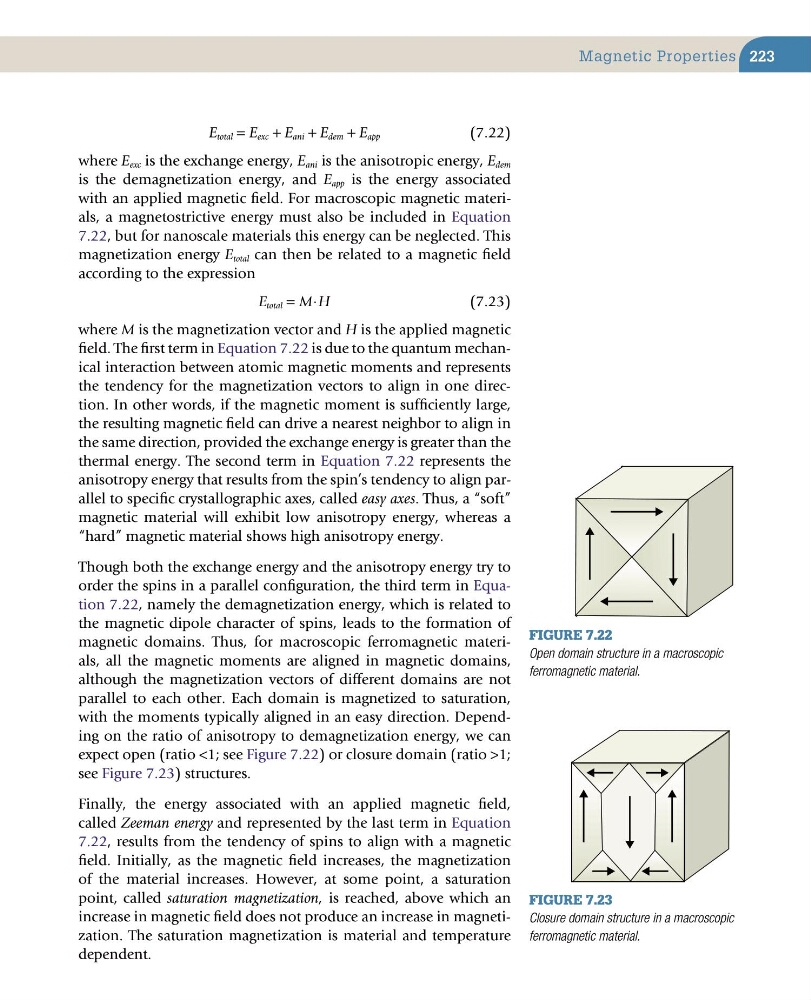
with the moments typically aligned in an easy direction. Depending on the ratio of anisotropy to demagnetization energy, we can
expect open (ratio <1; see Figure 7.22) or closure domain (ratio >1;
see Figure 7.23) structures.
Finally, the energy associated with an applied magnetic field,
called Zeeman energy and represented by the last term in Equation
7.22, results from the tendency of spins to align with a magnetic
field. Initially, as the magnetic field increases, the magnetization
of the material increases. However, at some point, a saturation
point, called saturation magnetization, is reached, above which an
increase in magnetic field does not produce an increase in magnetization. The saturation magnetization is material and temperature
dependent.
Figure 7.22
Open domain structure in a macroscopic
ferromagnetic material.
Figure 7.23
Closure domain structure in a macroscopic
ferromagnetic material.
Magnetic Properties
E
E
E
E
E
total
exc
ani
dem
app
=
+
+
+
(7.22)
where E exc is the exchange energy, E ani is the anisotropic energy, E dem
is the demagnetization energy, and E app is the energy associated
with an applied magnetic field. For macroscopic magnetic materials, a magnetostrictive energy must also be included in Equation
7.22, but for nanoscale materials this energy can be neglected. This
magnetization energy E total can then be related to a magnetic field
according to the expression
E
M H
total = ⋅
(7.23)
where M is the magnetization vector and H is the applied magnetic
field. The first term in Equation 7.22 is due to the quantum mechanical interaction between atomic magnetic moments and represents
the tendency for the magnetization vectors to align in one direction. In other words, if the magnetic moment is sufficiently large,
the resulting magnetic field can drive a nearest neighbor to align in
the same direction, provided the exchange energy is greater than the
thermal energy. The second term in Equation 7.22 represents the
anisotropy energy that results from the spin’s tendency to align parallel to specific crystallographic axes, called easy axes. Thus, a “soft”
magnetic material will exhibit low anisotropy energy, whereas a
“hard” magnetic material shows high anisotropy energy.
Though both the exchange energy and the anisotropy energy try to
order the spins in a parallel configuration, the third term in Equation 7.22, namely the demagnetization energy, which is related to
the magnetic dipole character of spins, leads to the formation of
magnetic domains. Thus, for macroscopic ferromagnetic materials, all the magnetic moments are aligned in magnetic domains,
although the magnetization vectors of different domains are not
parallel to each other. Each domain is magnetized to saturation,
with the moments typically aligned in an easy direction. Depending on the ratio of anisotropy to demagnetization energy, we can
expect open (ratio <1; see Figure 7.22) or closure domain (ratio >1;
see Figure 7.23) structures.
Finally, the energy associated with an applied magnetic field,
called Zeeman energy and represented by the last term in Equation
7.22, results from the tendency of spins to align with a magnetic
field. Initially, as the magnetic field increases, the magnetization
of the material increases. However, at some point, a saturation
point, called saturation magnetization, is reached, above which an
increase in magnetic field does not produce an increase in magnetization. The saturation magnetization is material and temperature
dependent.
Figure 7.22
Open domain structure in a macroscopic
ferromagnetic material.
Figure 7.23
Closure domain structure in a macroscopic
ferromagnetic material.
Magnetic Properties