

chaPter 7 nanomaterials: Properties
222
defined as C = I/V, was shown to increase due to electron tunneling
compared to the case in which the nanoparticles were not connected by the organic molecules.
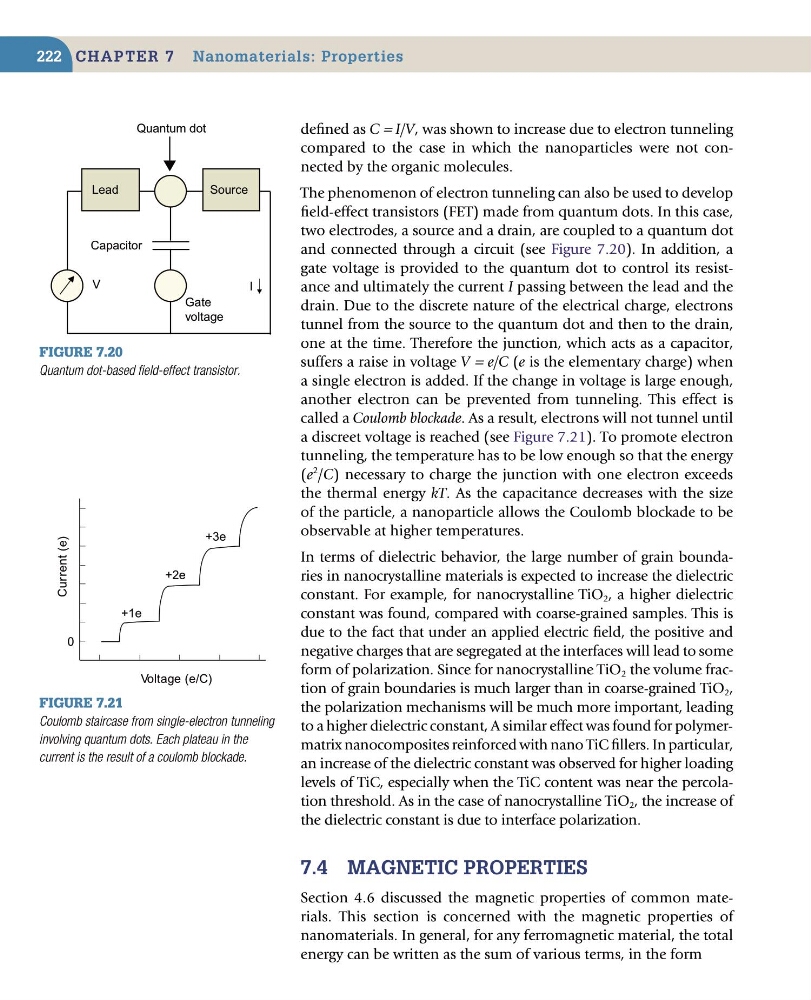
The phenomenon of electron tunneling can also be used to develop
field-effect transistors (FET) made from quantum dots. In this case,
two electrodes, a source and a drain, are coupled to a quantum dot
and connected through a circuit (see Figure 7.20). In addition, a
gate voltage is provided to the quantum dot to control its resistance and ultimately the current I passing between the lead and the
drain. Due to the discrete nature of the electrical charge, electrons
tunnel from the source to the quantum dot and then to the drain,
one at the time. Therefore the junction, which acts as a capacitor,
suffers a raise in voltage V = e/C (e is the elementary charge) when
a single electron is added. If the change in voltage is large enough,
another electron can be prevented from tunneling. This effect is
called a Coulomb blockade. As a result, electrons will not tunnel until
a discreet voltage is reached (see Figure 7.21). To promote electron
tunneling, the temperature has to be low enough so that the energy
(e
2 /C) necessary to charge the junction with one electron exceeds
the thermal energy kT. As the capacitance decreases with the size
of the particle, a nanoparticle allows the Coulomb blockade to be
observable at higher temperatures.
In terms of dielectric behavior, the large number of grain boundaries in nanocrystalline materials is expected to increase the dielectric
constant. For example, for nanocrystalline TiO 2 , a higher dielectric
constant was found, compared with coarse-grained samples. This is
due to the fact that under an applied electric field, the positive and
negative charges that are segregated at the interfaces will lead to some
form of polarization. Since for nanocrystalline TiO 2 the volume fraction of grain boundaries is much larger than in coarse-grained TiO 2 ,
the polarization mechanisms will be much more important, leading
to a higher dielectric constant, A similar effect was found for polymermatrix nanocomposites reinforced with nano TiC fillers. In particular,
an increase of the dielectric constant was observed for higher loading
levels of TiC, especially when the TiC content was near the percolation threshold. As in the case of nanocrystalline TiO 2 , the increase of
the dielectric constant is due to interface polarization.
7.4 Magnetic ProPerties
Section 4.6 discussed the magnetic properties of common materials. This section is concerned with the magnetic properties of
nanomaterials. In general, for any ferromagnetic material, the total
energy can be written as the sum of various terms, in the form
Figure 7.20
Quantum dot-based field-effect transistor.
Figure 7.21
Coulomb staircase from single-electron tunneling
involving quantum dots. Each plateau in the
current is the result of a coulomb blockade.
V
I
Lead
Source
Capacitor
Gate
voltage
Quantum dot
+1e
+2e
+3e
Voltage (e/C)
Current (e)
0
222
defined as C = I/V, was shown to increase due to electron tunneling
compared to the case in which the nanoparticles were not connected by the organic molecules.
The phenomenon of electron tunneling can also be used to develop
field-effect transistors (FET) made from quantum dots. In this case,
two electrodes, a source and a drain, are coupled to a quantum dot
and connected through a circuit (see Figure 7.20). In addition, a
gate voltage is provided to the quantum dot to control its resistance and ultimately the current I passing between the lead and the
drain. Due to the discrete nature of the electrical charge, electrons
tunnel from the source to the quantum dot and then to the drain,
one at the time. Therefore the junction, which acts as a capacitor,
suffers a raise in voltage V = e/C (e is the elementary charge) when
a single electron is added. If the change in voltage is large enough,
another electron can be prevented from tunneling. This effect is
called a Coulomb blockade. As a result, electrons will not tunnel until
a discreet voltage is reached (see Figure 7.21). To promote electron
tunneling, the temperature has to be low enough so that the energy
(e
2 /C) necessary to charge the junction with one electron exceeds
the thermal energy kT. As the capacitance decreases with the size
of the particle, a nanoparticle allows the Coulomb blockade to be
observable at higher temperatures.
In terms of dielectric behavior, the large number of grain boundaries in nanocrystalline materials is expected to increase the dielectric
constant. For example, for nanocrystalline TiO 2 , a higher dielectric
constant was found, compared with coarse-grained samples. This is
due to the fact that under an applied electric field, the positive and
negative charges that are segregated at the interfaces will lead to some
form of polarization. Since for nanocrystalline TiO 2 the volume fraction of grain boundaries is much larger than in coarse-grained TiO 2 ,
the polarization mechanisms will be much more important, leading
to a higher dielectric constant, A similar effect was found for polymermatrix nanocomposites reinforced with nano TiC fillers. In particular,
an increase of the dielectric constant was observed for higher loading
levels of TiC, especially when the TiC content was near the percolation threshold. As in the case of nanocrystalline TiO 2 , the increase of
the dielectric constant is due to interface polarization.
7.4 Magnetic ProPerties
Section 4.6 discussed the magnetic properties of common materials. This section is concerned with the magnetic properties of
nanomaterials. In general, for any ferromagnetic material, the total
energy can be written as the sum of various terms, in the form
Figure 7.20
Quantum dot-based field-effect transistor.
Figure 7.21
Coulomb staircase from single-electron tunneling
involving quantum dots. Each plateau in the
current is the result of a coulomb blockade.
V
I
Lead
Source
Capacitor
Gate
voltage
Quantum dot
+1e
+2e
+3e
Voltage (e/C)
Current (e)
0