

221
ticularly at low temperatures. For example, in the case of metallic
carbon nanotubes, the conductivity is extremely high, as much as
one billion amperes/cm
2 , in contrast to 1 million amperes/cm
2 for
copper. In addition to the effects described here, carbon nanotubes
also exhibit a low density of defects and high thermal dissipation,
reducing even further the chances for scattering.
For 0-D nanomaterials, the motion of electrons is now totally confined along the three directions Lx, Ly, and Lx. Therefore, the total
energy can be given by
E
n
mL
n
mL
n
mL
nx ny nz
x
x
y
y
z
, , =
+
+
π
π
π
2 2 2
2
2 2 2
2
2 2 2
2
2
2
z z
2
(7.21)
In this fashion, all the energy states are discreet and no electron
delocalization occurs. Under these conditions, metallic systems can
behave as insulators due to the formation of an energy band gap,
which is not allowed in the bulk form.
So far we have been discussing the electrical properties of 0-D, 1-D,
2-D, and 3-D nanomaterials as isolated entities. However, from a
practical point of view, these materials need to be coupled to external circuits by electrodes. For 2-D and 3-D nanomaterials, ohmic
contacts are possible. However, for 0-D and 1-D nanomaterials,
the contact resistances between nanomaterials and the connecting
leads are usually high. Thus one mechanism of providing conduction is through electron tunneling. This is a quantum mechanical
effect in which an electron can penetrate a potential barrier higher
than the kinetic energy of the electron. To better understand this
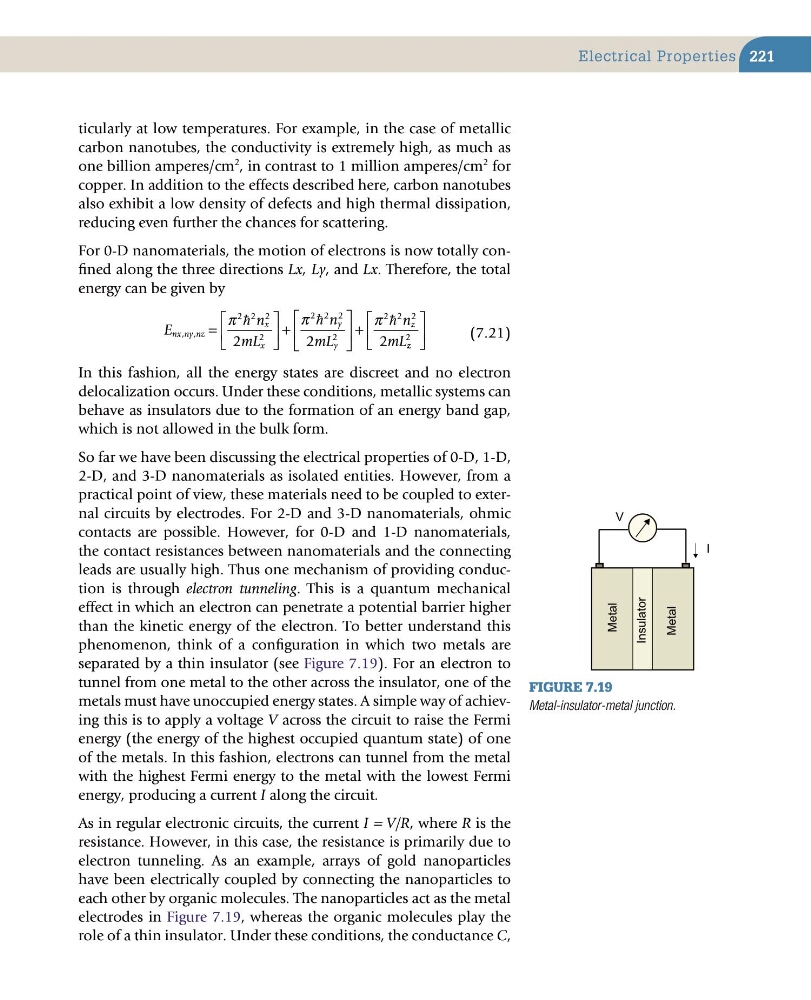
phenomenon, think of a configuration in which two metals are
separated by a thin insulator (see Figure 7.19). For an electron to
tunnel from one metal to the other across the insulator, one of the
metals must have unoccupied energy states. A simple way of achieving this is to apply a voltage V across the circuit to raise the Fermi
energy (the energy of the highest occupied quantum state) of one
of the metals. In this fashion, electrons can tunnel from the metal
with the highest Fermi energy to the metal with the lowest Fermi
energy, producing a current I along the circuit.
As in regular electronic circuits, the current I = V/R, where R is the
resistance. However, in this case, the resistance is primarily due to
electron tunneling. As an example, arrays of gold nanoparticles
have been electrically coupled by connecting the nanoparticles to
each other by organic molecules. The nanoparticles act as the metal
electrodes in Figure 7.19, whereas the organic molecules play the
role of a thin insulator. Under these conditions, the conductance C,
Figure 7.19
Metal-insulator-metal junction.
Metal
Metal
Insulator
V
I
Electrical Properties
ticularly at low temperatures. For example, in the case of metallic
carbon nanotubes, the conductivity is extremely high, as much as
one billion amperes/cm
2 , in contrast to 1 million amperes/cm
2 for
copper. In addition to the effects described here, carbon nanotubes
also exhibit a low density of defects and high thermal dissipation,
reducing even further the chances for scattering.
For 0-D nanomaterials, the motion of electrons is now totally confined along the three directions Lx, Ly, and Lx. Therefore, the total
energy can be given by
E
n
mL
n
mL
n
mL
nx ny nz
x
x
y
y
z
, , =
+
+
π
π
π
2 2 2
2
2 2 2
2
2 2 2
2
2
2
z z
2
(7.21)
In this fashion, all the energy states are discreet and no electron
delocalization occurs. Under these conditions, metallic systems can
behave as insulators due to the formation of an energy band gap,
which is not allowed in the bulk form.
So far we have been discussing the electrical properties of 0-D, 1-D,
2-D, and 3-D nanomaterials as isolated entities. However, from a
practical point of view, these materials need to be coupled to external circuits by electrodes. For 2-D and 3-D nanomaterials, ohmic
contacts are possible. However, for 0-D and 1-D nanomaterials,
the contact resistances between nanomaterials and the connecting
leads are usually high. Thus one mechanism of providing conduction is through electron tunneling. This is a quantum mechanical
effect in which an electron can penetrate a potential barrier higher
than the kinetic energy of the electron. To better understand this
phenomenon, think of a configuration in which two metals are
separated by a thin insulator (see Figure 7.19). For an electron to
tunnel from one metal to the other across the insulator, one of the
metals must have unoccupied energy states. A simple way of achieving this is to apply a voltage V across the circuit to raise the Fermi
energy (the energy of the highest occupied quantum state) of one
of the metals. In this fashion, electrons can tunnel from the metal
with the highest Fermi energy to the metal with the lowest Fermi
energy, producing a current I along the circuit.
As in regular electronic circuits, the current I = V/R, where R is the
resistance. However, in this case, the resistance is primarily due to
electron tunneling. As an example, arrays of gold nanoparticles
have been electrically coupled by connecting the nanoparticles to
each other by organic molecules. The nanoparticles act as the metal
electrodes in Figure 7.19, whereas the organic molecules play the
role of a thin insulator. Under these conditions, the conductance C,
Figure 7.19
Metal-insulator-metal junction.
Metal
Metal
Insulator
V
I
Electrical Properties