

chaPter 7 nanomaterials: Properties
220
where k
k k
F
x
y
=
+
2
2
and the other symbols have the same meaning
as before. At the temperature of absolute zero, all the conduction
electrons are contained within a circle of radius k F . As a result, the
total energy of an electron (due to confinement and unrestricted
motion) in a 2-D nanomaterial with thickness at the nanoscale can
be given by
E
n
mL
k
m
n
F
=
+
π
2 2 2
2
2 2
2
2
(7.18)
Since the electronic states are confined along the nanoscale thickness, the electron momentum is only relevant along the in-plane
directions. As a result, scattering by phonons and impurities occurs
mainly in-plane, leading to a 2-D electron conduction. However, for
2-D nanomaterials with nanocrystalline structure, the large amount
of grain boundary area provides an additional source for in-plane
scattering. So, the smaller the grain size, the lower the electrical conductivity of 2-D nanocrystalline materials.
In the case of 1-D nanomaterials, quantum confinement occurs
in two dimensions, whereas unrestricted motion occurs only along
the long axis of the nanotube/rod/wire. Contrary to a 2-D nanomaterial, which allows only one value of the principal quantum
number n for each energy state (Equation 7.1), for a 1-D nanomaterial, the energy of a 2-D confinement depends on two quantum
numbers, n y and n z , in the form
E
n
mL
n
mL
ny nz
y
y
z
z
, =
+
π
π
2 2 2
2
2 2 2
2
2
2
(7.19)
Considering now the electron free motion along the x-direction
(long axis), Equation 7.19 can be modified to
E
n
mL
n
mL
k
m
ny nz
y
y
z
z
x
, =
+
+
π
π
2 2 2
2
2 2 2
2
2 2
2
2
2
(7.20)
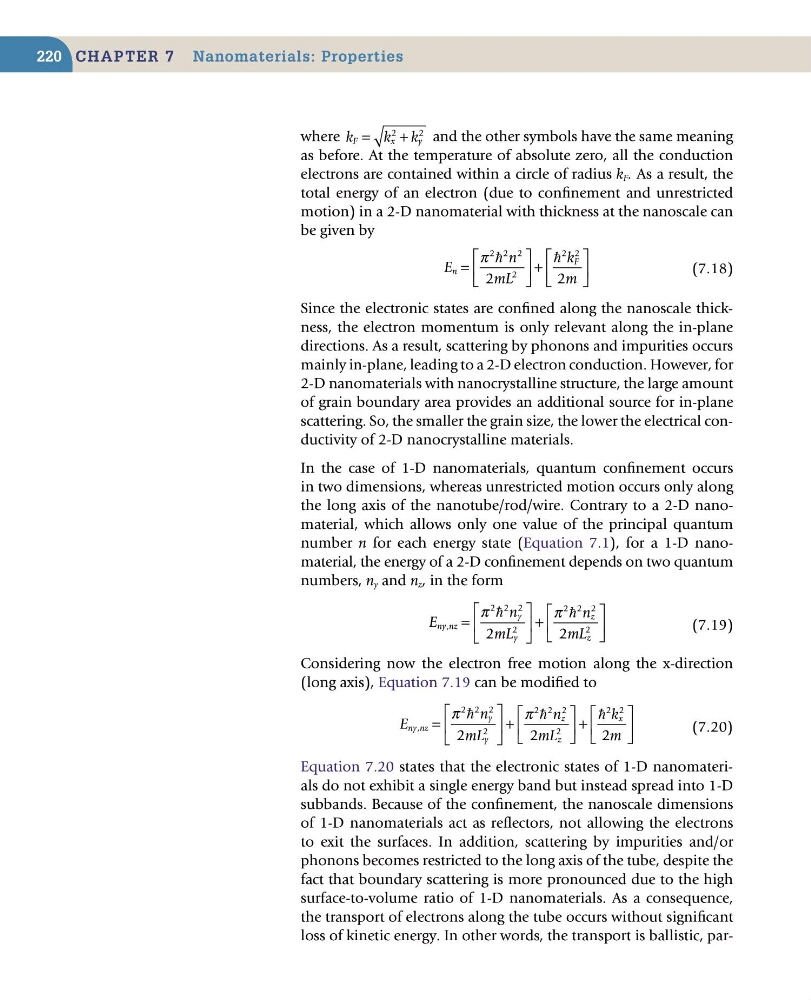
Equation 7.20 states that the electronic states of 1-D nanomaterials do not exhibit a single energy band but instead spread into 1-D
subbands. Because of the confinement, the nanoscale dimensions
of 1-D nanomaterials act as reflectors, not allowing the electrons
to exit the surfaces. In addition, scattering by impurities and/or
phonons becomes restricted to the long axis of the tube, despite the
fact that boundary scattering is more pronounced due to the high
surface-to-volume ratio of 1-D nanomaterials. As a consequence,
the transport of electrons along the tube occurs without significant
loss of kinetic energy. In other words, the transport is ballistic, par-
220
where k
k k
F
x
y
=
+
2
2
and the other symbols have the same meaning
as before. At the temperature of absolute zero, all the conduction
electrons are contained within a circle of radius k F . As a result, the
total energy of an electron (due to confinement and unrestricted
motion) in a 2-D nanomaterial with thickness at the nanoscale can
be given by
E
n
mL
k
m
n
F
=
+
π
2 2 2
2
2 2
2
2
(7.18)
Since the electronic states are confined along the nanoscale thickness, the electron momentum is only relevant along the in-plane
directions. As a result, scattering by phonons and impurities occurs
mainly in-plane, leading to a 2-D electron conduction. However, for
2-D nanomaterials with nanocrystalline structure, the large amount
of grain boundary area provides an additional source for in-plane
scattering. So, the smaller the grain size, the lower the electrical conductivity of 2-D nanocrystalline materials.
In the case of 1-D nanomaterials, quantum confinement occurs
in two dimensions, whereas unrestricted motion occurs only along
the long axis of the nanotube/rod/wire. Contrary to a 2-D nanomaterial, which allows only one value of the principal quantum
number n for each energy state (Equation 7.1), for a 1-D nanomaterial, the energy of a 2-D confinement depends on two quantum
numbers, n y and n z , in the form
E
n
mL
n
mL
ny nz
y
y
z
z
, =
+
π
π
2 2 2
2
2 2 2
2
2
2
(7.19)
Considering now the electron free motion along the x-direction
(long axis), Equation 7.19 can be modified to
E
n
mL
n
mL
k
m
ny nz
y
y
z
z
x
, =
+
+
π
π
2 2 2
2
2 2 2
2
2 2
2
2
2
(7.20)
Equation 7.20 states that the electronic states of 1-D nanomaterials do not exhibit a single energy band but instead spread into 1-D
subbands. Because of the confinement, the nanoscale dimensions
of 1-D nanomaterials act as reflectors, not allowing the electrons
to exit the surfaces. In addition, scattering by impurities and/or
phonons becomes restricted to the long axis of the tube, despite the
fact that boundary scattering is more pronounced due to the high
surface-to-volume ratio of 1-D nanomaterials. As a consequence,
the transport of electrons along the tube occurs without significant
loss of kinetic energy. In other words, the transport is ballistic, par-