

chaPter 7 nanomaterials: Properties
224
For nanocrystalline ferromagnetic materials, an important consideration is the interaction among exchange energy, anisotropic energy,
and demagnetization energy. For very small particles or grain sizes,
the exchange forces are dominant due to strong coupling, causing
all the spins in neighboring grains to align, superseding in this way
the anisotropic and demagnetizing forces. Therefore there is a critical grain size, below which the material will be single domain. For
spherical grains, the critical diameter is given by
D
M
cri
B
s
=
9
0
2
γ
µ
(7.24)
where γ B = 4(AK 1 )
1/2 is the wall energy of the material; A is an
exchange constant, also known as exchange stiffness, which is a function of the material and temperature; K 1 is the anisotropic constant;
µ 0 is the permittivity of free space; and M s is the saturation magnetization. Thus if the particle or grain size is below the critical diameter expressed by Equation 7.24, the material is single domain. For
example, the critical diameter for Co is around 70 nm, whereas for
Fe it is 15 nm. If the particle or grain size becomes significantly
smaller (typically a few nm) than the critical diameter, the magnetization is likely to become unstable and loss of magnetization occurs due to thermal fluctuations. These materials are called
superparamagnetic.
Other magnetic properties are also strongly affected by scale. To
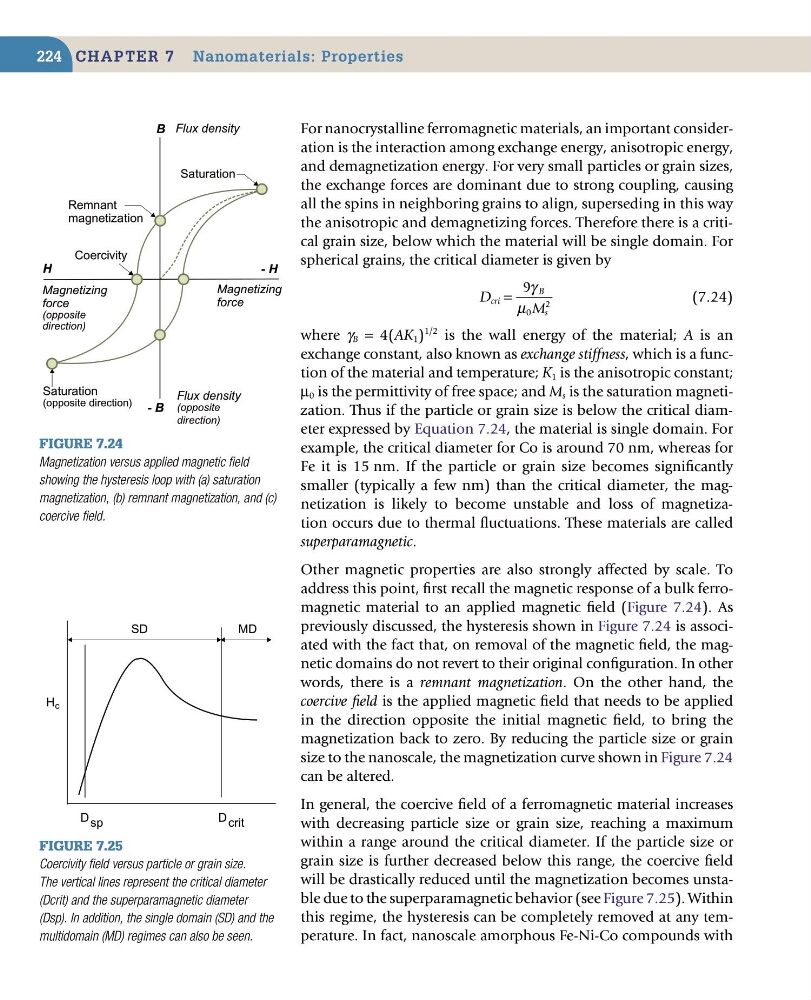
address this point, first recall the magnetic response of a bulk ferromagnetic material to an applied magnetic field (Figure 7.24). As
previously discussed, the hysteresis shown in Figure 7.24 is associated with the fact that, on removal of the magnetic field, the magnetic domains do not revert to their original configuration. In other
words, there is a remnant magnetization. On the other hand, the
coercive field is the applied magnetic field that needs to be applied
in the direction opposite the initial magnetic field, to bring the
magnetization back to zero. By reducing the particle size or grain
size to the nanoscale, the magnetization curve shown in Figure 7.24
can be altered.
In general, the coercive field of a ferromagnetic material increases
with decreasing particle size or grain size, reaching a maximum
within a range around the critical diameter. If the particle size or
grain size is further decreased below this range, the coercive field
will be drastically reduced until the magnetization becomes unstable due to the superparamagnetic behavior (see Figure 7.25). Within
this regime, the hysteresis can be completely removed at any temperature. In fact, nanoscale amorphous Fe-Ni-Co compounds with
Figure 7.24
Magnetization versus applied magnetic field
showing the hysteresis loop with (a) saturation
magnetization, (b) remnant magnetization, and (c)
coercive field.
Remnant
magnetization
Magnetizing
force
(opposite
direction)
Magnetizing
force
Flux density
Saturation
Coercivity
Flux density
(opposite
direction)
- B
- H
B
H
Saturation
(opposite direction)
Figure 7.25
Coercivity field versus particle or grain size.
The vertical lines represent the critical diameter
(Dcrit) and the superparamagnetic diameter
(Dsp). In addition, the single domain (SD) and the
multidomain (MD) regimes can also be seen.
SD
MD
D sp
D crit
H c
224
For nanocrystalline ferromagnetic materials, an important consideration is the interaction among exchange energy, anisotropic energy,
and demagnetization energy. For very small particles or grain sizes,
the exchange forces are dominant due to strong coupling, causing
all the spins in neighboring grains to align, superseding in this way
the anisotropic and demagnetizing forces. Therefore there is a critical grain size, below which the material will be single domain. For
spherical grains, the critical diameter is given by
D
M
cri
B
s
=
9
0
2
γ
µ
(7.24)
where γ B = 4(AK 1 )
1/2 is the wall energy of the material; A is an
exchange constant, also known as exchange stiffness, which is a function of the material and temperature; K 1 is the anisotropic constant;
µ 0 is the permittivity of free space; and M s is the saturation magnetization. Thus if the particle or grain size is below the critical diameter expressed by Equation 7.24, the material is single domain. For
example, the critical diameter for Co is around 70 nm, whereas for
Fe it is 15 nm. If the particle or grain size becomes significantly
smaller (typically a few nm) than the critical diameter, the magnetization is likely to become unstable and loss of magnetization occurs due to thermal fluctuations. These materials are called
superparamagnetic.
Other magnetic properties are also strongly affected by scale. To
address this point, first recall the magnetic response of a bulk ferromagnetic material to an applied magnetic field (Figure 7.24). As
previously discussed, the hysteresis shown in Figure 7.24 is associated with the fact that, on removal of the magnetic field, the magnetic domains do not revert to their original configuration. In other
words, there is a remnant magnetization. On the other hand, the
coercive field is the applied magnetic field that needs to be applied
in the direction opposite the initial magnetic field, to bring the
magnetization back to zero. By reducing the particle size or grain
size to the nanoscale, the magnetization curve shown in Figure 7.24
can be altered.
In general, the coercive field of a ferromagnetic material increases
with decreasing particle size or grain size, reaching a maximum
within a range around the critical diameter. If the particle size or
grain size is further decreased below this range, the coercive field
will be drastically reduced until the magnetization becomes unstable due to the superparamagnetic behavior (see Figure 7.25). Within
this regime, the hysteresis can be completely removed at any temperature. In fact, nanoscale amorphous Fe-Ni-Co compounds with
Figure 7.24
Magnetization versus applied magnetic field
showing the hysteresis loop with (a) saturation
magnetization, (b) remnant magnetization, and (c)
coercive field.
Remnant
magnetization
Magnetizing
force
(opposite
direction)
Magnetizing
force
Flux density
Saturation
Coercivity
Flux density
(opposite
direction)
- B
- H
B
H
Saturation
(opposite direction)
Figure 7.25
Coercivity field versus particle or grain size.
The vertical lines represent the critical diameter
(Dcrit) and the superparamagnetic diameter
(Dsp). In addition, the single domain (SD) and the
multidomain (MD) regimes can also be seen.
SD
MD
D sp
D crit
H c