

chaPter 7 nanomaterials: Properties
202
over 40 years now) derive their strength in this way. Nano is not
new to the metallurgist.
There are many ways to make materials stronger. They were illustrated in Figure 4.41 of Chapter 4, Section 4.3. These are alloying
(atomic-level hardening), dispersion hardening, and work hardening (hardening by dislocations that interact with each other and
obstruct their motion). All are well known and exhaustively studied.
The new idea is that further gains might be made by reducing the
scale of the individual crystal (or grains) in which these mechanisms
operate to that of nanometers by making nanocrystals, nanolayers,
or, the ultimate, amorphous structures. What do these offer?
nanocrystalline solids
Making materials with grains at nanoscale is not easy. The lowest
energy state of most materials is as a single crystal. Subdividing
it to make it polycrystalline raises its energy because the boundaries where the crystals meet have associated distortions. Therefore,
making it nanocrystalline creates a very large area of internal boundary, difficult to make and to retain once made. Research over the
last decade has enabled both problems to be overcome (using the
methods described in Section 8.1). As anticipated, the resulting
materials have interesting properties.
Figure 7.5, top, shows how the hardness H of copper increases as
the grain size is reduced. Coarse-grained copper has a hardness of
less than 200 MPa. Reducing the grain size to 5 nm raises the hardness to over 2000 MPa, an increase of more than a factor of 10. The
same data is replotted on logarithmic scales in the lower part of
the figure. The points lie along a line with a slope of approximately
–0.5, meaning that the hardness depends on grain size as
80
90
100
110
120
130
140
0.1
1.0
10
100
1000
Al-4% Cu,
age hardened
Vickers hardness Hv (kg/mm
2
)
Aging time (hours)
Nanoparticles
form
Particles
coarsen
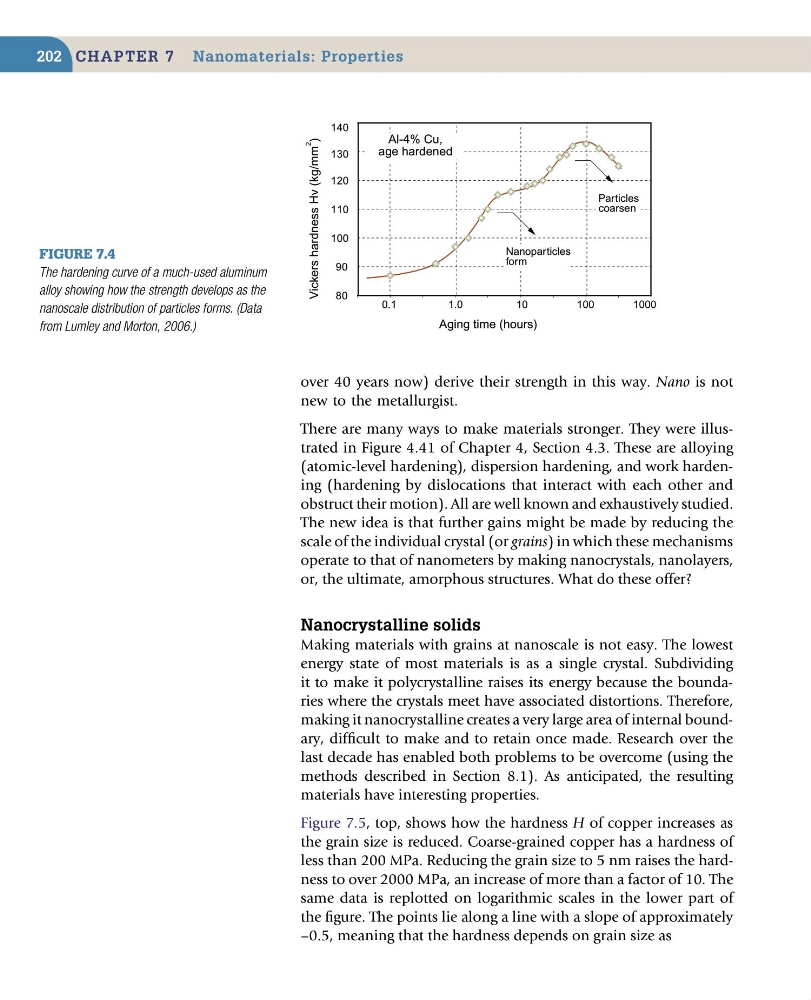
Figure 7.4
The hardening curve of a much-used aluminum
alloy showing how the strength develops as the
nanoscale distribution of particles forms. (Data
from Lumley and Morton, 2006.)
202
over 40 years now) derive their strength in this way. Nano is not
new to the metallurgist.
There are many ways to make materials stronger. They were illustrated in Figure 4.41 of Chapter 4, Section 4.3. These are alloying
(atomic-level hardening), dispersion hardening, and work hardening (hardening by dislocations that interact with each other and
obstruct their motion). All are well known and exhaustively studied.
The new idea is that further gains might be made by reducing the
scale of the individual crystal (or grains) in which these mechanisms
operate to that of nanometers by making nanocrystals, nanolayers,
or, the ultimate, amorphous structures. What do these offer?
nanocrystalline solids
Making materials with grains at nanoscale is not easy. The lowest
energy state of most materials is as a single crystal. Subdividing
it to make it polycrystalline raises its energy because the boundaries where the crystals meet have associated distortions. Therefore,
making it nanocrystalline creates a very large area of internal boundary, difficult to make and to retain once made. Research over the
last decade has enabled both problems to be overcome (using the
methods described in Section 8.1). As anticipated, the resulting
materials have interesting properties.
Figure 7.5, top, shows how the hardness H of copper increases as
the grain size is reduced. Coarse-grained copper has a hardness of
less than 200 MPa. Reducing the grain size to 5 nm raises the hardness to over 2000 MPa, an increase of more than a factor of 10. The
same data is replotted on logarithmic scales in the lower part of
the figure. The points lie along a line with a slope of approximately
–0.5, meaning that the hardness depends on grain size as
80
90
100
110
120
130
140
0.1
1.0
10
100
1000
Al-4% Cu,
age hardened
Vickers hardness Hv (kg/mm
2
)
Aging time (hours)
Nanoparticles
form
Particles
coarsen
Figure 7.4
The hardening curve of a much-used aluminum
alloy showing how the strength develops as the
nanoscale distribution of particles forms. (Data
from Lumley and Morton, 2006.)