

195
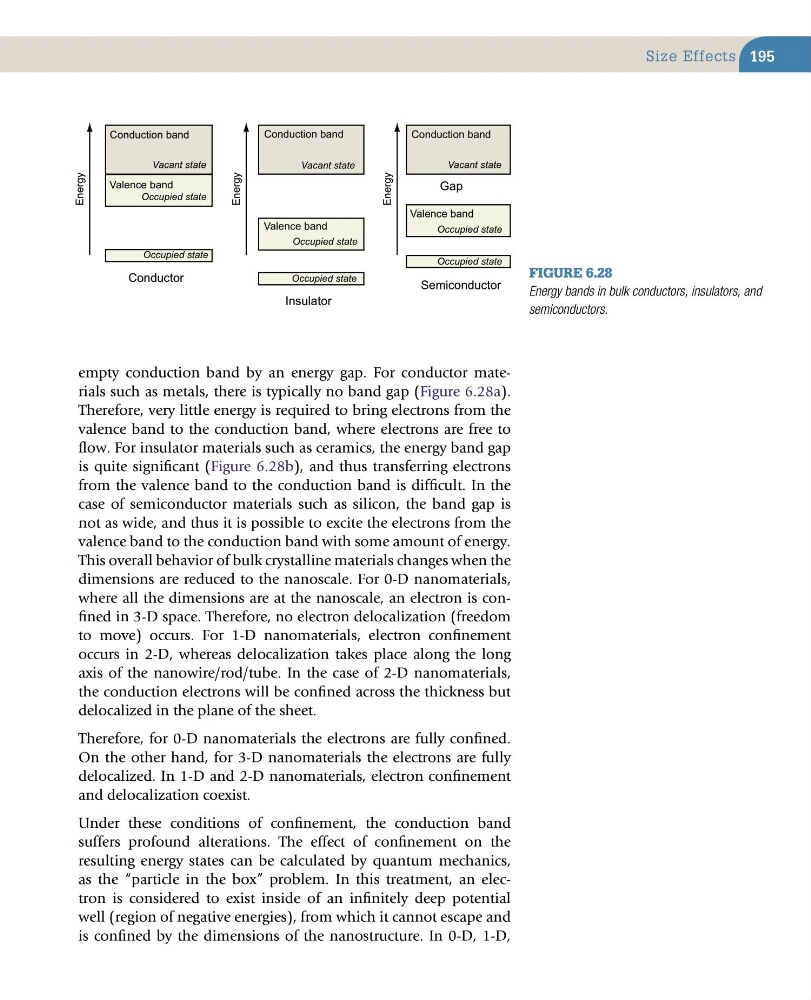
Figure 6.28
Energy bands in bulk conductors, insulators, and
semiconductors.
empty conduction band by an energy gap. For conductor materials such as metals, there is typically no band gap (Figure 6.28a).
Therefore, very little energy is required to bring electrons from the
valence band to the conduction band, where electrons are free to
flow. For insulator materials such as ceramics, the energy band gap
is quite significant (Figure 6.28b), and thus transferring electrons
from the valence band to the conduction band is difficult. In the
case of semiconductor materials such as silicon, the band gap is
not as wide, and thus it is possible to excite the electrons from the
valence band to the conduction band with some amount of energy.
This overall behavior of bulk crystalline materials changes when the
dimensions are reduced to the nanoscale. For 0-D nanomaterials,
where all the dimensions are at the nanoscale, an electron is confined in 3-D space. Therefore, no electron delocalization (freedom
to move) occurs. For 1-D nanomaterials, electron confinement
occurs in 2-D, whereas delocalization takes place along the long
axis of the nanowire/rod/tube. In the case of 2-D nanomaterials,
the conduction electrons will be confined across the thickness but
delocalized in the plane of the sheet.
Therefore, for 0-D nanomaterials the electrons are fully confined.
On the other hand, for 3-D nanomaterials the electrons are fully
delocalized. In 1-D and 2-D nanomaterials, electron confinement
and delocalization coexist.
Under these conditions of confinement, the conduction band
suffers profound alterations. The effect of confinement on the
resulting energy states can be calculated by quantum mechanics,
as the “particle in the box” problem. In this treatment, an electron is considered to exist inside of an infinitely deep potential
well (region of negative energies), from which it cannot escape and
is confined by the dimensions of the nanostructure. In 0-D, 1-D,
Energy
Energy
Energy
Conductor
Insulator
Semiconductor
Gap
Vacant state
Vacant state
Vacant state
Occupied state
Occupied state
Occupied state
Occupied state
Occupied state
Occupied state
Valence band
Conduction band
Valence band
Conduction band
Valence band
Conduction band
Size Effects
Figure 6.28
Energy bands in bulk conductors, insulators, and
semiconductors.
empty conduction band by an energy gap. For conductor materials such as metals, there is typically no band gap (Figure 6.28a).
Therefore, very little energy is required to bring electrons from the
valence band to the conduction band, where electrons are free to
flow. For insulator materials such as ceramics, the energy band gap
is quite significant (Figure 6.28b), and thus transferring electrons
from the valence band to the conduction band is difficult. In the
case of semiconductor materials such as silicon, the band gap is
not as wide, and thus it is possible to excite the electrons from the
valence band to the conduction band with some amount of energy.
This overall behavior of bulk crystalline materials changes when the
dimensions are reduced to the nanoscale. For 0-D nanomaterials,
where all the dimensions are at the nanoscale, an electron is confined in 3-D space. Therefore, no electron delocalization (freedom
to move) occurs. For 1-D nanomaterials, electron confinement
occurs in 2-D, whereas delocalization takes place along the long
axis of the nanowire/rod/tube. In the case of 2-D nanomaterials,
the conduction electrons will be confined across the thickness but
delocalized in the plane of the sheet.
Therefore, for 0-D nanomaterials the electrons are fully confined.
On the other hand, for 3-D nanomaterials the electrons are fully
delocalized. In 1-D and 2-D nanomaterials, electron confinement
and delocalization coexist.
Under these conditions of confinement, the conduction band
suffers profound alterations. The effect of confinement on the
resulting energy states can be calculated by quantum mechanics,
as the “particle in the box” problem. In this treatment, an electron is considered to exist inside of an infinitely deep potential
well (region of negative energies), from which it cannot escape and
is confined by the dimensions of the nanostructure. In 0-D, 1-D,
Energy
Energy
Energy
Conductor
Insulator
Semiconductor
Gap
Vacant state
Vacant state
Vacant state
Occupied state
Occupied state
Occupied state
Occupied state
Occupied state
Occupied state
Valence band
Conduction band
Valence band
Conduction band
Valence band
Conduction band
Size Effects