

C hapter 6 nanomaterials: Classes and fundamentals
194
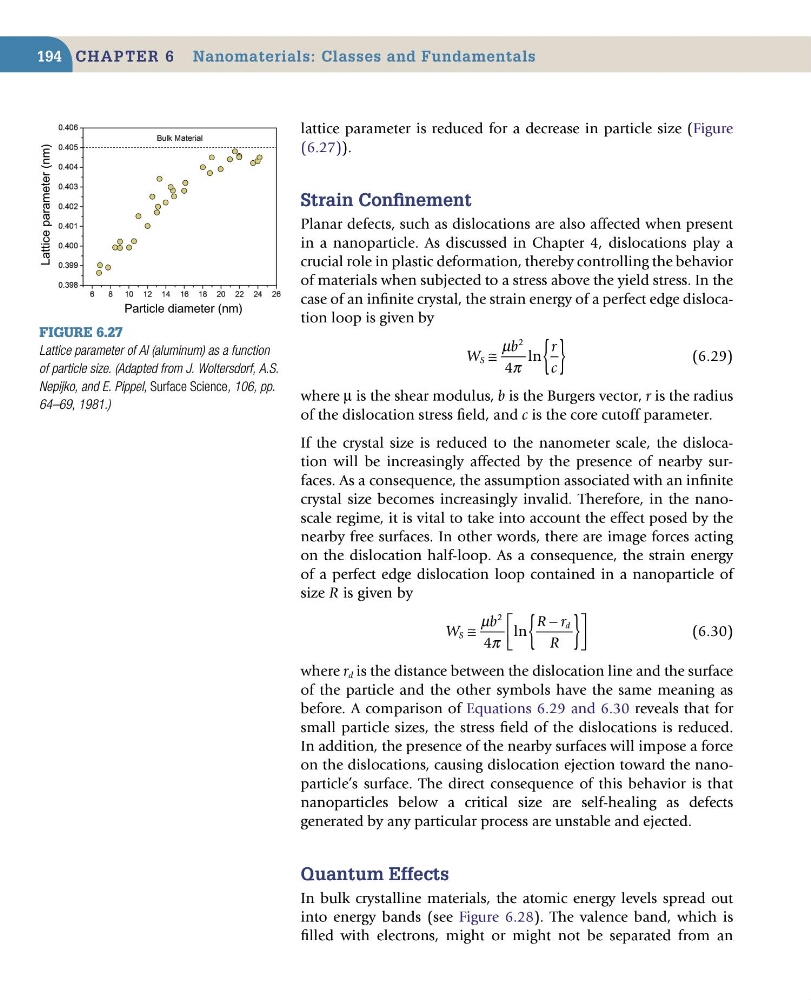
lattice parameter is reduced for a decrease in particle size (Figure
(6.27)).
strain Confinement
Planar defects, such as dislocations are also affected when present
in a nanoparticle. As discussed in Chapter 4, dislocations play a
crucial role in plastic deformation, thereby controlling the behavior
of materials when subjected to a stress above the yield stress. In the
case of an infinite crystal, the strain energy of a perfect edge dislocation loop is given by
W
b
r
c
S ≅
{ }
µ
π
2
4
ln
(6.29)
where µ is the shear modulus, b is the Burgers vector, r is the radius
of the dislocation stress field, and c is the core cutoff parameter.
If the crystal size is reduced to the nanometer scale, the dislocation will be increasingly affected by the presence of nearby surfaces. As a consequence, the assumption associated with an infinite
crystal size becomes increasingly invalid. Therefore, in the nanoscale regime, it is vital to take into account the effect posed by the
nearby free surfaces. In other words, there are image forces acting
on the dislocation half-loop. As a consequence, the strain energy
of a perfect edge dislocation loop contained in a nanoparticle of
size R is given by
W
b
R r
R
S
d
≅
−
{ }
µ
π
2
4
ln
(6.30)
where r d is the distance between the dislocation line and the surface
of the particle and the other symbols have the same meaning as
before. A comparison of Equations 6.29 and 6.30 reveals that for
small particle sizes, the stress field of the dislocations is reduced.
In addition, the presence of the nearby surfaces will impose a force
on the dislocations, causing dislocation ejection toward the nanoparticle’s surface. The direct consequence of this behavior is that
nanoparticles below a critical size are self-healing as defects
generated by any particular process are unstable and ejected.
Quantum effects
In bulk crystalline materials, the atomic energy levels spread out
into energy bands (see Figure 6.28). The valence band, which is
filled with electrons, might or might not be separated from an
Figure 6.27
Lattice parameter of Al (aluminum) as a function
of particle size. (Adapted from J. Woltersdorf, A.S.
Nepijko, and E. Pippel, Surface Science, 106, pp.
64–69, 1981.)
Particle diameter (nm)
Lattice parameter (nm)
194
lattice parameter is reduced for a decrease in particle size (Figure
(6.27)).
strain Confinement
Planar defects, such as dislocations are also affected when present
in a nanoparticle. As discussed in Chapter 4, dislocations play a
crucial role in plastic deformation, thereby controlling the behavior
of materials when subjected to a stress above the yield stress. In the
case of an infinite crystal, the strain energy of a perfect edge dislocation loop is given by
W
b
r
c
S ≅
{ }
µ
π
2
4
ln
(6.29)
where µ is the shear modulus, b is the Burgers vector, r is the radius
of the dislocation stress field, and c is the core cutoff parameter.
If the crystal size is reduced to the nanometer scale, the dislocation will be increasingly affected by the presence of nearby surfaces. As a consequence, the assumption associated with an infinite
crystal size becomes increasingly invalid. Therefore, in the nanoscale regime, it is vital to take into account the effect posed by the
nearby free surfaces. In other words, there are image forces acting
on the dislocation half-loop. As a consequence, the strain energy
of a perfect edge dislocation loop contained in a nanoparticle of
size R is given by
W
b
R r
R
S
d
≅
−
{ }
µ
π
2
4
ln
(6.30)
where r d is the distance between the dislocation line and the surface
of the particle and the other symbols have the same meaning as
before. A comparison of Equations 6.29 and 6.30 reveals that for
small particle sizes, the stress field of the dislocations is reduced.
In addition, the presence of the nearby surfaces will impose a force
on the dislocations, causing dislocation ejection toward the nanoparticle’s surface. The direct consequence of this behavior is that
nanoparticles below a critical size are self-healing as defects
generated by any particular process are unstable and ejected.
Quantum effects
In bulk crystalline materials, the atomic energy levels spread out
into energy bands (see Figure 6.28). The valence band, which is
filled with electrons, might or might not be separated from an
Figure 6.27
Lattice parameter of Al (aluminum) as a function
of particle size. (Adapted from J. Woltersdorf, A.S.
Nepijko, and E. Pippel, Surface Science, 106, pp.
64–69, 1981.)
Particle diameter (nm)
Lattice parameter (nm)