

193
effect of curvature on the diffusivity of nanoparticles of silver, gold,
and platinum.
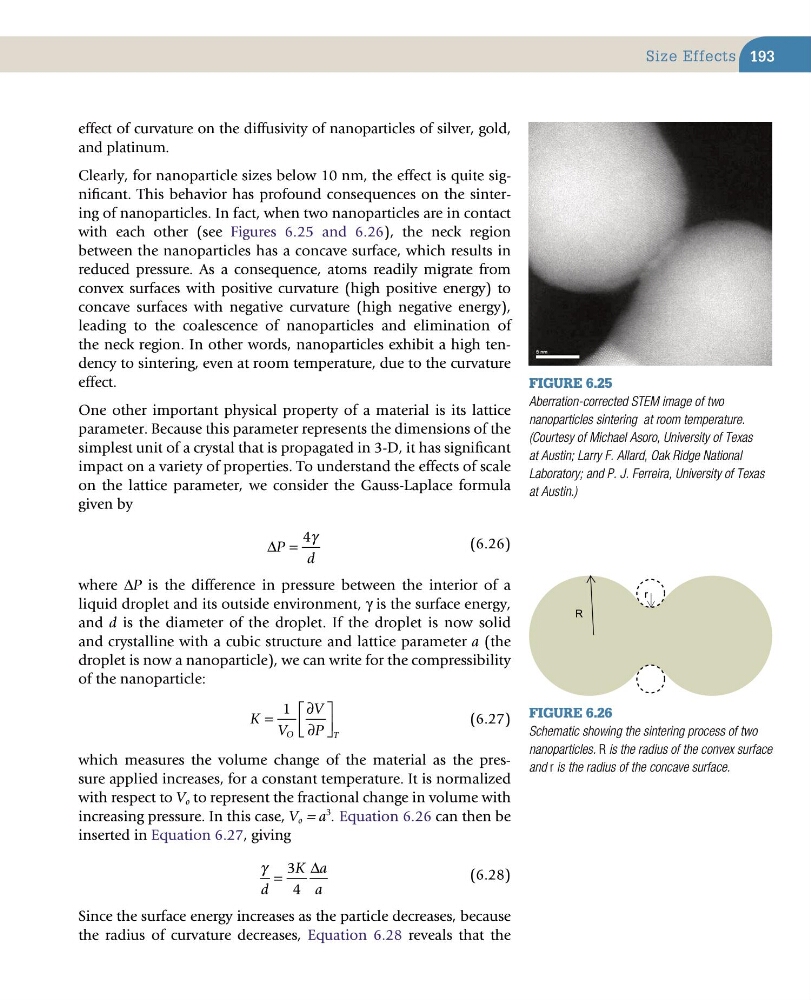
Clearly, for nanoparticle sizes below 10 nm, the effect is quite significant. This behavior has profound consequences on the sintering of nanoparticles. In fact, when two nanoparticles are in contact
with each other (see Figures 6.25 and 6.26), the neck region
between the nanoparticles has a concave surface, which results in
reduced pressure. As a consequence, atoms readily migrate from
convex surfaces with positive curvature (high positive energy) to
concave surfaces with negative curvature (high negative energy),
leading to the coalescence of nanoparticles and elimination of
the neck region. In other words, nanoparticles exhibit a high tendency to sintering, even at room temperature, due to the curvature
effect.
One other important physical property of a material is its lattice
parameter. Because this parameter represents the dimensions of the
simplest unit of a crystal that is propagated in 3-D, it has significant
impact on a variety of properties. To understand the effects of scale
on the lattice parameter, we consider the Gauss-Laplace formula
given by
∆P d
=
4γ
(6.26)
where ΔP is the difference in pressure between the interior of a
liquid droplet and its outside environment, γ is the surface energy,
and d is the diameter of the droplet. If the droplet is now solid
and crystalline with a cubic structure and lattice parameter a (the
droplet is now a nanoparticle), we can write for the compressibility
of the nanoparticle:
K V
V
P
O
T
=
∂
∂
1
(6.27)
which measures the volume change of the material as the pressure applied increases, for a constant temperature. It is normalized
with respect to V o to represent the fractional change in volume with
increasing pressure. In this case, V o = a
3 . Equation 6.26 can then be
inserted in Equation 6.27, giving
γ
d
K a
a
=
3
4
∆
(6.28)
Since the surface energy increases as the particle decreases, because
the radius of curvature decreases, Equation 6.28 reveals that the
Figure 6.25
Aberration-corrected STEM image of two
nanoparticles sintering at room temperature.
(Courtesy of Michael Asoro, University of Texas
at Austin; Larry F. Allard, Oak Ridge National
Laboratory; and P. J. Ferreira, University of Texas
at Austin.)
Figure 6.26
Schematic showing the sintering process of two
nanoparticles. R is the radius of the convex surface
and r is the radius of the concave surface.
r
R
Size Effects
effect of curvature on the diffusivity of nanoparticles of silver, gold,
and platinum.
Clearly, for nanoparticle sizes below 10 nm, the effect is quite significant. This behavior has profound consequences on the sintering of nanoparticles. In fact, when two nanoparticles are in contact
with each other (see Figures 6.25 and 6.26), the neck region
between the nanoparticles has a concave surface, which results in
reduced pressure. As a consequence, atoms readily migrate from
convex surfaces with positive curvature (high positive energy) to
concave surfaces with negative curvature (high negative energy),
leading to the coalescence of nanoparticles and elimination of
the neck region. In other words, nanoparticles exhibit a high tendency to sintering, even at room temperature, due to the curvature
effect.
One other important physical property of a material is its lattice
parameter. Because this parameter represents the dimensions of the
simplest unit of a crystal that is propagated in 3-D, it has significant
impact on a variety of properties. To understand the effects of scale
on the lattice parameter, we consider the Gauss-Laplace formula
given by
∆P d
=
4γ
(6.26)
where ΔP is the difference in pressure between the interior of a
liquid droplet and its outside environment, γ is the surface energy,
and d is the diameter of the droplet. If the droplet is now solid
and crystalline with a cubic structure and lattice parameter a (the
droplet is now a nanoparticle), we can write for the compressibility
of the nanoparticle:
K V
V
P
O
T
=
∂
∂
1
(6.27)
which measures the volume change of the material as the pressure applied increases, for a constant temperature. It is normalized
with respect to V o to represent the fractional change in volume with
increasing pressure. In this case, V o = a
3 . Equation 6.26 can then be
inserted in Equation 6.27, giving
γ
d
K a
a
=
3
4
∆
(6.28)
Since the surface energy increases as the particle decreases, because
the radius of curvature decreases, Equation 6.28 reveals that the
Figure 6.25
Aberration-corrected STEM image of two
nanoparticles sintering at room temperature.
(Courtesy of Michael Asoro, University of Texas
at Austin; Larry F. Allard, Oak Ridge National
Laboratory; and P. J. Ferreira, University of Texas
at Austin.)
Figure 6.26
Schematic showing the sintering process of two
nanoparticles. R is the radius of the convex surface
and r is the radius of the concave surface.
r
R
Size Effects