

C hapter 6 nanomaterials: Classes and fundamentals
192
volume, γ the surface energy, and r the radius of curvature, Equation 6.18 can be rewritten as:
∆
∆
Ω
G
G
r
v
Total
v
bulk
=
+
γ
(6.19)
Therefore, the total equilibrium vacancy concentration in a nanoparticle can be given by
X
G
k T
v
Total
v
Total
B
=
−
exp
∆
(6.20)
where k B is the Boltzmann constant and T the temperature. Inserting Equation 6.19 into Equation 6.20 yields
X
G
k T
rk T
v
Total
v
bulk
B
B
=
−
−
exp
exp
∆
Ωγ
(6.21)
For the bulk case, where curvature effects can be neglected, the concentration of vacancies can be expressed as
X
G
k T
v
bulk
v
bulk
B
=
−
exp
∆
(6.22)
However for a nanoparticle, the concentration of vacancies can be
written as
X
X
rk T
v
Total
v
bulk
B
=
−
exp
Ωγ
(6.23)
As discussed, by convention, the local curvature is defined as positive if the surface is convex and negative if concave. Therefore, for a
convex surface, Equation 6.23. can be rewritten as
X
X
rk T
v
Total
v
Bulk
B
=
−
1
Ωγ
(6.24)
On the other hand, for concave surfaces, the mean curvature is given
by −1/r, and thus Equation 6.23 becomes
X
X
rk T
v
Total
v
Bulk
B
=
+
1
Ωγ
(6.25)
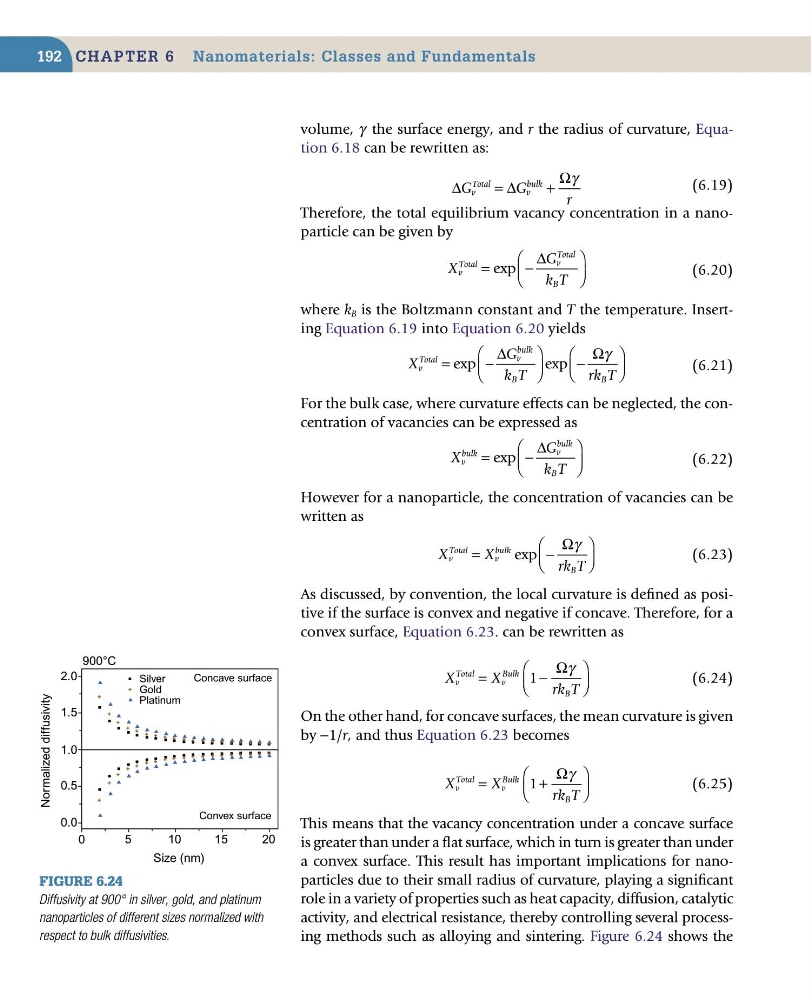
This means that the vacancy concentration under a concave surface
is greater than under a flat surface, which in turn is greater than under
a convex surface. This result has important implications for nanoparticles due to their small radius of curvature, playing a significant
role in a variety of properties such as heat capacity, diffusion, catalytic
activity, and electrical resistance, thereby controlling several processing methods such as alloying and sintering. Figure 6.24 shows the
Figure 6.24
Diffusivity at 900° in silver, gold, and platinum
nanoparticles of different sizes normalized with
respect to bulk diffusivities.
900°C
Size (nm)
0
0.0
0.5
1.0
2.0
1.5
5
10
20
15
Concave surface
Silver
Gold
Platinum
Convex surface
Normalized diffusivity
192
volume, γ the surface energy, and r the radius of curvature, Equation 6.18 can be rewritten as:
∆
∆
Ω
G
G
r
v
Total
v
bulk
=
+
γ
(6.19)
Therefore, the total equilibrium vacancy concentration in a nanoparticle can be given by
X
G
k T
v
Total
v
Total
B
=
−
exp
∆
(6.20)
where k B is the Boltzmann constant and T the temperature. Inserting Equation 6.19 into Equation 6.20 yields
X
G
k T
rk T
v
Total
v
bulk
B
B
=
−
−
exp
exp
∆
Ωγ
(6.21)
For the bulk case, where curvature effects can be neglected, the concentration of vacancies can be expressed as
X
G
k T
v
bulk
v
bulk
B
=
−
exp
∆
(6.22)
However for a nanoparticle, the concentration of vacancies can be
written as
X
X
rk T
v
Total
v
bulk
B
=
−
exp
Ωγ
(6.23)
As discussed, by convention, the local curvature is defined as positive if the surface is convex and negative if concave. Therefore, for a
convex surface, Equation 6.23. can be rewritten as
X
X
rk T
v
Total
v
Bulk
B
=
−
1
Ωγ
(6.24)
On the other hand, for concave surfaces, the mean curvature is given
by −1/r, and thus Equation 6.23 becomes
X
X
rk T
v
Total
v
Bulk
B
=
+
1
Ωγ
(6.25)
This means that the vacancy concentration under a concave surface
is greater than under a flat surface, which in turn is greater than under
a convex surface. This result has important implications for nanoparticles due to their small radius of curvature, playing a significant
role in a variety of properties such as heat capacity, diffusion, catalytic
activity, and electrical resistance, thereby controlling several processing methods such as alloying and sintering. Figure 6.24 shows the
Figure 6.24
Diffusivity at 900° in silver, gold, and platinum
nanoparticles of different sizes normalized with
respect to bulk diffusivities.
900°C
Size (nm)
0
0.0
0.5
1.0
2.0
1.5
5
10
20
15
Concave surface
Silver
Gold
Platinum
Convex surface
Normalized diffusivity