

191
γ = −
E TS
S
S
(6.15)
where E
S is the internal energy, T is the temperature, and S
S is the
surface thermal entropy. Equally important is the fact that the
geometry of the surface, specifically its local curvature, will cause
a change in the system’s pressure. These effects are normally called
capillarity effects due to the fact that the initial studies were done in
fine glass tubes called capillaries. To introduce the concept of surface
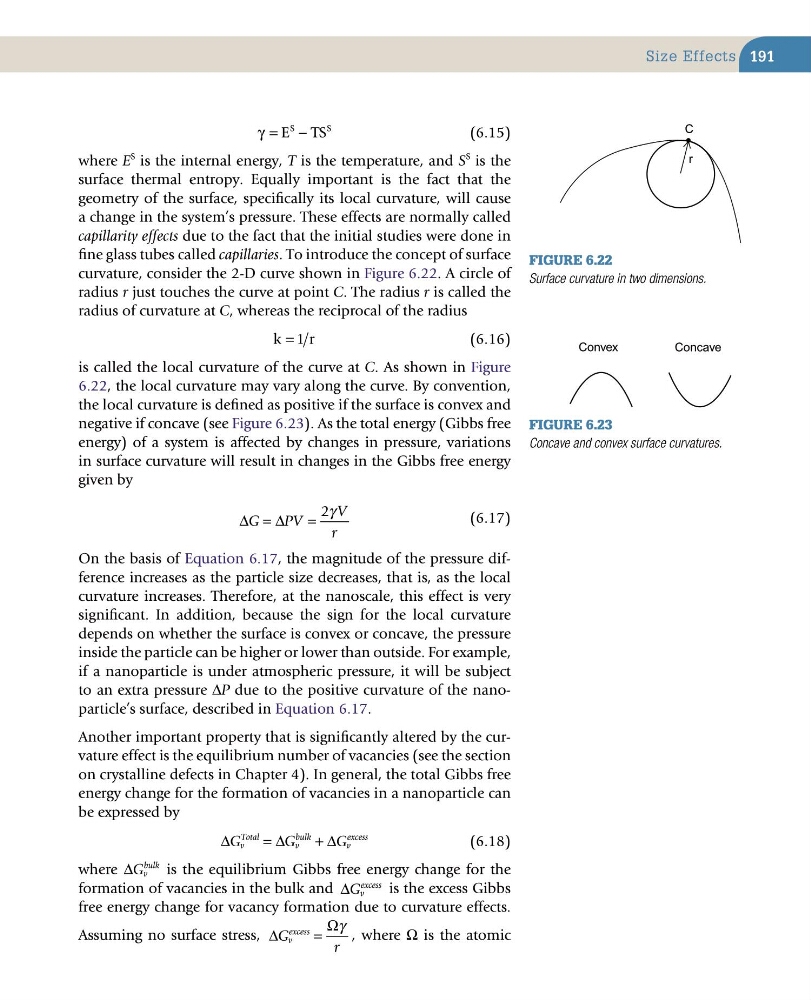
curvature, consider the 2-D curve shown in Figure 6.22. A circle of
radius r just touches the curve at point C. The radius r is called the
radius of curvature at C, whereas the reciprocal of the radius
k
r
= 1
(6.16)
is called the local curvature of the curve at C. As shown in Figure
6.22, the local curvature may vary along the curve. By convention,
the local curvature is defined as positive if the surface is convex and
negative if concave (see Figure 6.23). As the total energy (Gibbs free
energy) of a system is affected by changes in pressure, variations
in surface curvature will result in changes in the Gibbs free energy
given by
∆
∆
G
PV
V
r
=
=
2γ
(6.17)
On the basis of Equation 6.17, the magnitude of the pressure difference increases as the particle size decreases, that is, as the local
curvature increases. Therefore, at the nanoscale, this effect is very
significant. In addition, because the sign for the local curvature
depends on whether the surface is convex or concave, the pressure
inside the particle can be higher or lower than outside. For example,
if a nanoparticle is under atmospheric pressure, it will be subject
to an extra pressure ΔP due to the positive curvature of the nanoparticle’s surface, described in Equation 6.17.
Another important property that is significantly altered by the curvature effect is the equilibrium number of vacancies (see the section
on crystalline defects in Chapter 4). In general, the total Gibbs free
energy change for the formation of vacancies in a nanoparticle can
be expressed by
∆
∆
∆
G
G
G
v
Total
v
bulk
v
excess
=
+
(6.18)
where ΔG v
bulk is the equilibrium Gibbs free energy change for the
formation of vacancies in the bulk and ΔG v
excess
is the excess Gibbs
free energy change for vacancy formation due to curvature effects.
Assuming no surface stress, ∆
Ω
G
r
v
excess
=
γ , where Ω is the atomic
Figure 6.22
Surface curvature in two dimensions.
r
C
Figure 6.23
Concave and convex surface curvatures.
Convex
Concave
Size Effects
γ = −
E TS
S
S
(6.15)
where E
S is the internal energy, T is the temperature, and S
S is the
surface thermal entropy. Equally important is the fact that the
geometry of the surface, specifically its local curvature, will cause
a change in the system’s pressure. These effects are normally called
capillarity effects due to the fact that the initial studies were done in
fine glass tubes called capillaries. To introduce the concept of surface
curvature, consider the 2-D curve shown in Figure 6.22. A circle of
radius r just touches the curve at point C. The radius r is called the
radius of curvature at C, whereas the reciprocal of the radius
k
r
= 1
(6.16)
is called the local curvature of the curve at C. As shown in Figure
6.22, the local curvature may vary along the curve. By convention,
the local curvature is defined as positive if the surface is convex and
negative if concave (see Figure 6.23). As the total energy (Gibbs free
energy) of a system is affected by changes in pressure, variations
in surface curvature will result in changes in the Gibbs free energy
given by
∆
∆
G
PV
V
r
=
=
2γ
(6.17)
On the basis of Equation 6.17, the magnitude of the pressure difference increases as the particle size decreases, that is, as the local
curvature increases. Therefore, at the nanoscale, this effect is very
significant. In addition, because the sign for the local curvature
depends on whether the surface is convex or concave, the pressure
inside the particle can be higher or lower than outside. For example,
if a nanoparticle is under atmospheric pressure, it will be subject
to an extra pressure ΔP due to the positive curvature of the nanoparticle’s surface, described in Equation 6.17.
Another important property that is significantly altered by the curvature effect is the equilibrium number of vacancies (see the section
on crystalline defects in Chapter 4). In general, the total Gibbs free
energy change for the formation of vacancies in a nanoparticle can
be expressed by
∆
∆
∆
G
G
G
v
Total
v
bulk
v
excess
=
+
(6.18)
where ΔG v
bulk is the equilibrium Gibbs free energy change for the
formation of vacancies in the bulk and ΔG v
excess
is the excess Gibbs
free energy change for vacancy formation due to curvature effects.
Assuming no surface stress, ∆
Ω
G
r
v
excess
=
γ , where Ω is the atomic
Figure 6.22
Surface curvature in two dimensions.
r
C
Figure 6.23
Concave and convex surface curvatures.
Convex
Concave
Size Effects