

C hapter 6 nanomaterials: Classes and fundamentals
190
occur for certain cluster sizes. For example, potassium clusters produced in a supersonic jet beam and composed of 8, 20, 40, 58, and
92 atoms occur frequently. This is because potassium has the 4s
orbital (outermost shell) occupied and thus clusters for which the
total number of valence electrons fill an electronic shell are especially stable. Thus, in general, electronic magic numbers correspond
to main electronic shell closings.
surface Curvature
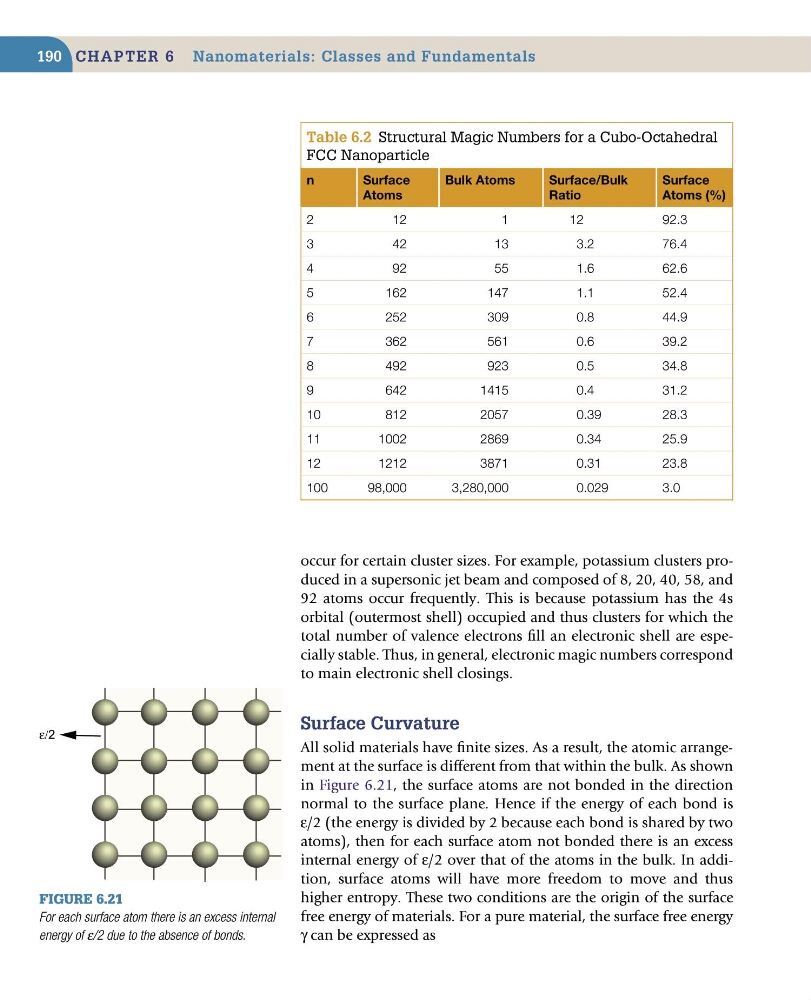
All solid materials have finite sizes. As a result, the atomic arrangement at the surface is different from that within the bulk. As shown
in Figure 6.21, the surface atoms are not bonded in the direction
normal to the surface plane. Hence if the energy of each bond is
ε/2 (the energy is divided by 2 because each bond is shared by two
atoms), then for each surface atom not bonded there is an excess
internal energy of ε/2 over that of the atoms in the bulk. In addition, surface atoms will have more freedom to move and thus
higher entropy. These two conditions are the origin of the surface
free energy of materials. For a pure material, the surface free energy
γ can be expressed as
Figure 6.21
For each surface atom there is an excess internal
energy of ε/2 due to the absence of bonds.
ε/2
table 6.2 Structural Magic Numbers for a Cubo-Octahedral
FCC Nanoparticle
n
Surface
Atoms
Bulk Atoms
Surface/Bulk
Ratio
Surface
Atoms (%)
2
12
1
12
92.3
3
42
13
3.2
76.4
4
92
55
1.6
62.6
5
162
147
1.1
52.4
6
252
309
0.8
44.9
7
362
561
0.6
39.2
8
492
923
0.5
34.8
9
642
1415
0.4
31.2
10
812
2057
0.39
28.3
11
1002
2869
0.34
25.9
12
1212
3871
0.31
23.8
100
98,000
3,280,000
0.029
3.0
190
occur for certain cluster sizes. For example, potassium clusters produced in a supersonic jet beam and composed of 8, 20, 40, 58, and
92 atoms occur frequently. This is because potassium has the 4s
orbital (outermost shell) occupied and thus clusters for which the
total number of valence electrons fill an electronic shell are especially stable. Thus, in general, electronic magic numbers correspond
to main electronic shell closings.
surface Curvature
All solid materials have finite sizes. As a result, the atomic arrangement at the surface is different from that within the bulk. As shown
in Figure 6.21, the surface atoms are not bonded in the direction
normal to the surface plane. Hence if the energy of each bond is
ε/2 (the energy is divided by 2 because each bond is shared by two
atoms), then for each surface atom not bonded there is an excess
internal energy of ε/2 over that of the atoms in the bulk. In addition, surface atoms will have more freedom to move and thus
higher entropy. These two conditions are the origin of the surface
free energy of materials. For a pure material, the surface free energy
γ can be expressed as
Figure 6.21
For each surface atom there is an excess internal
energy of ε/2 due to the absence of bonds.
ε/2
table 6.2 Structural Magic Numbers for a Cubo-Octahedral
FCC Nanoparticle
n
Surface
Atoms
Bulk Atoms
Surface/Bulk
Ratio
Surface
Atoms (%)
2
12
1
12
92.3
3
42
13
3.2
76.4
4
92
55
1.6
62.6
5
162
147
1.1
52.4
6
252
309
0.8
44.9
7
362
561
0.6
39.2
8
492
923
0.5
34.8
9
642
1415
0.4
31.2
10
812
2057
0.39
28.3
11
1002
2869
0.34
25.9
12
1212
3871
0.31
23.8
100
98,000
3,280,000
0.029
3.0