

189
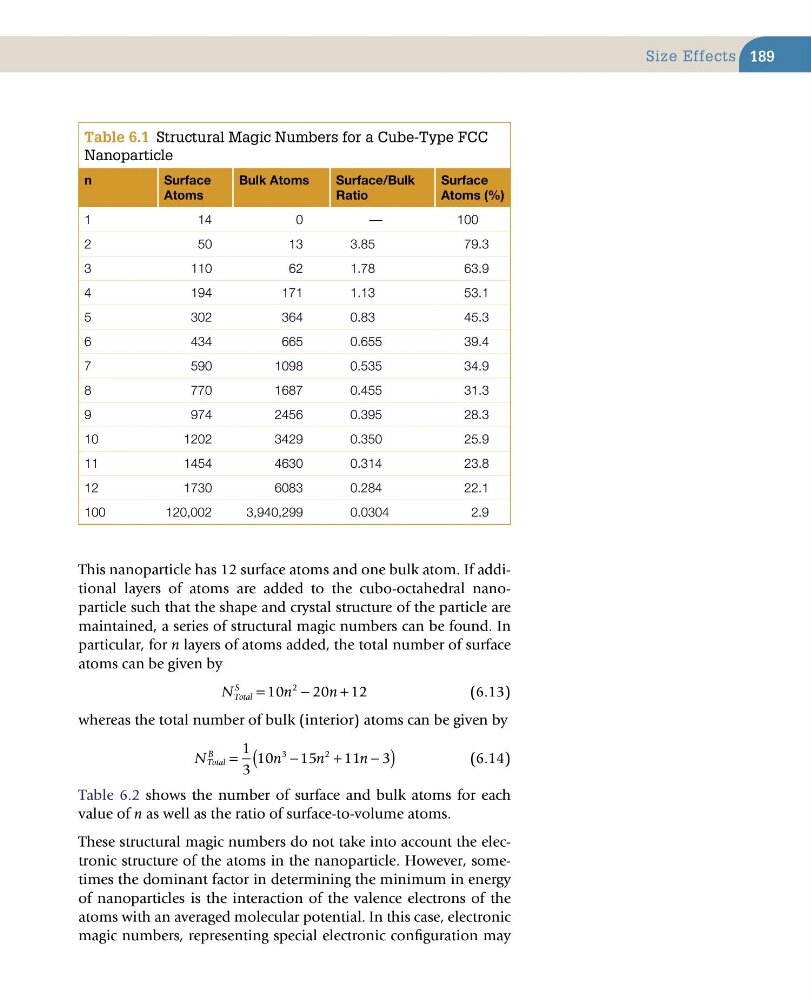
This nanoparticle has 12 surface atoms and one bulk atom. If additional layers of atoms are added to the cubo-octahedral nanoparticle such that the shape and crystal structure of the particle are
maintained, a series of structural magic numbers can be found. In
particular, for n layers of atoms added, the total number of surface
atoms can be given by
N
n
n
Total
S
=
−
+
10
20 12
2
(6.13)
whereas the total number of bulk (interior) atoms can be given by
N
n
n
n
Total
B
=
−
+
−
(
)
1
3
10
15
11 3
3
2
(6.14)
Table 6.2 shows the number of surface and bulk atoms for each
value of n as well as the ratio of surface-to-volume atoms.
These structural magic numbers do not take into account the electronic structure of the atoms in the nanoparticle. However, sometimes the dominant factor in determining the minimum in energy
of nanoparticles is the interaction of the valence electrons of the
atoms with an averaged molecular potential. In this case, electronic
magic numbers, representing special electronic configuration may
table 6.1 Structural Magic Numbers for a Cube-Type FCC
Nanoparticle
n
Surface
Atoms
Bulk Atoms
Surface/Bulk
Ratio
Surface
Atoms (%)
1
14
0
—
100
2
50
13
3.85
79.3
3
110
62
1.78
63.9
4
194
171
1.13
53.1
5
302
364
0.83
45.3
6
434
665
0.655
39.4
7
590
1098
0.535
34.9
8
770
1687
0.455
31.3
9
974
2456
0.395
28.3
10
1202
3429
0.350
25.9
11
1454
4630
0.314
23.8
12
1730
6083
0.284
22.1
100
120,002
3,940,299
0.0304
2.9
Size Effects
This nanoparticle has 12 surface atoms and one bulk atom. If additional layers of atoms are added to the cubo-octahedral nanoparticle such that the shape and crystal structure of the particle are
maintained, a series of structural magic numbers can be found. In
particular, for n layers of atoms added, the total number of surface
atoms can be given by
N
n
n
Total
S
=
−
+
10
20 12
2
(6.13)
whereas the total number of bulk (interior) atoms can be given by
N
n
n
n
Total
B
=
−
+
−
(
)
1
3
10
15
11 3
3
2
(6.14)
Table 6.2 shows the number of surface and bulk atoms for each
value of n as well as the ratio of surface-to-volume atoms.
These structural magic numbers do not take into account the electronic structure of the atoms in the nanoparticle. However, sometimes the dominant factor in determining the minimum in energy
of nanoparticles is the interaction of the valence electrons of the
atoms with an averaged molecular potential. In this case, electronic
magic numbers, representing special electronic configuration may
table 6.1 Structural Magic Numbers for a Cube-Type FCC
Nanoparticle
n
Surface
Atoms
Bulk Atoms
Surface/Bulk
Ratio
Surface
Atoms (%)
1
14
0
—
100
2
50
13
3.85
79.3
3
110
62
1.78
63.9
4
194
171
1.13
53.1
5
302
364
0.83
45.3
6
434
665
0.655
39.4
7
590
1098
0.535
34.9
8
770
1687
0.455
31.3
9
974
2456
0.395
28.3
10
1202
3429
0.350
25.9
11
1454
4630
0.314
23.8
12
1730
6083
0.284
22.1
100
120,002
3,940,299
0.0304
2.9
Size Effects