

C hapter 6 nanomaterials: Classes and fundamentals
188
A
r n
A
= 4
2 2 3
π
(6.8)
where V is the volume of the nanoparticle, A is the surface area of
the nanoparticle, r A is the atomic radius, and n is the number of
atoms. On this basis, the fraction of atoms F A on the surface of a
spherical nanoparticle can be given by
F r n
A
A
=
3
1 3
(6.9)
We now consider a crystalline nanoparticle. In this case, in addition to the shape of the particle, we have to take into consideration the crystal structure. For illustration purposes, we assume
a nanoparticle with a face-centered cubic (FCC) structure. This
crystal structure is of practical importance because nanoparticles
of gold (Au), silver (Ag), nickel (Ni), aluminum (Al), copper (Cu)
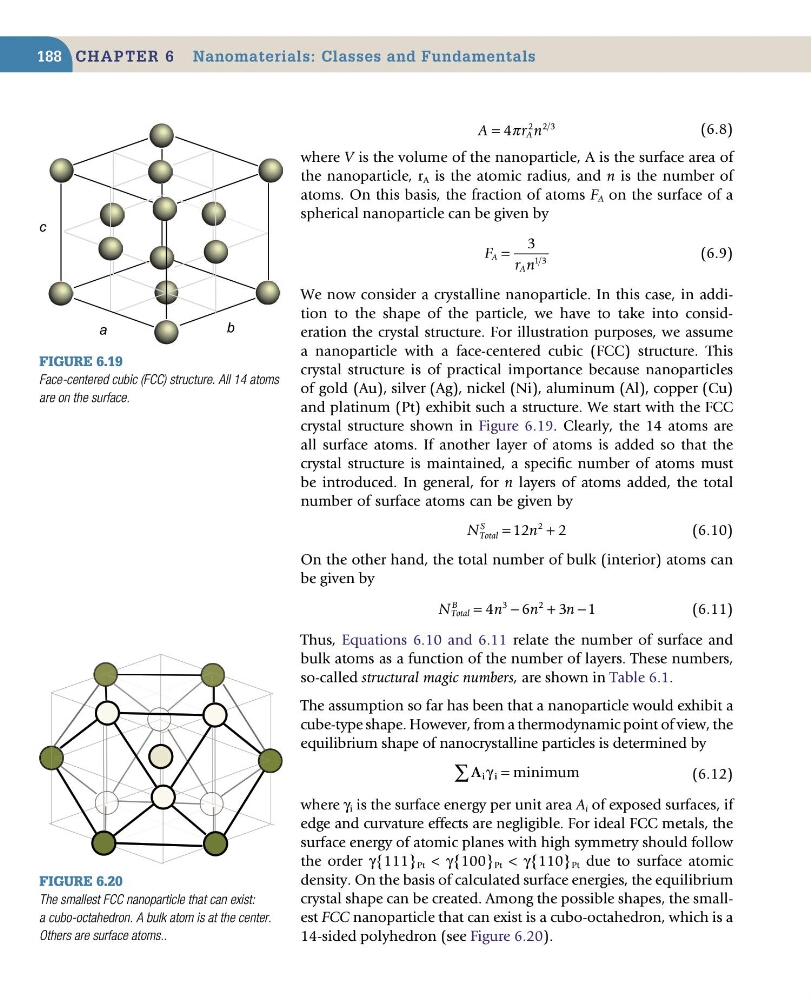
and platinum (Pt) exhibit such a structure. We start with the FCC
crystal structure shown in Figure 6.19. Clearly, the 14 atoms are
all surface atoms. If another layer of atoms is added so that the
crystal structure is maintained, a specific number of atoms must
be introduced. In general, for n layers of atoms added, the total
number of surface atoms can be given by
N
n
Total
S
=
+
12
2
2
(6.10)
On the other hand, the total number of bulk (interior) atoms can
be given by
N
n
n
n
Total
B
=
−
+ −
4
6
3 1
3
2
(6.11)
Thus, Equations 6.10 and 6.11 relate the number of surface and
bulk atoms as a function of the number of layers. These numbers,
so-called structural magic numbers, are shown in Table 6.1.
The assumption so far has been that a nanoparticle would exhibit a
cube-type shape. However, from a thermodynamic point of view, the
equilibrium shape of nanocrystalline particles is determined by
A i i
γ
∑
= minimum
(6.12)
where γ i is the surface energy per unit area A i of exposed surfaces, if
edge and curvature effects are negligible. For ideal FCC metals, the
surface energy of atomic planes with high symmetry should follow
the order γ{111} Pt < γ{100} Pt < γ{110} Pt due to surface atomic
density. On the basis of calculated surface energies, the equilibrium
crystal shape can be created. Among the possible shapes, the smallest FCC nanoparticle that can exist is a cubo-octahedron, which is a
14-sided polyhedron (see Figure 6.20).
Figure 6.19
Face-centered cubic (FCC) structure. All 14 atoms
are on the surface.
Figure 6.20
The smallest FCC nanoparticle that can exist:
a cubo-octahedron. A bulk atom is at the center.
Others are surface atoms..
b
a
c
188
A
r n
A
= 4
2 2 3
π
(6.8)
where V is the volume of the nanoparticle, A is the surface area of
the nanoparticle, r A is the atomic radius, and n is the number of
atoms. On this basis, the fraction of atoms F A on the surface of a
spherical nanoparticle can be given by
F r n
A
A
=
3
1 3
(6.9)
We now consider a crystalline nanoparticle. In this case, in addition to the shape of the particle, we have to take into consideration the crystal structure. For illustration purposes, we assume
a nanoparticle with a face-centered cubic (FCC) structure. This
crystal structure is of practical importance because nanoparticles
of gold (Au), silver (Ag), nickel (Ni), aluminum (Al), copper (Cu)
and platinum (Pt) exhibit such a structure. We start with the FCC
crystal structure shown in Figure 6.19. Clearly, the 14 atoms are
all surface atoms. If another layer of atoms is added so that the
crystal structure is maintained, a specific number of atoms must
be introduced. In general, for n layers of atoms added, the total
number of surface atoms can be given by
N
n
Total
S
=
+
12
2
2
(6.10)
On the other hand, the total number of bulk (interior) atoms can
be given by
N
n
n
n
Total
B
=
−
+ −
4
6
3 1
3
2
(6.11)
Thus, Equations 6.10 and 6.11 relate the number of surface and
bulk atoms as a function of the number of layers. These numbers,
so-called structural magic numbers, are shown in Table 6.1.
The assumption so far has been that a nanoparticle would exhibit a
cube-type shape. However, from a thermodynamic point of view, the
equilibrium shape of nanocrystalline particles is determined by
A i i
γ
∑
= minimum
(6.12)
where γ i is the surface energy per unit area A i of exposed surfaces, if
edge and curvature effects are negligible. For ideal FCC metals, the
surface energy of atomic planes with high symmetry should follow
the order γ{111} Pt < γ{100} Pt < γ{110} Pt due to surface atomic
density. On the basis of calculated surface energies, the equilibrium
crystal shape can be created. Among the possible shapes, the smallest FCC nanoparticle that can exist is a cubo-octahedron, which is a
14-sided polyhedron (see Figure 6.20).
Figure 6.19
Face-centered cubic (FCC) structure. All 14 atoms
are on the surface.
Figure 6.20
The smallest FCC nanoparticle that can exist:
a cubo-octahedron. A bulk atom is at the center.
Others are surface atoms..
b
a
c