

179
■ Amorphous or crystalline
■ Single crystalline or polycrystalline
■ Chemically pure or impure
■ Standalone materials or embedded in within another
medium
■ Metallic, ceramic, or polymeric
Two-dimensional nanomaterials are somewhat more difficult to
classify, as we will see later. However, assuming for the time being
the aforementioned definitions for 0-D and 1-D nanomaterials,
2-D nanomaterials are materials in which two of the dimensions
are not confined to the nanoscale. As a result, 2-D nanomaterials
exhibit platelike shapes (see Figure 6.4). Two-dimensional nanomaterials include nanofilms, nanolayers, and nanocoatings. These
nanomaterials can be:
■ Amorphous or crystalline
■ Made up of various chemical compositions
■ Used as a single layer or as multilayer structures
■ Deposited on a substrate
■ Integrated in a surrounding matrix material
■ Metallic, ceramic, or polymeric
Three-dimensional nanomaterials, also known as bulk nanomaterials, are relatively difficult to classify, as we discuss shortly. However,
in keeping with the dimensional parameters we’ve established so
far, it is true to say that bulk nanomaterials are materials that are
not confined to the nanoscale in any dimension. These materials
are thus characterized by having three arbitrarily dimensions above
100 nm (see Figure 6.5). With the introduction of these arbitrary
dimensions, we could certainly ask why these materials are called
nanomaterials at all. The reason for the continued classification of
these materials as nanomaterials is this: Despite their nanoscale
dimensions, these materials possess a nanocrystalline structure or
involve the presence of features at the nanoscale. In terms of nanocrystalline structure, bulk nanomaterials can be composed of a multiple arrangement of nanosize crystals, most typically in different
orientations. With respect to the presence of features at the nanoscale, 3-D nanomaterials can contain dispersions of nanoparticles,
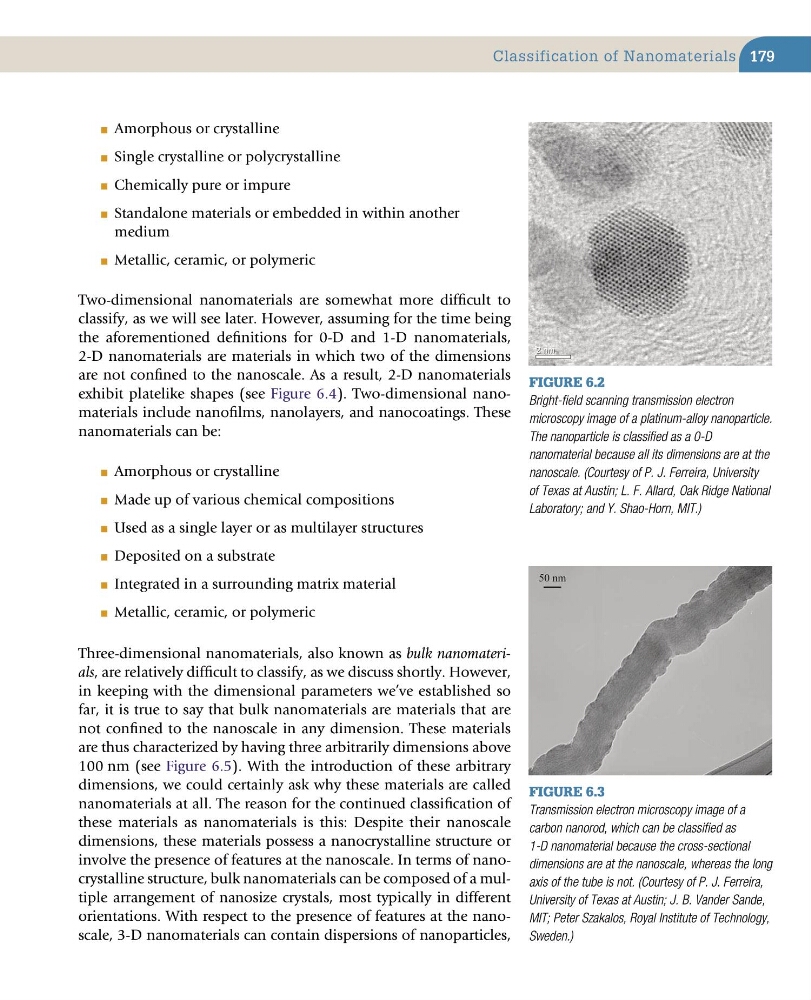
Figure 6.2
Bright-field scanning transmission electron
microscopy image of a platinum-alloy nanoparticle.
The nanoparticle is classified as a 0-D
nanomaterial because all its dimensions are at the
nanoscale. (Courtesy of P. J. Ferreira, University
of Texas at Austin; L. F. Allard, Oak Ridge National
Laboratory; and Y. Shao-Horn, MIT.)
Figure 6.3
Transmission electron microscopy image of a
carbon nanorod, which can be classified as
1-D nanomaterial because the cross-sectional
dimensions are at the nanoscale, whereas the long
axis of the tube is not. (Courtesy of P. J. Ferreira,
University of Texas at Austin; J. B. Vander Sande,
MIT; Peter Szakalos, Royal Institute of Technology,
Sweden.)
Classification of Nanomaterials
■ Amorphous or crystalline
■ Single crystalline or polycrystalline
■ Chemically pure or impure
■ Standalone materials or embedded in within another
medium
■ Metallic, ceramic, or polymeric
Two-dimensional nanomaterials are somewhat more difficult to
classify, as we will see later. However, assuming for the time being
the aforementioned definitions for 0-D and 1-D nanomaterials,
2-D nanomaterials are materials in which two of the dimensions
are not confined to the nanoscale. As a result, 2-D nanomaterials
exhibit platelike shapes (see Figure 6.4). Two-dimensional nanomaterials include nanofilms, nanolayers, and nanocoatings. These
nanomaterials can be:
■ Amorphous or crystalline
■ Made up of various chemical compositions
■ Used as a single layer or as multilayer structures
■ Deposited on a substrate
■ Integrated in a surrounding matrix material
■ Metallic, ceramic, or polymeric
Three-dimensional nanomaterials, also known as bulk nanomaterials, are relatively difficult to classify, as we discuss shortly. However,
in keeping with the dimensional parameters we’ve established so
far, it is true to say that bulk nanomaterials are materials that are
not confined to the nanoscale in any dimension. These materials
are thus characterized by having three arbitrarily dimensions above
100 nm (see Figure 6.5). With the introduction of these arbitrary
dimensions, we could certainly ask why these materials are called
nanomaterials at all. The reason for the continued classification of
these materials as nanomaterials is this: Despite their nanoscale
dimensions, these materials possess a nanocrystalline structure or
involve the presence of features at the nanoscale. In terms of nanocrystalline structure, bulk nanomaterials can be composed of a multiple arrangement of nanosize crystals, most typically in different
orientations. With respect to the presence of features at the nanoscale, 3-D nanomaterials can contain dispersions of nanoparticles,
Figure 6.2
Bright-field scanning transmission electron
microscopy image of a platinum-alloy nanoparticle.
The nanoparticle is classified as a 0-D
nanomaterial because all its dimensions are at the
nanoscale. (Courtesy of P. J. Ferreira, University
of Texas at Austin; L. F. Allard, Oak Ridge National
Laboratory; and Y. Shao-Horn, MIT.)
Figure 6.3
Transmission electron microscopy image of a
carbon nanorod, which can be classified as
1-D nanomaterial because the cross-sectional
dimensions are at the nanoscale, whereas the long
axis of the tube is not. (Courtesy of P. J. Ferreira,
University of Texas at Austin; J. B. Vander Sande,
MIT; Peter Szakalos, Royal Institute of Technology,
Sweden.)
Classification of Nanomaterials