

C hapter 6 nanomaterials: Classes and fundamentals
180
bundles of nanowires, and nanotubes as well as multinanolayers.
Three-dimensional nanomaterials can be:
■ Amorphous or crystalline
■ Chemically pure or impure
■ Composite materials
■ Composed of multinanolayers
■ Metallic, ceramic, or polymeric
This procedure of classification by dimensions allows nanomaterials to be identified and classified in a 3-D space, as shown in Figure
6.6. The distances x, y, and z represent dimensions below 100 nm.
As we look in more detail at the aforementioned categories, the
straightforward nature of 0-D and 1-D nanomaterials speak for
themselves, and we will look at their synthesis, characterization,
properties, and applications in further detail in Chapters 7 and 8.
Yet for us to begin thinking in more detail about 2-D and 3-D nanomaterials, we need a stronger understanding of their classification.
With that in mind, we start by discussing 2-D nanomaterials.
The simplest case of a 2-D nanomaterial looks like the example
given in Figure 6.1. Here the assumption is that the 2-D nanomaterial is a single-layer material, with a thickness below 100 nm and
length and width that exceed nanometer dimensions. However, as
discussed, a material may be categorized as a nanomaterial simply
on the basis of its internal structural dimensions, regardless of its
exterior material dimensions. The inclusion of these internal structural qualifications is part of what makes the classification of 2-D
nanomaterials more complex. In this regard, look at Figure 6.7 for
an example. Here, a 2-D nanomaterial is shown with a particular
internal structure, composed of crystals (or grains) with nanoscale
dimension. This 2-D nanomaterial may be called a nanocrystalline
film because of two features: (1) the material exhibits an overall
exterior thickness with nanoscale dimensions, and (2) its internal structure is also at the nanoscale. Though this example helps
illustrate two possible ways of categorizing of 2-D nanomaterials,
both these restrictions do not need to be in place for the material
to be considered a nanomaterial. In fact, as we see in Figure 6.8,
if the exterior thickness remains at the nanoscale, it is possible for
the same film shown in Figure 6.1 to have a larger (above 100 nm)
internal grain structure and still qualify the entire material as
a nanoscale material. These examples help point out how the
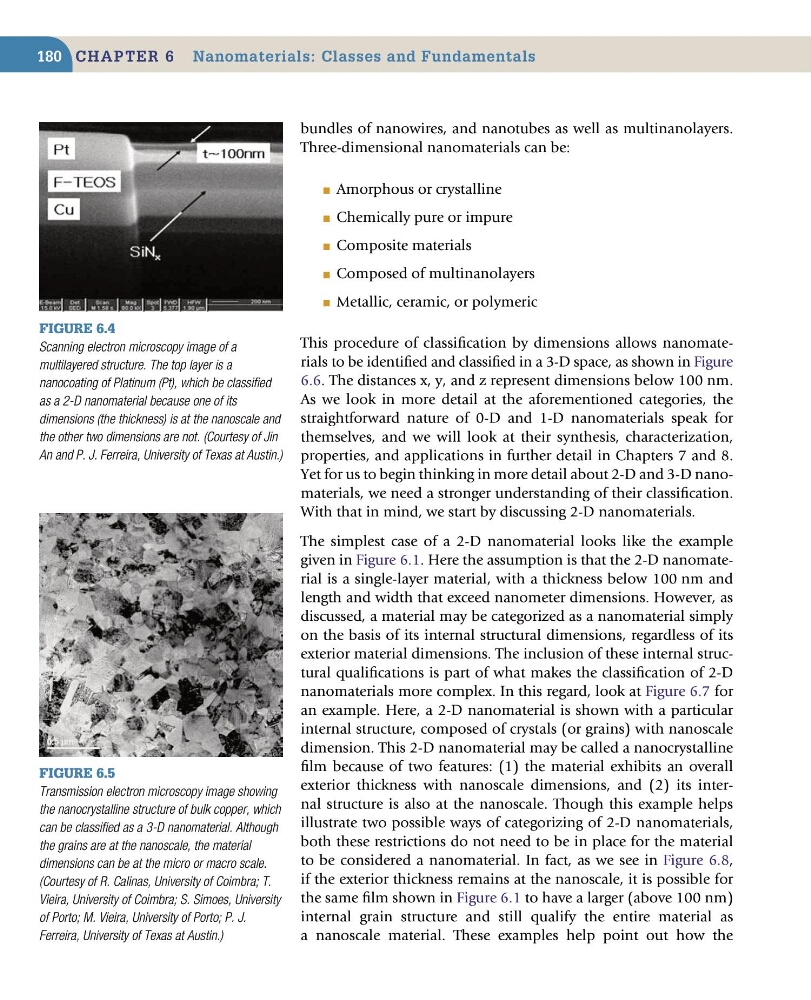
Figure 6.4
Scanning electron microscopy image of a
multilayered structure. The top layer is a
nanocoating of Platinum (Pt), which be classified
as a 2-D nanomaterial because one of its
dimensions (the thickness) is at the nanoscale and
the other two dimensions are not. (Courtesy of Jin
An and P. J. Ferreira, University of Texas at Austin.)
Figure 6.5
Transmission electron microscopy image showing
the nanocrystalline structure of bulk copper, which
can be classified as a 3-D nanomaterial. Although
the grains are at the nanoscale, the material
dimensions can be at the micro or macro scale.
(Courtesy of R. Calinas, University of Coimbra; T.
Vieira, University of Coimbra; S. Simoes, University
of Porto; M. Vieira, University of Porto; P. J.
Ferreira, University of Texas at Austin.)
180
bundles of nanowires, and nanotubes as well as multinanolayers.
Three-dimensional nanomaterials can be:
■ Amorphous or crystalline
■ Chemically pure or impure
■ Composite materials
■ Composed of multinanolayers
■ Metallic, ceramic, or polymeric
This procedure of classification by dimensions allows nanomaterials to be identified and classified in a 3-D space, as shown in Figure
6.6. The distances x, y, and z represent dimensions below 100 nm.
As we look in more detail at the aforementioned categories, the
straightforward nature of 0-D and 1-D nanomaterials speak for
themselves, and we will look at their synthesis, characterization,
properties, and applications in further detail in Chapters 7 and 8.
Yet for us to begin thinking in more detail about 2-D and 3-D nanomaterials, we need a stronger understanding of their classification.
With that in mind, we start by discussing 2-D nanomaterials.
The simplest case of a 2-D nanomaterial looks like the example
given in Figure 6.1. Here the assumption is that the 2-D nanomaterial is a single-layer material, with a thickness below 100 nm and
length and width that exceed nanometer dimensions. However, as
discussed, a material may be categorized as a nanomaterial simply
on the basis of its internal structural dimensions, regardless of its
exterior material dimensions. The inclusion of these internal structural qualifications is part of what makes the classification of 2-D
nanomaterials more complex. In this regard, look at Figure 6.7 for
an example. Here, a 2-D nanomaterial is shown with a particular
internal structure, composed of crystals (or grains) with nanoscale
dimension. This 2-D nanomaterial may be called a nanocrystalline
film because of two features: (1) the material exhibits an overall
exterior thickness with nanoscale dimensions, and (2) its internal structure is also at the nanoscale. Though this example helps
illustrate two possible ways of categorizing of 2-D nanomaterials,
both these restrictions do not need to be in place for the material
to be considered a nanomaterial. In fact, as we see in Figure 6.8,
if the exterior thickness remains at the nanoscale, it is possible for
the same film shown in Figure 6.1 to have a larger (above 100 nm)
internal grain structure and still qualify the entire material as
a nanoscale material. These examples help point out how the
Figure 6.4
Scanning electron microscopy image of a
multilayered structure. The top layer is a
nanocoating of Platinum (Pt), which be classified
as a 2-D nanomaterial because one of its
dimensions (the thickness) is at the nanoscale and
the other two dimensions are not. (Courtesy of Jin
An and P. J. Ferreira, University of Texas at Austin.)
Figure 6.5
Transmission electron microscopy image showing
the nanocrystalline structure of bulk copper, which
can be classified as a 3-D nanomaterial. Although
the grains are at the nanoscale, the material
dimensions can be at the micro or macro scale.
(Courtesy of R. Calinas, University of Coimbra; T.
Vieira, University of Coimbra; S. Simoes, University
of Porto; M. Vieira, University of Porto; P. J.
Ferreira, University of Texas at Austin.)