

C haPter 5 Material Property Charts and their Uses
152
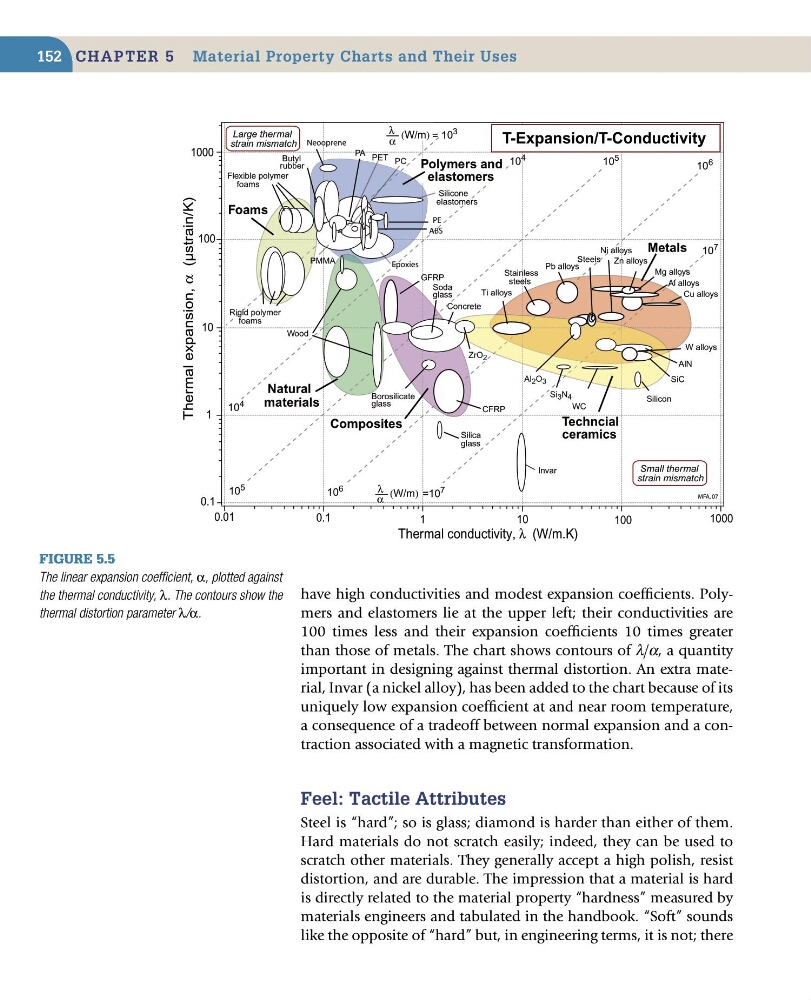
have high conductivities and modest expansion coefficients. Polymers and elastomers lie at the upper left; their conductivities are
100 times less and their expansion coefficients 10 times greater
than those of metals. The chart shows contours of λ/α, a quantity
important in designing against thermal distortion. An extra material, Invar (a nickel alloy), has been added to the chart because of its
uniquely low expansion coefficient at and near room temperature,
a consequence of a tradeoff between normal expansion and a contraction associated with a magnetic transformation.
Feel: tactile attributes
Steel is “hard”; so is glass; diamond is harder than either of them.
Hard materials do not scratch easily; indeed, they can be used to
scratch other materials. They generally accept a high polish, resist
distortion, and are durable. The impression that a material is hard
is directly related to the material property “hardness” measured by
materials engineers and tabulated in the handbook. “Soft” sounds
like the opposite of “hard” but, in engineering terms, it is not; there
Figure 5.5
The linear expansion coefficient, α, plotted against
the thermal conductivity, λ. The contours show the
thermal distortion parameter λ/α.
Thermal conductivity, λ (W/m.K)
0.01
Thermal expansion,
α (µstrain/K)
0.1
1
0.1
10
100
1000
1
10
100
1000
= 10
3
Large thermal
strain mismatch
Small thermal
strain mismatch
λ
α
(W/m)
λ
α
(W/m)
10
4
10 5
10 6
10
6
10 7
=10 7
10
4
10
5
Foams
Polymers and
elastomers
Metals
Techncial
ceramics
Composites
Natural
materials
W alloys
Steels
Ti alloys
Mg alloys
CFRP
GFRP
Al alloys
Rigid polymer
foams
Flexible polymer
foams
Ni alloys
Cu alloys
Zn alloys
PA
PMMA
PC
PET
Wood
Butyl
rubber
Silicone
elastomers
Concrete
WC
Al 2 O 3
SiC
Si 3 N 4
T-Expansion/T-Conductivity
Pb alloys
Stainless
steels
Silica
glass
Silicon
AlN
Soda
glass
Neooprene
PE
Epoxies
ABS
E
MFA, 07
Invar
Borosilicate
glass
ZrO 2
152
have high conductivities and modest expansion coefficients. Polymers and elastomers lie at the upper left; their conductivities are
100 times less and their expansion coefficients 10 times greater
than those of metals. The chart shows contours of λ/α, a quantity
important in designing against thermal distortion. An extra material, Invar (a nickel alloy), has been added to the chart because of its
uniquely low expansion coefficient at and near room temperature,
a consequence of a tradeoff between normal expansion and a contraction associated with a magnetic transformation.
Feel: tactile attributes
Steel is “hard”; so is glass; diamond is harder than either of them.
Hard materials do not scratch easily; indeed, they can be used to
scratch other materials. They generally accept a high polish, resist
distortion, and are durable. The impression that a material is hard
is directly related to the material property “hardness” measured by
materials engineers and tabulated in the handbook. “Soft” sounds
like the opposite of “hard” but, in engineering terms, it is not; there
Figure 5.5
The linear expansion coefficient, α, plotted against
the thermal conductivity, λ. The contours show the
thermal distortion parameter λ/α.
Thermal conductivity, λ (W/m.K)
0.01
Thermal expansion,
α (µstrain/K)
0.1
1
0.1
10
100
1000
1
10
100
1000
= 10
3
Large thermal
strain mismatch
Small thermal
strain mismatch
λ
α
(W/m)
λ
α
(W/m)
10
4
10 5
10 6
10
6
10 7
=10 7
10
4
10
5
Foams
Polymers and
elastomers
Metals
Techncial
ceramics
Composites
Natural
materials
W alloys
Steels
Ti alloys
Mg alloys
CFRP
GFRP
Al alloys
Rigid polymer
foams
Flexible polymer
foams
Ni alloys
Cu alloys
Zn alloys
PA
PMMA
PC
PET
Wood
Butyl
rubber
Silicone
elastomers
Concrete
WC
Al 2 O 3
SiC
Si 3 N 4
T-Expansion/T-Conductivity
Pb alloys
Stainless
steels
Silica
glass
Silicon
AlN
Soda
glass
Neooprene
PE
Epoxies
ABS
E
MFA, 07
Invar
Borosilicate
glass
ZrO 2