

153
is no engineering property called softness. A soft material deflects
when handled, it gives a little, it is squashy, but when it is released
it returns to its original shape. This is elastic (or visco-elastic)
behavior and the material property that has most influence on it is
the modulus, not the hardness. Elastomers (rubbers) feel soft; so
do polymer films; both classes of materials have moduli that are
100 to 10,000 times lower than ordinary “hard” solids. It is this that
makes them feel soft. Hard materials can be made soft by forming
them into shapes in which they bend or twist—hard steel shaped
into soft springs or glass drawn into fibers and woven into cloth, for
instance. To compare the intrinsic softness of materials (as opposed
to the softness acquired by shape), materials must be compared in
the same shape, and then it is the modulus that is the key property.
An appropriate measure of hardness and softness is the product EH.
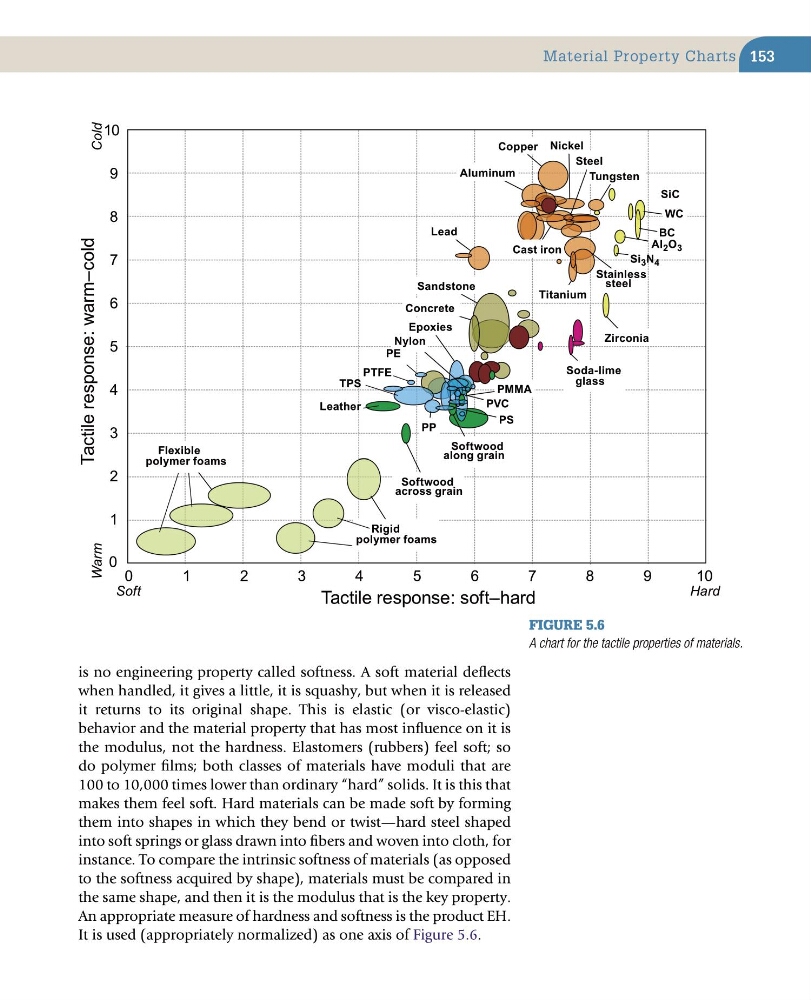
It is used (appropriately normalized) as one axis of Figure 5.6.
Figure 5.6
A chart for the tactile properties of materials.
Copper
Aluminum
Lead
Titanium
Rigid
polymer foams
Flexible
polymer foams
Softwood
across grain
PS
Softwood
along grain
PP
PE
Epoxies
PVC
PMMA
Sandstone
Concrete
Nylon
Leather
TPS
PTFE
Soda-lime
glass
Zirconia
Cast iron
Nickel
Tungsten
Steel
Stainless
steel
Si 3 N 4
Al 2 O 3
BC
WC
SiC
Tactile response: soft–hard
Tactile response: warm–cold
Soft
Hard
Warm
Cold
1
10
2
3
4
5
6
7
8
9
0
1
10
2
3
4
5
6
7
8
9
0
Material Property Charts
is no engineering property called softness. A soft material deflects
when handled, it gives a little, it is squashy, but when it is released
it returns to its original shape. This is elastic (or visco-elastic)
behavior and the material property that has most influence on it is
the modulus, not the hardness. Elastomers (rubbers) feel soft; so
do polymer films; both classes of materials have moduli that are
100 to 10,000 times lower than ordinary “hard” solids. It is this that
makes them feel soft. Hard materials can be made soft by forming
them into shapes in which they bend or twist—hard steel shaped
into soft springs or glass drawn into fibers and woven into cloth, for
instance. To compare the intrinsic softness of materials (as opposed
to the softness acquired by shape), materials must be compared in
the same shape, and then it is the modulus that is the key property.
An appropriate measure of hardness and softness is the product EH.
It is used (appropriately normalized) as one axis of Figure 5.6.
Figure 5.6
A chart for the tactile properties of materials.
Copper
Aluminum
Lead
Titanium
Rigid
polymer foams
Flexible
polymer foams
Softwood
across grain
PS
Softwood
along grain
PP
PE
Epoxies
PVC
PMMA
Sandstone
Concrete
Nylon
Leather
TPS
PTFE
Soda-lime
glass
Zirconia
Cast iron
Nickel
Tungsten
Steel
Stainless
steel
Si 3 N 4
Al 2 O 3
BC
WC
SiC
Tactile response: soft–hard
Tactile response: warm–cold
Soft
Hard
Warm
Cold
1
10
2
3
4
5
6
7
8
9
0
1
10
2
3
4
5
6
7
8
9
0
Material Property Charts