

135
a material, it slows down. The index of refraction, n, is the ratio of its
velocity in vacuum, c o , to that in the material, c:
n
c
c
o
=
(4.51)
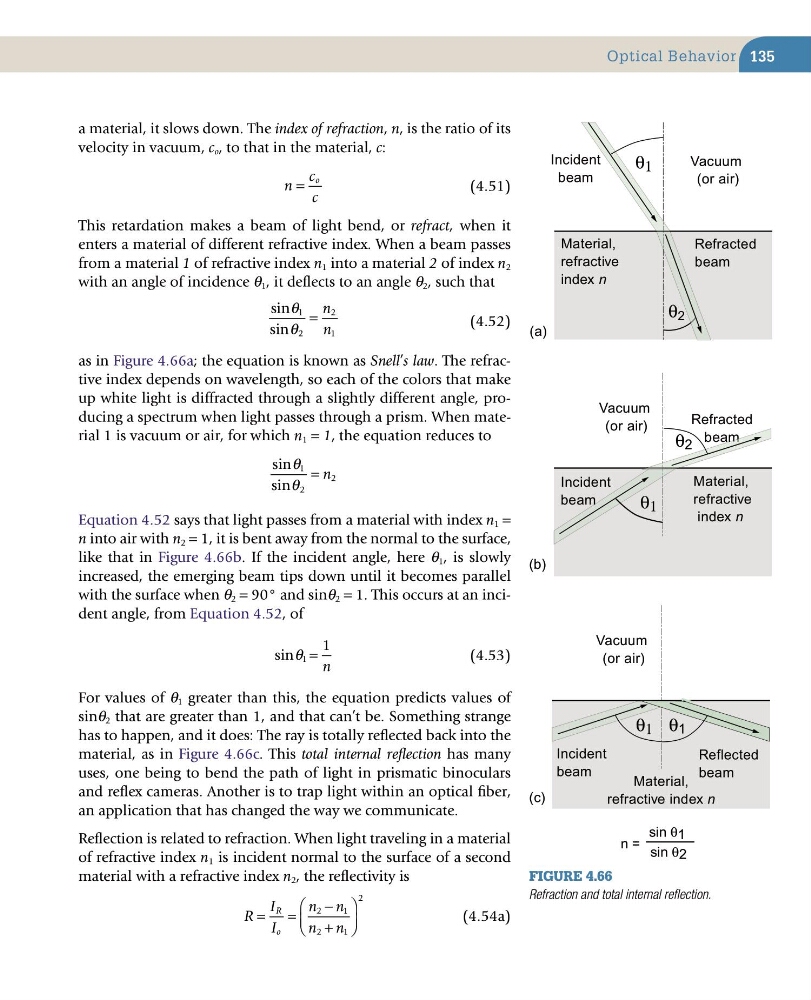
This retardation makes a beam of light bend, or refract, when it
enters a material of different refractive index. When a beam passes
from a material 1 of refractive index n 1 into a material 2 of index n 2
with an angle of incidence θ 1 , it deflects to an angle θ 2 , such that
sin
sin
θ
θ
1
=
2
2
1
n
n
(4.52)
as in Figure 4.66a; the equation is known as Snell’s law. The refractive index depends on wavelength, so each of the colors that make
up white light is diffracted through a slightly different angle, producing a spectrum when light passes through a prism. When material 1 is vacuum or air, for which n 1 = 1, the equation reduces to
sin
sin
θ
θ
1
=
2
2
n
Equation 4.52 says that light passes from a material with index n 1 =
n into air with n 2 = 1, it is bent away from the normal to the surface,
like that in Figure 4.66b. If the incident angle, here θ 1 , is slowly
increased, the emerging beam tips down until it becomes parallel
with the surface when θ 2 = 90° and sinθ 2 = 1. This occurs at an incident angle, from Equation 4.52, of
sinθ 1 =
1
n
(4.53)
For values of θ 1 greater than this, the equation predicts values of
sinθ 2 that are greater than 1, and that can’t be. Something strange
has to happen, and it does: The ray is totally reflected back into the
material, as in Figure 4.66c. This total internal reflection has many
uses, one being to bend the path of light in prismatic binoculars
and reflex cameras. Another is to trap light within an optical fiber,
an application that has changed the way we communicate.
Reflection is related to refraction. When light traveling in a material
of refractive index n 1 is incident normal to the surface of a second
material with a refractive index n 2 , the reflectivity is
R
I
I
n n
n n
R
o
=
=
−
+
2
1
2
1
2
(4.54a)
θ 1
θ 2
Incident
beam
Refracted
beam
Material,
refractive
index n
Vacuum
(or air)
θ 1
Incident
beam
Refracted
beam
Material,
refractive
index n
Vacuum
(or air)
m m m
θ 2
θ 1
Incident
beam
Reflected
beam
Material,
refractive index n
Vacuum
(or air)
θ 1
(a)
(b)
(c)
sin θ 1
sin θ 2
n =
Figure 4.66
Refraction and total internal reflection.
Optical Behavior
a material, it slows down. The index of refraction, n, is the ratio of its
velocity in vacuum, c o , to that in the material, c:
n
c
c
o
=
(4.51)
This retardation makes a beam of light bend, or refract, when it
enters a material of different refractive index. When a beam passes
from a material 1 of refractive index n 1 into a material 2 of index n 2
with an angle of incidence θ 1 , it deflects to an angle θ 2 , such that
sin
sin
θ
θ
1
=
2
2
1
n
n
(4.52)
as in Figure 4.66a; the equation is known as Snell’s law. The refractive index depends on wavelength, so each of the colors that make
up white light is diffracted through a slightly different angle, producing a spectrum when light passes through a prism. When material 1 is vacuum or air, for which n 1 = 1, the equation reduces to
sin
sin
θ
θ
1
=
2
2
n
Equation 4.52 says that light passes from a material with index n 1 =
n into air with n 2 = 1, it is bent away from the normal to the surface,
like that in Figure 4.66b. If the incident angle, here θ 1 , is slowly
increased, the emerging beam tips down until it becomes parallel
with the surface when θ 2 = 90° and sinθ 2 = 1. This occurs at an incident angle, from Equation 4.52, of
sinθ 1 =
1
n
(4.53)
For values of θ 1 greater than this, the equation predicts values of
sinθ 2 that are greater than 1, and that can’t be. Something strange
has to happen, and it does: The ray is totally reflected back into the
material, as in Figure 4.66c. This total internal reflection has many
uses, one being to bend the path of light in prismatic binoculars
and reflex cameras. Another is to trap light within an optical fiber,
an application that has changed the way we communicate.
Reflection is related to refraction. When light traveling in a material
of refractive index n 1 is incident normal to the surface of a second
material with a refractive index n 2 , the reflectivity is
R
I
I
n n
n n
R
o
=
=
−
+
2
1
2
1
2
(4.54a)
θ 1
θ 2
Incident
beam
Refracted
beam
Material,
refractive
index n
Vacuum
(or air)
θ 1
Incident
beam
Refracted
beam
Material,
refractive
index n
Vacuum
(or air)
m m m
θ 2
θ 1
Incident
beam
Reflected
beam
Material,
refractive index n
Vacuum
(or air)
θ 1
(a)
(b)
(c)
sin θ 1
sin θ 2
n =
Figure 4.66
Refraction and total internal reflection.
Optical Behavior