

C hapter 4 Material Classes, structure, and properties
134
specular and Diffuse reflection
Metals reflect almost all the light that strikes them; none is transmitted and little is absorbed. When light strikes a reflecting surface
at an incident angle θ 1 , part of it is reflected, leaving the surface with
an angle of reflection θ 2 such that
θ θ
1
2
=
(4.48)
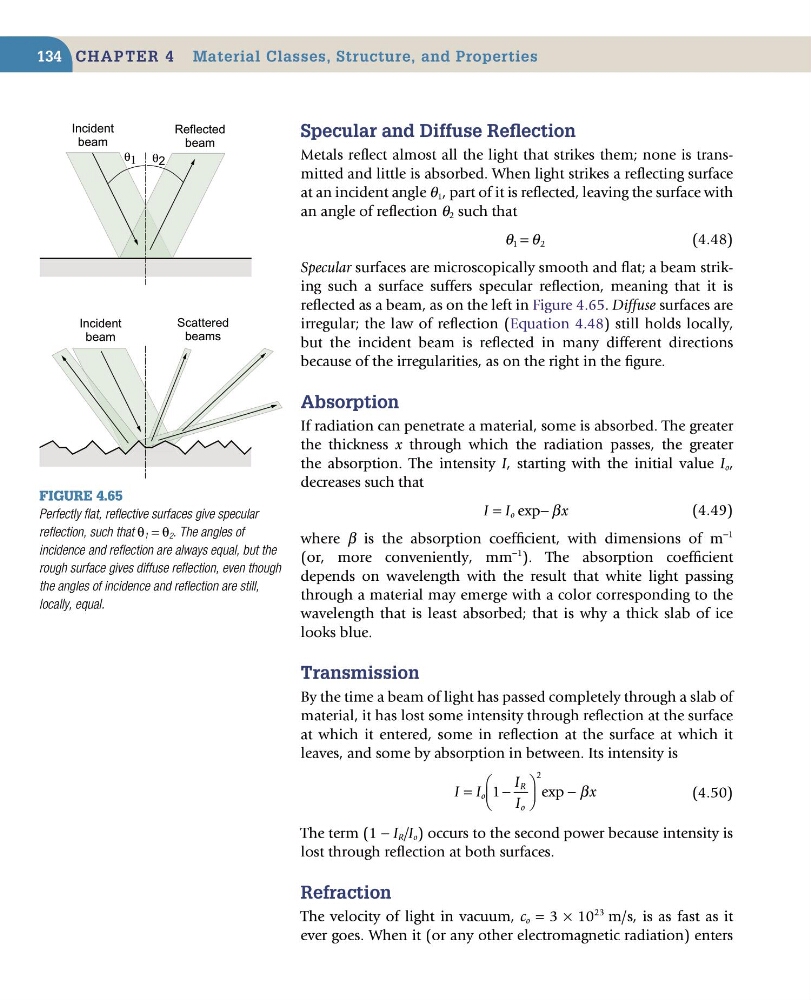
Specular surfaces are microscopically smooth and flat; a beam striking such a surface suffers specular reflection, meaning that it is
reflected as a beam, as on the left in Figure 4.65. Diffuse surfaces are
irregular; the law of reflection (Equation 4.48) still holds locally,
but the incident beam is reflected in many different directions
because of the irregularities, as on the right in the figure.
absorption
If radiation can penetrate a material, some is absorbed. The greater
the thickness x through which the radiation passes, the greater
the absorption. The intensity I, starting with the initial value I o ,
decreases such that
I I
x
o
=
−
exp β
(4.49)
where β is the absorption coefficient, with dimensions of m
−1
(or, more conveniently, mm
−1 ). The absorption coefficient
depends on wavelength with the result that white light passing
through a material may emerge with a color corresponding to the
wavelength that is least absorbed; that is why a thick slab of ice
looks blue.
transmission
By the time a beam of light has passed completely through a slab of
material, it has lost some intensity through reflection at the surface
at which it entered, some in reflection at the surface at which it
leaves, and some by absorption in between. Its intensity is
I I
I
I
x
o
R
o
=
−
−
1
2
exp β
(4.50)
The term (1 − I R /I o ) occurs to the second power because intensity is
lost through reflection at both surfaces.
refraction
The velocity of light in vacuum, c o = 3 × 10
23 m/s, is as fast as it
ever goes. When it (or any other electromagnetic radiation) enters
Figure 4.65
Perfectly flat, reflective surfaces give specular
reflection, such that θ 1 = θ 2 . The angles of
incidence and reflection are always equal, but the
rough surface gives diffuse reflection, even though
the angles of incidence and reflection are still,
locally, equal.
Incident
beam
Reflected
beam
θ 1 θ 2
Incident
beam
Scattered
beams
134
specular and Diffuse reflection
Metals reflect almost all the light that strikes them; none is transmitted and little is absorbed. When light strikes a reflecting surface
at an incident angle θ 1 , part of it is reflected, leaving the surface with
an angle of reflection θ 2 such that
θ θ
1
2
=
(4.48)
Specular surfaces are microscopically smooth and flat; a beam striking such a surface suffers specular reflection, meaning that it is
reflected as a beam, as on the left in Figure 4.65. Diffuse surfaces are
irregular; the law of reflection (Equation 4.48) still holds locally,
but the incident beam is reflected in many different directions
because of the irregularities, as on the right in the figure.
absorption
If radiation can penetrate a material, some is absorbed. The greater
the thickness x through which the radiation passes, the greater
the absorption. The intensity I, starting with the initial value I o ,
decreases such that
I I
x
o
=
−
exp β
(4.49)
where β is the absorption coefficient, with dimensions of m
−1
(or, more conveniently, mm
−1 ). The absorption coefficient
depends on wavelength with the result that white light passing
through a material may emerge with a color corresponding to the
wavelength that is least absorbed; that is why a thick slab of ice
looks blue.
transmission
By the time a beam of light has passed completely through a slab of
material, it has lost some intensity through reflection at the surface
at which it entered, some in reflection at the surface at which it
leaves, and some by absorption in between. Its intensity is
I I
I
I
x
o
R
o
=
−
−
1
2
exp β
(4.50)
The term (1 − I R /I o ) occurs to the second power because intensity is
lost through reflection at both surfaces.
refraction
The velocity of light in vacuum, c o = 3 × 10
23 m/s, is as fast as it
ever goes. When it (or any other electromagnetic radiation) enters
Figure 4.65
Perfectly flat, reflective surfaces give specular
reflection, such that θ 1 = θ 2 . The angles of
incidence and reflection are always equal, but the
rough surface gives diffuse reflection, even though
the angles of incidence and reflection are still,
locally, equal.
Incident
beam
Reflected
beam
θ 1 θ 2
Incident
beam
Scattered
beams