

133
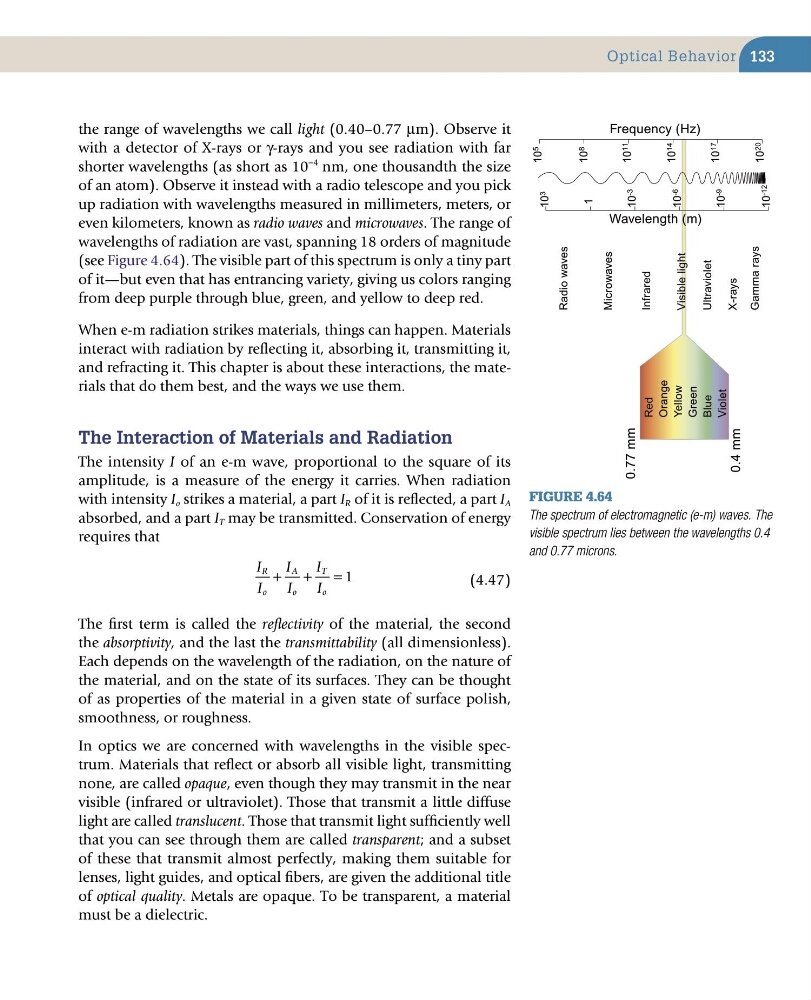
the range of wavelengths we call light (0.40–0.77 µm). Observe it
with a detector of X-rays or γ-rays and you see radiation with far
shorter wavelengths (as short as 10
−4 nm, one thousandth the size
of an atom). Observe it instead with a radio telescope and you pick
up radiation with wavelengths measured in millimeters, meters, or
even kilometers, known as radio waves and microwaves. The range of
wavelengths of radiation are vast, spanning 18 orders of magnitude
(see Figure 4.64). The visible part of this spectrum is only a tiny part
of it—but even that has entrancing variety, giving us colors ranging
from deep purple through blue, green, and yellow to deep red.
When e-m radiation strikes materials, things can happen. Materials
interact with radiation by reflecting it, absorbing it, transmitting it,
and refracting it. This chapter is about these interactions, the materials that do them best, and the ways we use them.
the interaction of Materials and radiation
The intensity I of an e-m wave, proportional to the square of its
amplitude, is a measure of the energy it carries. When radiation
with intensity I o strikes a material, a part I R of it is reflected, a part I A
absorbed, and a part I T may be transmitted. Conservation of energy
requires that
I
I
I
I
I
I
R
o
A
o
T
o
+ + = 1
(4.47)
The first term is called the reflectivity of the material, the second
the absorptivity, and the last the transmittability (all dimensionless).
Each depends on the wavelength of the radiation, on the nature of
the material, and on the state of its surfaces. They can be thought
of as properties of the material in a given state of surface polish,
smoothness, or roughness.
In optics we are concerned with wavelengths in the visible spectrum. Materials that reflect or absorb all visible light, transmitting
none, are called opaque, even though they may transmit in the near
visible (infrared or ultraviolet). Those that transmit a little diffuse
light are called translucent. Those that transmit light sufficiently well
that you can see through them are called transparent; and a subset
of these that transmit almost perfectly, making them suitable for
lenses, light guides, and optical fibers, are given the additional title
of optical quality. Metals are opaque. To be transparent, a material
must be a dielectric.
Figure 4.64
The spectrum of electromagnetic (e-m) waves. The
visible spectrum lies between the wavelengths 0.4
and 0.77 microns.
Frequency (Hz)
10 20
10 17
10 11
10 14
10 8
10 5
Wavelength (m)
10 3
1
10 -3
10 -6
10 -9
10 -12
Radio waves
Microwaves
Infrared
Visible light
Ultraviolet
X-rays
Gamma rays
0.77 mm
0.4 mm
Red
Orange
Yellow
Green
Blue
Violet
Optical Behavior
the range of wavelengths we call light (0.40–0.77 µm). Observe it
with a detector of X-rays or γ-rays and you see radiation with far
shorter wavelengths (as short as 10
−4 nm, one thousandth the size
of an atom). Observe it instead with a radio telescope and you pick
up radiation with wavelengths measured in millimeters, meters, or
even kilometers, known as radio waves and microwaves. The range of
wavelengths of radiation are vast, spanning 18 orders of magnitude
(see Figure 4.64). The visible part of this spectrum is only a tiny part
of it—but even that has entrancing variety, giving us colors ranging
from deep purple through blue, green, and yellow to deep red.
When e-m radiation strikes materials, things can happen. Materials
interact with radiation by reflecting it, absorbing it, transmitting it,
and refracting it. This chapter is about these interactions, the materials that do them best, and the ways we use them.
the interaction of Materials and radiation
The intensity I of an e-m wave, proportional to the square of its
amplitude, is a measure of the energy it carries. When radiation
with intensity I o strikes a material, a part I R of it is reflected, a part I A
absorbed, and a part I T may be transmitted. Conservation of energy
requires that
I
I
I
I
I
I
R
o
A
o
T
o
+ + = 1
(4.47)
The first term is called the reflectivity of the material, the second
the absorptivity, and the last the transmittability (all dimensionless).
Each depends on the wavelength of the radiation, on the nature of
the material, and on the state of its surfaces. They can be thought
of as properties of the material in a given state of surface polish,
smoothness, or roughness.
In optics we are concerned with wavelengths in the visible spectrum. Materials that reflect or absorb all visible light, transmitting
none, are called opaque, even though they may transmit in the near
visible (infrared or ultraviolet). Those that transmit a little diffuse
light are called translucent. Those that transmit light sufficiently well
that you can see through them are called transparent; and a subset
of these that transmit almost perfectly, making them suitable for
lenses, light guides, and optical fibers, are given the additional title
of optical quality. Metals are opaque. To be transparent, a material
must be a dielectric.
Figure 4.64
The spectrum of electromagnetic (e-m) waves. The
visible spectrum lies between the wavelengths 0.4
and 0.77 microns.
Frequency (Hz)
10 20
10 17
10 11
10 14
10 8
10 5
Wavelength (m)
10 3
1
10 -3
10 -6
10 -9
10 -12
Radio waves
Microwaves
Infrared
Visible light
Ultraviolet
X-rays
Gamma rays
0.77 mm
0.4 mm
Red
Orange
Yellow
Green
Blue
Violet
Optical Behavior