

C hapter 4 Material Classes, structure, and properties
132
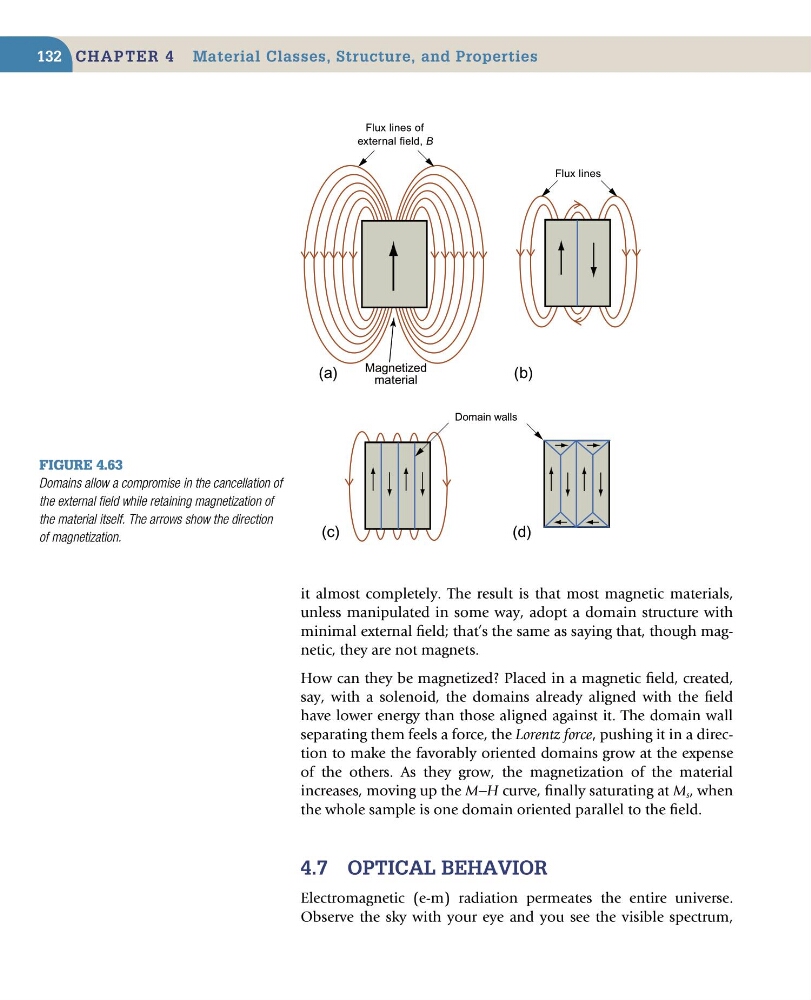
it almost completely. The result is that most magnetic materials,
unless manipulated in some way, adopt a domain structure with
minimal external field; that’s the same as saying that, though magnetic, they are not magnets.
How can they be magnetized? Placed in a magnetic field, created,
say, with a solenoid, the domains already aligned with the field
have lower energy than those aligned against it. The domain wall
separating them feels a force, the Lorentz force, pushing it in a direction to make the favorably oriented domains grow at the expense
of the others. As they grow, the magnetization of the material
increases, moving up the M−H curve, finally saturating at M s , when
the whole sample is one domain oriented parallel to the field.
4.7 optiCal Behavior
Electromagnetic (e-m) radiation permeates the entire universe.
Observe the sky with your eye and you see the visible spectrum,
Flux lines of
external field, B
Magnetized
material
Flux lines
(a)
(b)
Domain walls
(d)
(c)
Figure 4.63
Domains allow a compromise in the cancellation of
the external field while retaining magnetization of
the material itself. The arrows show the direction
of magnetization.
132
it almost completely. The result is that most magnetic materials,
unless manipulated in some way, adopt a domain structure with
minimal external field; that’s the same as saying that, though magnetic, they are not magnets.
How can they be magnetized? Placed in a magnetic field, created,
say, with a solenoid, the domains already aligned with the field
have lower energy than those aligned against it. The domain wall
separating them feels a force, the Lorentz force, pushing it in a direction to make the favorably oriented domains grow at the expense
of the others. As they grow, the magnetization of the material
increases, moving up the M−H curve, finally saturating at M s , when
the whole sample is one domain oriented parallel to the field.
4.7 optiCal Behavior
Electromagnetic (e-m) radiation permeates the entire universe.
Observe the sky with your eye and you see the visible spectrum,
Flux lines of
external field, B
Magnetized
material
Flux lines
(a)
(b)
Domain walls
(d)
(c)
Figure 4.63
Domains allow a compromise in the cancellation of
the external field while retaining magnetization of
the material itself. The arrows show the direction
of magnetization.