

131
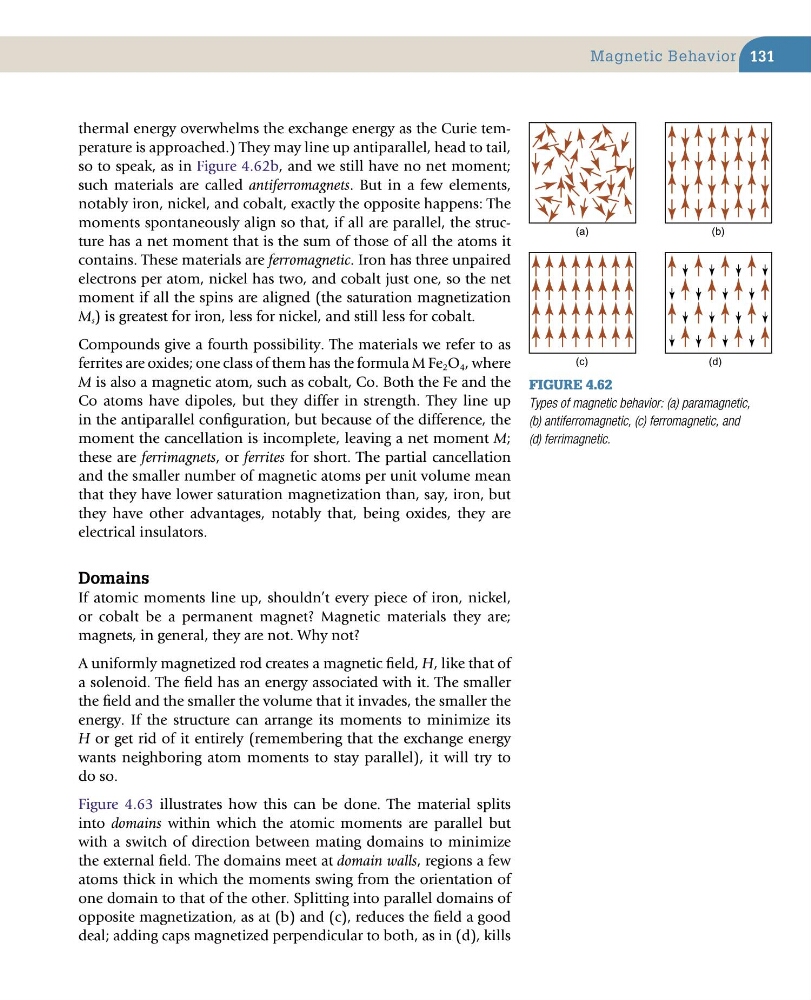
thermal energy overwhelms the exchange energy as the Curie temperature is approached.) They may line up antiparallel, head to tail,
so to speak, as in Figure 4.62b, and we still have no net moment;
such materials are called antiferromagnets. But in a few elements,
notably iron, nickel, and cobalt, exactly the opposite happens: The
moments spontaneously align so that, if all are parallel, the structure has a net moment that is the sum of those of all the atoms it
contains. These materials are ferromagnetic. Iron has three unpaired
electrons per atom, nickel has two, and cobalt just one, so the net
moment if all the spins are aligned (the saturation magnetization
M s ) is greatest for iron, less for nickel, and still less for cobalt.
Compounds give a fourth possibility. The materials we refer to as
ferrites are oxides; one class of them has the formula M Fe 2 O 4 , where
M is also a magnetic atom, such as cobalt, Co. Both the Fe and the
Co atoms have dipoles, but they differ in strength. They line up
in the antiparallel configuration, but because of the difference, the
moment the cancellation is incomplete, leaving a net moment M;
these are ferrimagnets, or ferrites for short. The partial cancellation
and the smaller number of magnetic atoms per unit volume mean
that they have lower saturation magnetization than, say, iron, but
they have other advantages, notably that, being oxides, they are
electrical insulators.
Domains
If atomic moments line up, shouldn’t every piece of iron, nickel,
or cobalt be a permanent magnet? Magnetic materials they are;
magnets, in general, they are not. Why not?
A uniformly magnetized rod creates a magnetic field, H, like that of
a solenoid. The field has an energy associated with it. The smaller
the field and the smaller the volume that it invades, the smaller the
energy. If the structure can arrange its moments to minimize its
H or get rid of it entirely (remembering that the exchange energy
wants neighboring atom moments to stay parallel), it will try to
do so.
Figure 4.63 illustrates how this can be done. The material splits
into domains within which the atomic moments are parallel but
with a switch of direction between mating domains to minimize
the external field. The domains meet at domain walls, regions a few
atoms thick in which the moments swing from the orientation of
one domain to that of the other. Splitting into parallel domains of
opposite magnetization, as at (b) and (c), reduces the field a good
deal; adding caps magnetized perpendicular to both, as in (d), kills
Figure 4.62
Types of magnetic behavior: (a) paramagnetic,
(b) antiferromagnetic, (c) ferromagnetic, and
(d) ferrimagnetic.
(a)
(b)
(c)
(d)
Magnetic Behavior
thermal energy overwhelms the exchange energy as the Curie temperature is approached.) They may line up antiparallel, head to tail,
so to speak, as in Figure 4.62b, and we still have no net moment;
such materials are called antiferromagnets. But in a few elements,
notably iron, nickel, and cobalt, exactly the opposite happens: The
moments spontaneously align so that, if all are parallel, the structure has a net moment that is the sum of those of all the atoms it
contains. These materials are ferromagnetic. Iron has three unpaired
electrons per atom, nickel has two, and cobalt just one, so the net
moment if all the spins are aligned (the saturation magnetization
M s ) is greatest for iron, less for nickel, and still less for cobalt.
Compounds give a fourth possibility. The materials we refer to as
ferrites are oxides; one class of them has the formula M Fe 2 O 4 , where
M is also a magnetic atom, such as cobalt, Co. Both the Fe and the
Co atoms have dipoles, but they differ in strength. They line up
in the antiparallel configuration, but because of the difference, the
moment the cancellation is incomplete, leaving a net moment M;
these are ferrimagnets, or ferrites for short. The partial cancellation
and the smaller number of magnetic atoms per unit volume mean
that they have lower saturation magnetization than, say, iron, but
they have other advantages, notably that, being oxides, they are
electrical insulators.
Domains
If atomic moments line up, shouldn’t every piece of iron, nickel,
or cobalt be a permanent magnet? Magnetic materials they are;
magnets, in general, they are not. Why not?
A uniformly magnetized rod creates a magnetic field, H, like that of
a solenoid. The field has an energy associated with it. The smaller
the field and the smaller the volume that it invades, the smaller the
energy. If the structure can arrange its moments to minimize its
H or get rid of it entirely (remembering that the exchange energy
wants neighboring atom moments to stay parallel), it will try to
do so.
Figure 4.63 illustrates how this can be done. The material splits
into domains within which the atomic moments are parallel but
with a switch of direction between mating domains to minimize
the external field. The domains meet at domain walls, regions a few
atoms thick in which the moments swing from the orientation of
one domain to that of the other. Splitting into parallel domains of
opposite magnetization, as at (b) and (c), reduces the field a good
deal; adding caps magnetized perpendicular to both, as in (d), kills
Figure 4.62
Types of magnetic behavior: (a) paramagnetic,
(b) antiferromagnetic, (c) ferromagnetic, and
(d) ferrimagnetic.
(a)
(b)
(c)
(d)
Magnetic Behavior