

C hapter 4 Material Classes, structure, and properties
130
magnets, which have thin loops, and hard magnets, which have fat
ones. The coercive field H c (which determines the width of the loop)
of hard magnetic materials such as Alnico is greater by a factor of
about 10
5 than that of soft magnetic materials such as silicon-iron.
the physics of Magnetic Behavior
ferromagnetic atoms
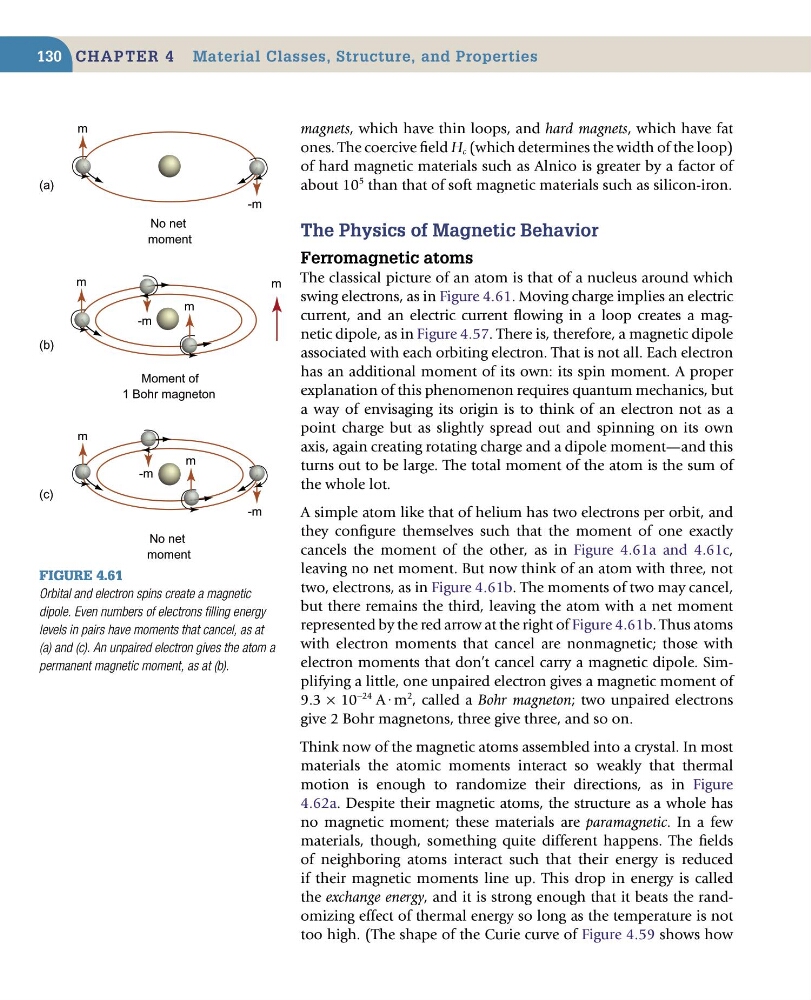
The classical picture of an atom is that of a nucleus around which
swing electrons, as in Figure 4.61. Moving charge implies an electric
current, and an electric current flowing in a loop creates a magnetic dipole, as in Figure 4.57. There is, therefore, a magnetic dipole
associated with each orbiting electron. That is not all. Each electron
has an additional moment of its own: its spin moment. A proper
explanation of this phenomenon requires quantum mechanics, but
a way of envisaging its origin is to think of an electron not as a
point charge but as slightly spread out and spinning on its own
axis, again creating rotating charge and a dipole moment—and this
turns out to be large. The total moment of the atom is the sum of
the whole lot.
A simple atom like that of helium has two electrons per orbit, and
they configure themselves such that the moment of one exactly
cancels the moment of the other, as in Figure 4.61a and 4.61c,
leaving no net moment. But now think of an atom with three, not
two, electrons, as in Figure 4.61b. The moments of two may cancel,
but there remains the third, leaving the atom with a net moment
represented by the red arrow at the right of Figure 4.61b. Thus atoms
with electron moments that cancel are nonmagnetic; those with
electron moments that don’t cancel carry a magnetic dipole. Simplifying a little, one unpaired electron gives a magnetic moment of
9.3 × 10
−24 A·m
2 , called a Bohr magneton; two unpaired electrons
give 2 Bohr magnetons, three give three, and so on.
Think now of the magnetic atoms assembled into a crystal. In most
materials the atomic moments interact so weakly that thermal
motion is enough to randomize their directions, as in Figure
4.62a. Despite their magnetic atoms, the structure as a whole has
no magnetic moment; these materials are paramagnetic. In a few
materials, though, something quite different happens. The fields
of neighboring atoms interact such that their energy is reduced
if their magnetic moments line up. This drop in energy is called
the exchange energy, and it is strong enough that it beats the randomizing effect of thermal energy so long as the temperature is not
too high. (The shape of the Curie curve of Figure 4.59 shows how
Figure 4.61
Orbital and electron spins create a magnetic
dipole. Even numbers of electrons filling energy
levels in pairs have moments that cancel, as at
(a) and (c). An unpaired electron gives the atom a
permanent magnetic moment, as at (b).
m
-m
m
-m
m
-m
m
No net
moment
m
-m
No net
moment
Moment of
1 Bohr magneton
m
(a)
(b)
(c)
130
magnets, which have thin loops, and hard magnets, which have fat
ones. The coercive field H c (which determines the width of the loop)
of hard magnetic materials such as Alnico is greater by a factor of
about 10
5 than that of soft magnetic materials such as silicon-iron.
the physics of Magnetic Behavior
ferromagnetic atoms
The classical picture of an atom is that of a nucleus around which
swing electrons, as in Figure 4.61. Moving charge implies an electric
current, and an electric current flowing in a loop creates a magnetic dipole, as in Figure 4.57. There is, therefore, a magnetic dipole
associated with each orbiting electron. That is not all. Each electron
has an additional moment of its own: its spin moment. A proper
explanation of this phenomenon requires quantum mechanics, but
a way of envisaging its origin is to think of an electron not as a
point charge but as slightly spread out and spinning on its own
axis, again creating rotating charge and a dipole moment—and this
turns out to be large. The total moment of the atom is the sum of
the whole lot.
A simple atom like that of helium has two electrons per orbit, and
they configure themselves such that the moment of one exactly
cancels the moment of the other, as in Figure 4.61a and 4.61c,
leaving no net moment. But now think of an atom with three, not
two, electrons, as in Figure 4.61b. The moments of two may cancel,
but there remains the third, leaving the atom with a net moment
represented by the red arrow at the right of Figure 4.61b. Thus atoms
with electron moments that cancel are nonmagnetic; those with
electron moments that don’t cancel carry a magnetic dipole. Simplifying a little, one unpaired electron gives a magnetic moment of
9.3 × 10
−24 A·m
2 , called a Bohr magneton; two unpaired electrons
give 2 Bohr magnetons, three give three, and so on.
Think now of the magnetic atoms assembled into a crystal. In most
materials the atomic moments interact so weakly that thermal
motion is enough to randomize their directions, as in Figure
4.62a. Despite their magnetic atoms, the structure as a whole has
no magnetic moment; these materials are paramagnetic. In a few
materials, though, something quite different happens. The fields
of neighboring atoms interact such that their energy is reduced
if their magnetic moments line up. This drop in energy is called
the exchange energy, and it is strong enough that it beats the randomizing effect of thermal energy so long as the temperature is not
too high. (The shape of the Curie curve of Figure 4.59 shows how
Figure 4.61
Orbital and electron spins create a magnetic
dipole. Even numbers of electrons filling energy
levels in pairs have moments that cancel, as at
(a) and (c). An unpaired electron gives the atom a
permanent magnetic moment, as at (b).
m
-m
m
-m
m
-m
m
No net
moment
m
-m
No net
moment
Moment of
1 Bohr magneton
m
(a)
(b)
(c)