

129
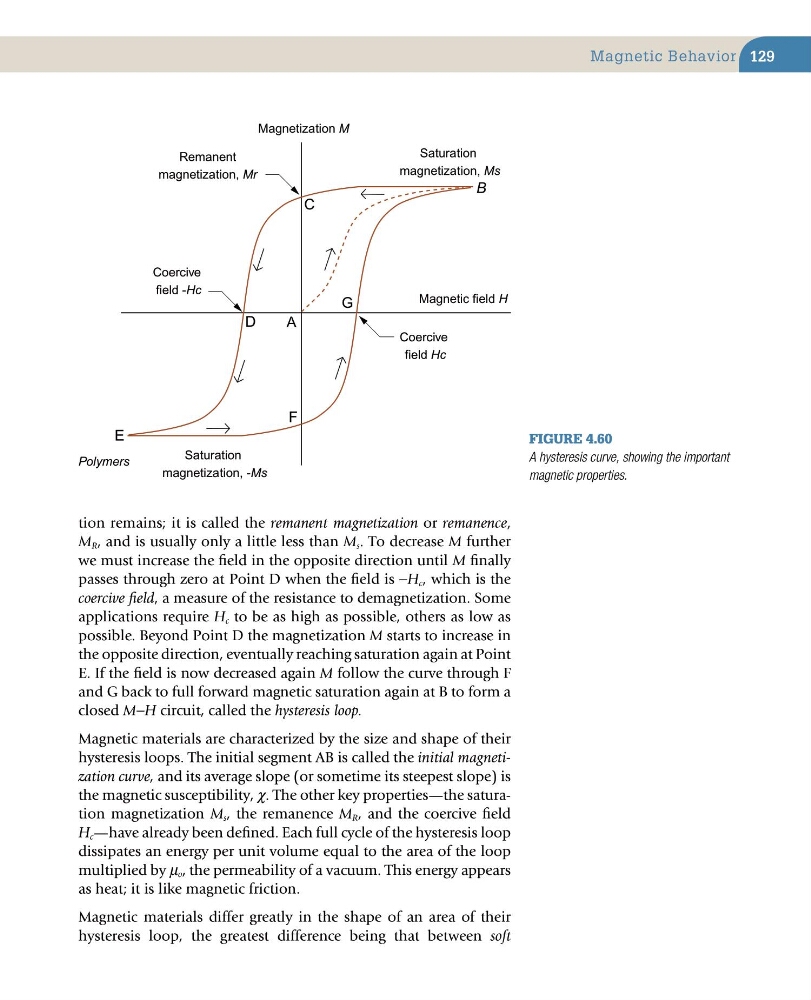
tion remains; it is called the remanent magnetization or remanence,
M R , and is usually only a little less than M s . To decrease M further
we must increase the field in the opposite direction until M finally
passes through zero at Point D when the field is −H c , which is the
coercive field, a measure of the resistance to demagnetization. Some
applications require H c to be as high as possible, others as low as
possible. Beyond Point D the magnetization M starts to increase in
the opposite direction, eventually reaching saturation again at Point
E. If the field is now decreased again M follow the curve through F
and G back to full forward magnetic saturation again at B to form a
closed M−H circuit, called the hysteresis loop.
Magnetic materials are characterized by the size and shape of their
hysteresis loops. The initial segment AB is called the initial magnetization curve, and its average slope (or sometime its steepest slope) is
the magnetic susceptibility, χ. The other key properties—the saturation magnetization M s , the remanence M R , and the coercive field
H c —have already been defined. Each full cycle of the hysteresis loop
dissipates an energy per unit volume equal to the area of the loop
multiplied by µ o , the permeability of a vacuum. This energy appears
as heat; it is like magnetic friction.
Magnetic materials differ greatly in the shape of an area of their
hysteresis loop, the greatest difference being that between soft
Figure 4.60
A hysteresis curve, showing the important
magnetic properties.
Magnetic field H
Magnetization M
Saturation
magnetization, Ms
Coercive
field Hc
Remanent
magnetization, Mr
Coercive
field -Hc
A
B
C
D
E
F
G
Saturation
magnetization, -Ms
Polymers
Magnetic Behavior
tion remains; it is called the remanent magnetization or remanence,
M R , and is usually only a little less than M s . To decrease M further
we must increase the field in the opposite direction until M finally
passes through zero at Point D when the field is −H c , which is the
coercive field, a measure of the resistance to demagnetization. Some
applications require H c to be as high as possible, others as low as
possible. Beyond Point D the magnetization M starts to increase in
the opposite direction, eventually reaching saturation again at Point
E. If the field is now decreased again M follow the curve through F
and G back to full forward magnetic saturation again at B to form a
closed M−H circuit, called the hysteresis loop.
Magnetic materials are characterized by the size and shape of their
hysteresis loops. The initial segment AB is called the initial magnetization curve, and its average slope (or sometime its steepest slope) is
the magnetic susceptibility, χ. The other key properties—the saturation magnetization M s , the remanence M R , and the coercive field
H c —have already been defined. Each full cycle of the hysteresis loop
dissipates an energy per unit volume equal to the area of the loop
multiplied by µ o , the permeability of a vacuum. This energy appears
as heat; it is like magnetic friction.
Magnetic materials differ greatly in the shape of an area of their
hysteresis loop, the greatest difference being that between soft
Figure 4.60
A hysteresis curve, showing the important
magnetic properties.
Magnetic field H
Magnetization M
Saturation
magnetization, Ms
Coercive
field Hc
Remanent
magnetization, Mr
Coercive
field -Hc
A
B
C
D
E
F
G
Saturation
magnetization, -Ms
Polymers
Magnetic Behavior