

C hapter 4 Material Classes, structure, and properties
136
If the incident beam is in air, with refractive index 1, this becomes
R
I
I
n
n
R
o
=
=
−
+
1
1
2
.
(4.54b)
Thus materials with high refractive index have high reflectivity.
Before leaving Snell and his law, ponder for a moment on the odd
fact that the beam is bent at all. Light entering a dielectric, as we
have said, slows down. If that is so, why does it not continue in a
straight line, only more slowly? Why should it bend? To understand
this concept we need Fresnel’s construction. We think of light as
advancing via a series of wave fronts. Every point on a wave front
acts as a source so that, in a time Δt, the front advances by νΔt, where
ν is the velocity of light in the medium through which it is passing
(ν = c in vacuum or air), as shown in Figure 4.67 with wave-front 1
advancing cΔt. When the wave enters a medium of higher refractive
index it slows down so that the advance of the wave front within
the medium is less than that outside, as shown with wave-front 2
advancing νΔt in the figure. If the angle of incidence θ 1 is not zero,
the wave front enters the second medium progressively, causing it
to bend, so that when it is fully in the material it is traveling in a
new direction, characterized by the angle of refraction, θ 2 . Simple
geometry then gives Equation 4.52.
the physics of optical properties
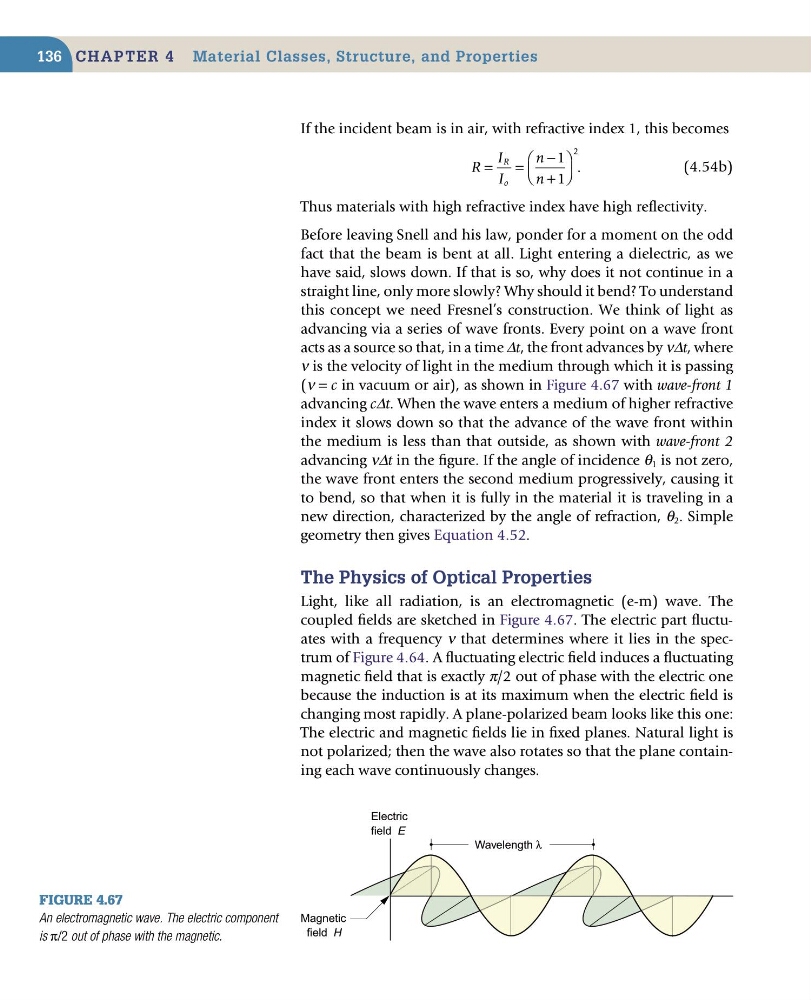
Light, like all radiation, is an electromagnetic (e-m) wave. The
coupled fields are sketched in Figure 4.67. The electric part fluctuates with a frequency ν that determines where it lies in the spectrum of Figure 4.64. A fluctuating electric field induces a fluctuating
magnetic field that is exactly π/2 out of phase with the electric one
because the induction is at its maximum when the electric field is
changing most rapidly. A plane-polarized beam looks like this one:
The electric and magnetic fields lie in fixed planes. Natural light is
not polarized; then the wave also rotates so that the plane containing each wave continuously changes.
Electric
field E
Magnetic
field H
Wavelength λ
Figure 4.67
An electromagnetic wave. The electric component
is π/2 out of phase with the magnetic.
136
If the incident beam is in air, with refractive index 1, this becomes
R
I
I
n
n
R
o
=
=
−
+
1
1
2
.
(4.54b)
Thus materials with high refractive index have high reflectivity.
Before leaving Snell and his law, ponder for a moment on the odd
fact that the beam is bent at all. Light entering a dielectric, as we
have said, slows down. If that is so, why does it not continue in a
straight line, only more slowly? Why should it bend? To understand
this concept we need Fresnel’s construction. We think of light as
advancing via a series of wave fronts. Every point on a wave front
acts as a source so that, in a time Δt, the front advances by νΔt, where
ν is the velocity of light in the medium through which it is passing
(ν = c in vacuum or air), as shown in Figure 4.67 with wave-front 1
advancing cΔt. When the wave enters a medium of higher refractive
index it slows down so that the advance of the wave front within
the medium is less than that outside, as shown with wave-front 2
advancing νΔt in the figure. If the angle of incidence θ 1 is not zero,
the wave front enters the second medium progressively, causing it
to bend, so that when it is fully in the material it is traveling in a
new direction, characterized by the angle of refraction, θ 2 . Simple
geometry then gives Equation 4.52.
the physics of optical properties
Light, like all radiation, is an electromagnetic (e-m) wave. The
coupled fields are sketched in Figure 4.67. The electric part fluctuates with a frequency ν that determines where it lies in the spectrum of Figure 4.64. A fluctuating electric field induces a fluctuating
magnetic field that is exactly π/2 out of phase with the electric one
because the induction is at its maximum when the electric field is
changing most rapidly. A plane-polarized beam looks like this one:
The electric and magnetic fields lie in fixed planes. Natural light is
not polarized; then the wave also rotates so that the plane containing each wave continuously changes.
Electric
field E
Magnetic
field H
Wavelength λ
Figure 4.67
An electromagnetic wave. The electric component
is π/2 out of phase with the magnetic.