

125
the mean-free path. The purer and more perfect the conductor, the
higher the conductivity.
The resistivity of metals increases with temperature because thermal
vibration scatters electrons. Resistance decreases as temperature
falls, which is why very high-powered electromagnets are precooled
in liquid nitrogen. As absolute zero is approached, most metals
retain some resistivity, but a few, at between 0 and 4°K, suddenly
lose all resistance and become superconducting.
Dielectric behavior
Dielectrics are insulators. So what happens to their electrons
when a field E is applied? In zero field, the electrons and protons
in most dielectrics are symmetrically distributed, so the material
carries no net charge or dipole moment. A field exerts a force on
a charge, pushing positive charges in the direction of the field and
negative charges in the opposite direction. The effect is easiest to
see in ionic crystals, since here neighboring ions carry opposite
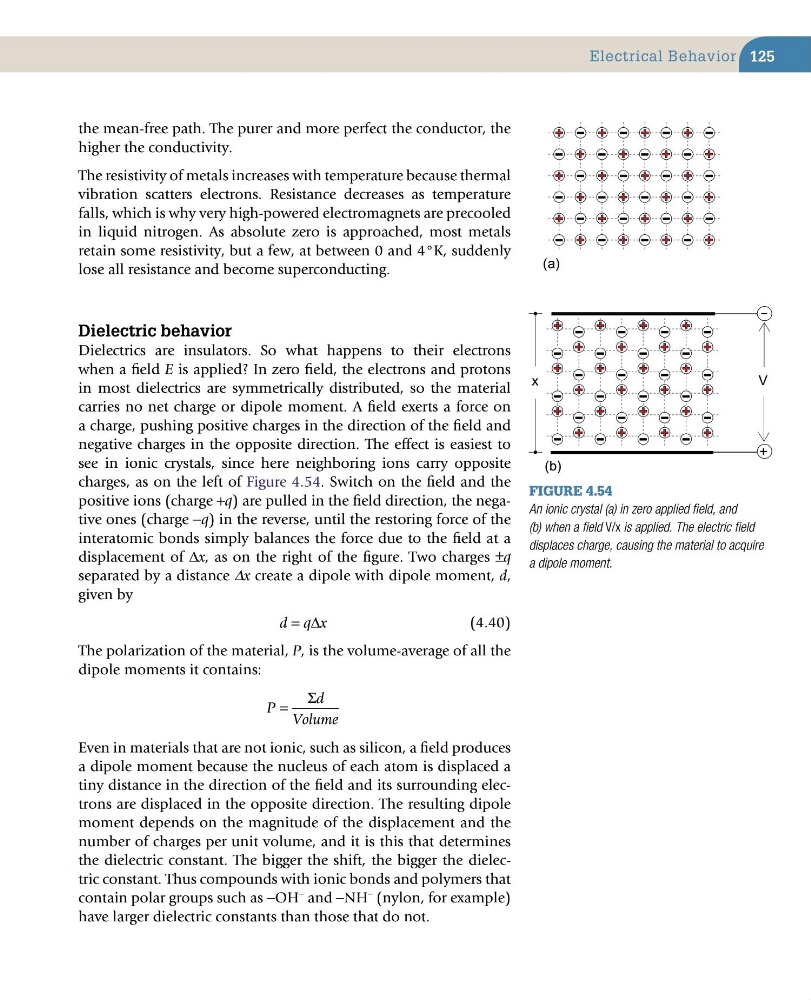
charges, as on the left of Figure 4.54. Switch on the field and the
positive ions (charge +q) are pulled in the field direction, the negative ones (charge −q) in the reverse, until the restoring force of the
interatomic bonds simply balances the force due to the field at a
displacement of Δx, as on the right of the figure. Two charges ±q
separated by a distance Δx create a dipole with dipole moment, d,
given by
d q x
= ∆
(4.40)
The polarization of the material, P, is the volume-average of all the
dipole moments it contains:
P
d
Volume
=
Σ
Even in materials that are not ionic, such as silicon, a field produces
a dipole moment because the nucleus of each atom is displaced a
tiny distance in the direction of the field and its surrounding electrons are displaced in the opposite direction. The resulting dipole
moment depends on the magnitude of the displacement and the
number of charges per unit volume, and it is this that determines
the dielectric constant. The bigger the shift, the bigger the dielectric constant. Thus compounds with ionic bonds and polymers that
contain polar groups such as −OH
− and −NH
− (nylon, for example)
have larger dielectric constants than those that do not.
Figure 4.54
An ionic crystal (a) in zero applied field, and
(b) when a field V/x is applied. The electric field
displaces charge, causing the material to acquire
a dipole moment.
x
+
+
+
+
+
+
+
+
+
+
+
+
+
+
+
+
+
+
+
+
+
+
+
+
+
V
(b)
+
+
+
+
+
+
+
+
+
+
+
+
+
+
+
+
+
+
+
+
+
+
+
+
(a)
Electrical Behavior
the mean-free path. The purer and more perfect the conductor, the
higher the conductivity.
The resistivity of metals increases with temperature because thermal
vibration scatters electrons. Resistance decreases as temperature
falls, which is why very high-powered electromagnets are precooled
in liquid nitrogen. As absolute zero is approached, most metals
retain some resistivity, but a few, at between 0 and 4°K, suddenly
lose all resistance and become superconducting.
Dielectric behavior
Dielectrics are insulators. So what happens to their electrons
when a field E is applied? In zero field, the electrons and protons
in most dielectrics are symmetrically distributed, so the material
carries no net charge or dipole moment. A field exerts a force on
a charge, pushing positive charges in the direction of the field and
negative charges in the opposite direction. The effect is easiest to
see in ionic crystals, since here neighboring ions carry opposite
charges, as on the left of Figure 4.54. Switch on the field and the
positive ions (charge +q) are pulled in the field direction, the negative ones (charge −q) in the reverse, until the restoring force of the
interatomic bonds simply balances the force due to the field at a
displacement of Δx, as on the right of the figure. Two charges ±q
separated by a distance Δx create a dipole with dipole moment, d,
given by
d q x
= ∆
(4.40)
The polarization of the material, P, is the volume-average of all the
dipole moments it contains:
P
d
Volume
=
Σ
Even in materials that are not ionic, such as silicon, a field produces
a dipole moment because the nucleus of each atom is displaced a
tiny distance in the direction of the field and its surrounding electrons are displaced in the opposite direction. The resulting dipole
moment depends on the magnitude of the displacement and the
number of charges per unit volume, and it is this that determines
the dielectric constant. The bigger the shift, the bigger the dielectric constant. Thus compounds with ionic bonds and polymers that
contain polar groups such as −OH
− and −NH
− (nylon, for example)
have larger dielectric constants than those that do not.
Figure 4.54
An ionic crystal (a) in zero applied field, and
(b) when a field V/x is applied. The electric field
displaces charge, causing the material to acquire
a dipole moment.
x
+
+
+
+
+
+
+
+
+
+
+
+
+
+
+
+
+
+
+
+
+
+
+
+
+
V
(b)
+
+
+
+
+
+
+
+
+
+
+
+
+
+
+
+
+
+
+
+
+
+
+
+
(a)
Electrical Behavior