

C hapter 4 Material Classes, structure, and properties
124
barrier to entering the empty states and thus allowing more carriers
to become mobile.
electrical resistance
If a field E exerts a force Ee on an electron, why does it not accelerate
forever, giving a current that continuously increases with time? This
is not what happens; instead, switching on a field causes a current
that almost immediately reaches a steady value. Referring back to
Equations 4.25 and 4.26, the current density i/A is proportional to
the field E
i
A
E
E
e
e
=
=
ρ
κ
(4.38)
where ρ e is the resistivity and κ e , its reciprocal, is the electrical
conductivity.
Broadly speaking, the picture is this: Conduction electrons are free to
move through the solid. Their thermal energy k B T (k B = Boltzmann’s
constant, T = absolute temperature) causes them to move like gas
atoms in all directions. In doing this they collide with scattering
centers, bouncing off in a new direction. Impurity or solute atoms
are particularly effective scattering centers (which is why alloys
always have a higher resistivity than pure metals), but electrons
are scattered also by imperfections such as dislocations and by the
thermal vibration of the atoms themselves. When there is no field,
there is no net transfer of charge in any direction, even though all
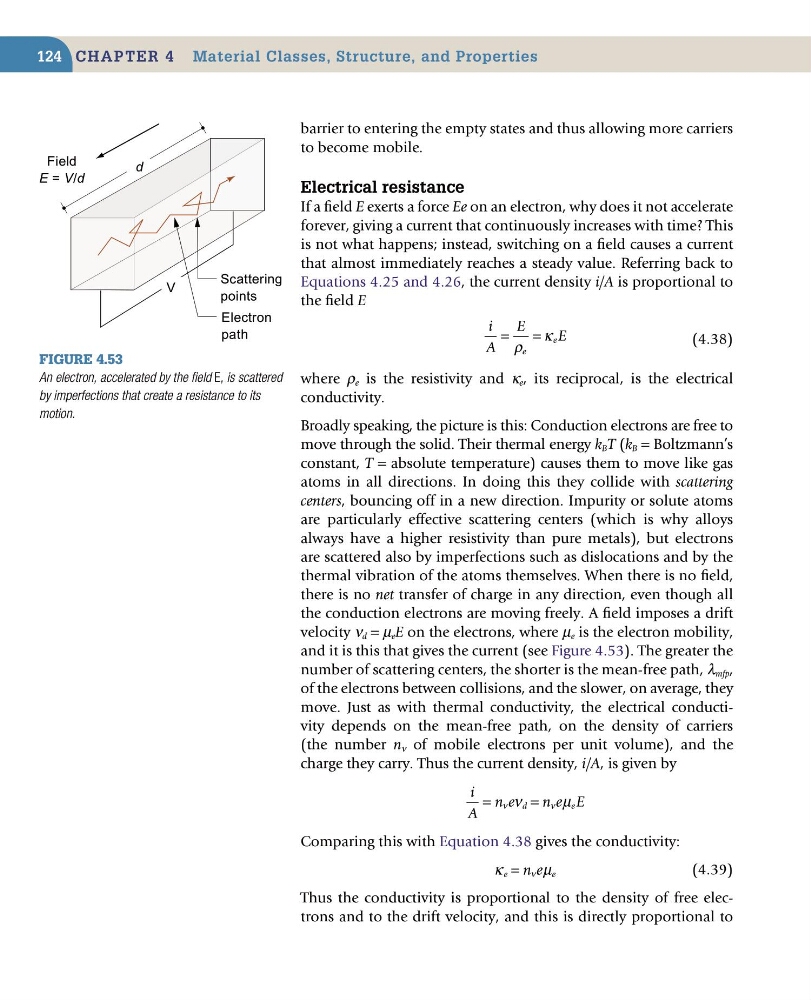
the conduction electrons are moving freely. A field imposes a drift
velocity ν d = µ e E on the electrons, where µ e is the electron mobility,
and it is this that gives the current (see Figure 4.53). The greater the
number of scattering centers, the shorter is the mean-free path, λ mfp ,
of the electrons between collisions, and the slower, on average, they
move. Just as with thermal conductivity, the electrical conductivity depends on the mean-free path, on the density of carriers
(the number n ν of mobile electrons per unit volume), and the
charge they carry. Thus the current density, i/A, is given by
i
A
n e
n e E
d
e
=
=
ν
ν
ν
µ
Comparing this with Equation 4.38 gives the conductivity:
κ
µ
ν
e
e
n e
=
(4.39)
Thus the conductivity is proportional to the density of free electrons and to the drift velocity, and this is directly proportional to
Figure 4.53
An electron, accelerated by the field E, is scattered
by imperfections that create a resistance to its
motion.
V
Field
E = V/d
d
Electron
path
Scattering
points
124
barrier to entering the empty states and thus allowing more carriers
to become mobile.
electrical resistance
If a field E exerts a force Ee on an electron, why does it not accelerate
forever, giving a current that continuously increases with time? This
is not what happens; instead, switching on a field causes a current
that almost immediately reaches a steady value. Referring back to
Equations 4.25 and 4.26, the current density i/A is proportional to
the field E
i
A
E
E
e
e
=
=
ρ
κ
(4.38)
where ρ e is the resistivity and κ e , its reciprocal, is the electrical
conductivity.
Broadly speaking, the picture is this: Conduction electrons are free to
move through the solid. Their thermal energy k B T (k B = Boltzmann’s
constant, T = absolute temperature) causes them to move like gas
atoms in all directions. In doing this they collide with scattering
centers, bouncing off in a new direction. Impurity or solute atoms
are particularly effective scattering centers (which is why alloys
always have a higher resistivity than pure metals), but electrons
are scattered also by imperfections such as dislocations and by the
thermal vibration of the atoms themselves. When there is no field,
there is no net transfer of charge in any direction, even though all
the conduction electrons are moving freely. A field imposes a drift
velocity ν d = µ e E on the electrons, where µ e is the electron mobility,
and it is this that gives the current (see Figure 4.53). The greater the
number of scattering centers, the shorter is the mean-free path, λ mfp ,
of the electrons between collisions, and the slower, on average, they
move. Just as with thermal conductivity, the electrical conductivity depends on the mean-free path, on the density of carriers
(the number n ν of mobile electrons per unit volume), and the
charge they carry. Thus the current density, i/A, is given by
i
A
n e
n e E
d
e
=
=
ν
ν
ν
µ
Comparing this with Equation 4.38 gives the conductivity:
κ
µ
ν
e
e
n e
=
(4.39)
Thus the conductivity is proportional to the density of free electrons and to the drift velocity, and this is directly proportional to
Figure 4.53
An electron, accelerated by the field E, is scattered
by imperfections that create a resistance to its
motion.
V
Field
E = V/d
d
Electron
path
Scattering
points