

123
n atoms (a large number) are brought together to form a solid, the
inner electrons remain the property of the atom on which they
started, but the outer ones interact. Each atom now sits in the field
created by the charges of its neighbors. This has the effect of decreasing slightly the energy levels of electrons spinning in a direction
favored by the field of its neighbors and raising that of those with
spins in the opposite direction, splitting each energy level. Thus the
discrete levels of an isolated atom broaden, in the solid, into bands
of very closely spaced levels. The number of electrons per atom that
have to be accommodated depends only on the atomic number of
the atoms. These electrons fill the bands from the bottom, lowestenergy slot on up, until all are on board, so to speak. The topmost
filled energy level is called the Fermi level. An electron in this level
still has an energy that is lower than it would have been if it were
isolated in a vacuum far from the atoms.
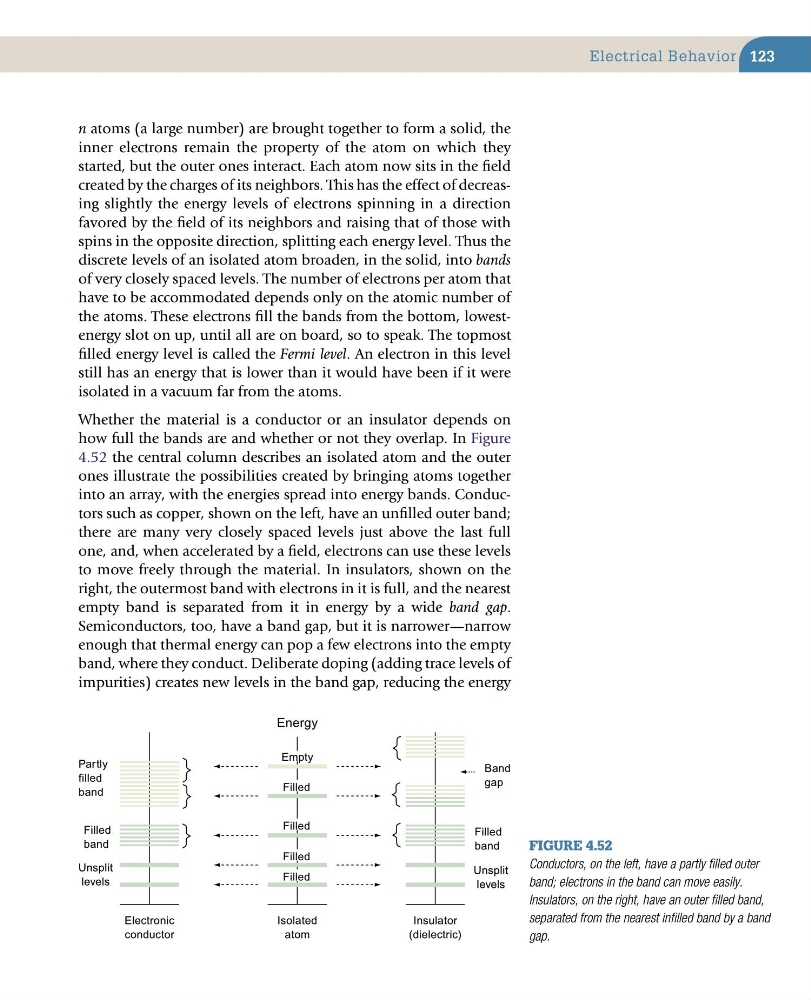
Whether the material is a conductor or an insulator depends on
how full the bands are and whether or not they overlap. In Figure
4.52 the central column describes an isolated atom and the outer
ones illustrate the possibilities created by bringing atoms together
into an array, with the energies spread into energy bands. Conductors such as copper, shown on the left, have an unfilled outer band;
there are many very closely spaced levels just above the last full
one, and, when accelerated by a field, electrons can use these levels
to move freely through the material. In insulators, shown on the
right, the outermost band with electrons in it is full, and the nearest
empty band is separated from it in energy by a wide band gap.
Semiconductors, too, have a band gap, but it is narrower—narrow
enough that thermal energy can pop a few electrons into the empty
band, where they conduct. Deliberate doping (adding trace levels of
impurities) creates new levels in the band gap, reducing the energy
Figure 4.52
Conductors, on the left, have a partly filled outer
band; electrons in the band can move easily.
Insulators, on the right, have an outer filled band,
separated from the nearest infilled band by a band
gap.
Electronic
conductor
Insulator
(dielectric)
Unsplit
levels
Unsplit
levels
Filled
band
Filled
band
Partly
filled
band
Band
gap
Isolated
atom
Energy
Empty
Filled
Filled
Filled
Filled
Electrical Behavior
n atoms (a large number) are brought together to form a solid, the
inner electrons remain the property of the atom on which they
started, but the outer ones interact. Each atom now sits in the field
created by the charges of its neighbors. This has the effect of decreasing slightly the energy levels of electrons spinning in a direction
favored by the field of its neighbors and raising that of those with
spins in the opposite direction, splitting each energy level. Thus the
discrete levels of an isolated atom broaden, in the solid, into bands
of very closely spaced levels. The number of electrons per atom that
have to be accommodated depends only on the atomic number of
the atoms. These electrons fill the bands from the bottom, lowestenergy slot on up, until all are on board, so to speak. The topmost
filled energy level is called the Fermi level. An electron in this level
still has an energy that is lower than it would have been if it were
isolated in a vacuum far from the atoms.
Whether the material is a conductor or an insulator depends on
how full the bands are and whether or not they overlap. In Figure
4.52 the central column describes an isolated atom and the outer
ones illustrate the possibilities created by bringing atoms together
into an array, with the energies spread into energy bands. Conductors such as copper, shown on the left, have an unfilled outer band;
there are many very closely spaced levels just above the last full
one, and, when accelerated by a field, electrons can use these levels
to move freely through the material. In insulators, shown on the
right, the outermost band with electrons in it is full, and the nearest
empty band is separated from it in energy by a wide band gap.
Semiconductors, too, have a band gap, but it is narrower—narrow
enough that thermal energy can pop a few electrons into the empty
band, where they conduct. Deliberate doping (adding trace levels of
impurities) creates new levels in the band gap, reducing the energy
Figure 4.52
Conductors, on the left, have a partly filled outer
band; electrons in the band can move easily.
Insulators, on the right, have an outer filled band,
separated from the nearest infilled band by a band
gap.
Electronic
conductor
Insulator
(dielectric)
Unsplit
levels
Unsplit
levels
Filled
band
Filled
band
Partly
filled
band
Band
gap
Isolated
atom
Energy
Empty
Filled
Filled
Filled
Filled
Electrical Behavior