

C hapter 4 Material Classes, structure, and properties
126
Dielectric loss
Think now of polarization in an alternating electric field. When
the upper plate of Figure 4.54b is negative, the displacements are
in the direction shown in the figure. When its polarity is reversed,
it is the negative ions that are displaced upward, the positive ions
downward; in an oscillating field, the ions oscillate. If their oscillations were exactly in phase with the field, no energy would be
lost, but this is never exactly true, and often the phase shift is
considerable.
Materials with high dielectric loss usually contain awkwardly
shaped molecules that themselves have a dipole moment; a water
molecule is an example. These respond to the oscillating field by
rotating, but because of their shape they interfere with each other
(you could think of it as molecular friction), and this dissipates
energy that appears as heat; that is how microwave heating works.
As Equation 4.38 shows, the energy that is dissipated depends on
the frequency of the electric field; generally speaking, the higher the
frequency, the greater the power dissipated (because power is workper-second, and the more times the molecules shuttle, the more
energy is lost), but there are peaks at certain frequencies that are
characteristic of the material structure.
Dielectric breakdown
In metals, as we have seen, even the smallest field causes electrons
to flow. In insulators they can’t, because of the band gap. But if,
at some weak spot, one electron is torn free from its parent atom,
the force Ee exerted by the field E accelerates it, giving it kinetic
energy; it continues to accelerate until it collides with another
atom. A sufficiently large field can give the electron so much
kinetic energy that, in the collision, it kicks one or more new electrons out of the atom it hits, and they, in turn, are accelerated and
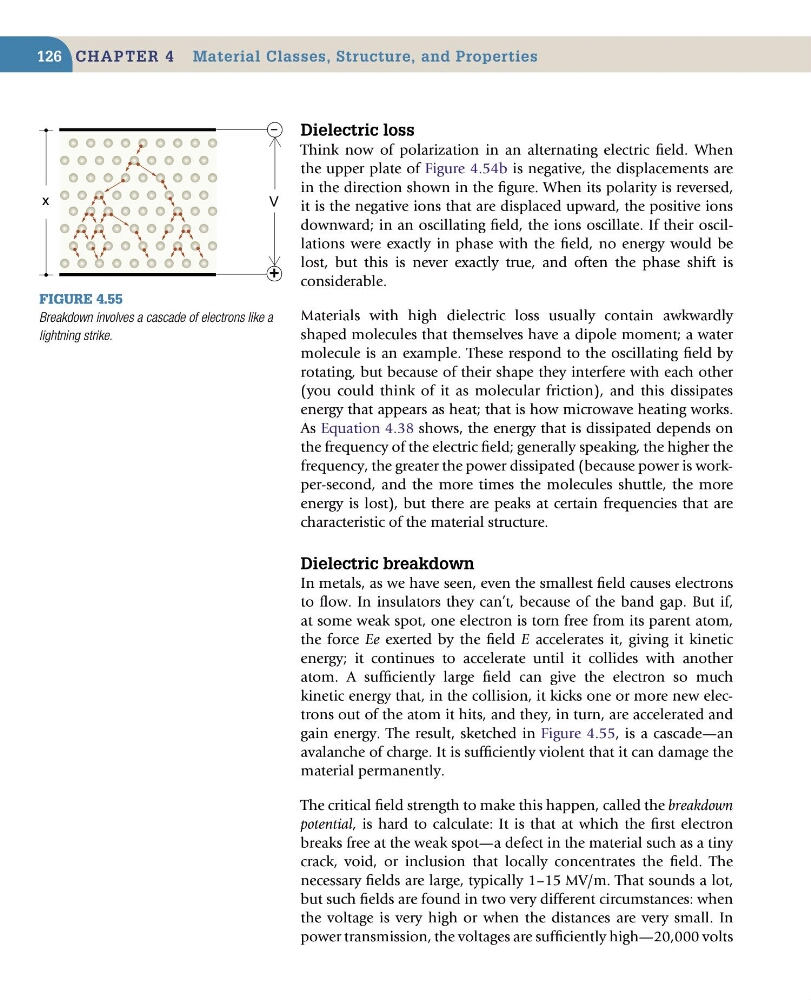
gain energy. The result, sketched in Figure 4.55, is a cascade—an
avalanche of charge. It is sufficiently violent that it can damage the
material permanently.
The critical field strength to make this happen, called the breakdown
potential, is hard to calculate: It is that at which the first electron
breaks free at the weak spot—a defect in the material such as a tiny
crack, void, or inclusion that locally concentrates the field. The
necessary fields are large, typically 1–15 MV/m. That sounds a lot,
but such fields are found in two very different circumstances: when
the voltage is very high or when the distances are very small. In
power transmission, the voltages are sufficiently high—20,000 volts
Figure 4.55
Breakdown involves a cascade of electrons like a
lightning strike.
x
V
+
126
Dielectric loss
Think now of polarization in an alternating electric field. When
the upper plate of Figure 4.54b is negative, the displacements are
in the direction shown in the figure. When its polarity is reversed,
it is the negative ions that are displaced upward, the positive ions
downward; in an oscillating field, the ions oscillate. If their oscillations were exactly in phase with the field, no energy would be
lost, but this is never exactly true, and often the phase shift is
considerable.
Materials with high dielectric loss usually contain awkwardly
shaped molecules that themselves have a dipole moment; a water
molecule is an example. These respond to the oscillating field by
rotating, but because of their shape they interfere with each other
(you could think of it as molecular friction), and this dissipates
energy that appears as heat; that is how microwave heating works.
As Equation 4.38 shows, the energy that is dissipated depends on
the frequency of the electric field; generally speaking, the higher the
frequency, the greater the power dissipated (because power is workper-second, and the more times the molecules shuttle, the more
energy is lost), but there are peaks at certain frequencies that are
characteristic of the material structure.
Dielectric breakdown
In metals, as we have seen, even the smallest field causes electrons
to flow. In insulators they can’t, because of the band gap. But if,
at some weak spot, one electron is torn free from its parent atom,
the force Ee exerted by the field E accelerates it, giving it kinetic
energy; it continues to accelerate until it collides with another
atom. A sufficiently large field can give the electron so much
kinetic energy that, in the collision, it kicks one or more new electrons out of the atom it hits, and they, in turn, are accelerated and
gain energy. The result, sketched in Figure 4.55, is a cascade—an
avalanche of charge. It is sufficiently violent that it can damage the
material permanently.
The critical field strength to make this happen, called the breakdown
potential, is hard to calculate: It is that at which the first electron
breaks free at the weak spot—a defect in the material such as a tiny
crack, void, or inclusion that locally concentrates the field. The
necessary fields are large, typically 1–15 MV/m. That sounds a lot,
but such fields are found in two very different circumstances: when
the voltage is very high or when the distances are very small. In
power transmission, the voltages are sufficiently high—20,000 volts
Figure 4.55
Breakdown involves a cascade of electrons like a
lightning strike.
x
V
+