

C hapter 4 Material Classes, structure, and properties
120
C
A
t
= ε
(4.30)
where ε is the permittivity of the dielectric with the same units as ε o .
It is usual to cite not this but the relative permittivity or dielectric
constant, ε r :
ε
ε
ε
r
with dielectric
no dielectric
o
C
C
=
=
(4.31)
making the capacitance:
C
A
t
r o
= ε ε
(4.32)
Being a ratio, ε r is dimensionless. Its value for empty space and, for
practical purposes, for most gases is 1. Most dielectrics have values
between 2 and 20, though low-density foams approach the value
1 because they are largely air. Ferroelectrics are special: They have
values of ε r as high as 20,000.
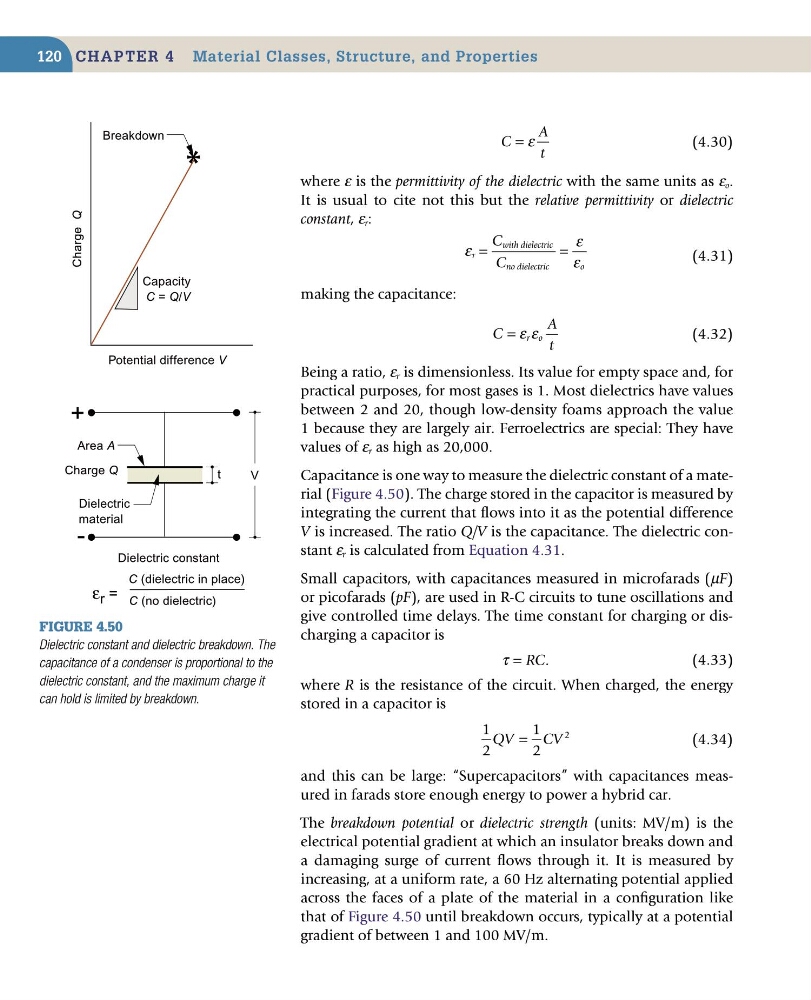
Capacitance is one way to measure the dielectric constant of a material (Figure 4.50). The charge stored in the capacitor is measured by
integrating the current that flows into it as the potential difference
V is increased. The ratio Q/V is the capacitance. The dielectric constant ε r is calculated from Equation 4.31.
Small capacitors, with capacitances measured in microfarads (µF)
or picofarads (pF), are used in R-C circuits to tune oscillations and
give controlled time delays. The time constant for charging or discharging a capacitor is
τ = RC.
(4.33)
where R is the resistance of the circuit. When charged, the energy
stored in a capacitor is
1
2
1
2
2
QV
CV
=
(4.34)
and this can be large: “Supercapacitors” with capacitances measured in farads store enough energy to power a hybrid car.
The breakdown potential or dielectric strength (units: MV/m) is the
electrical potential gradient at which an insulator breaks down and
a damaging surge of current flows through it. It is measured by
increasing, at a uniform rate, a 60 Hz alternating potential applied
across the faces of a plate of the material in a configuration like
that of Figure 4.50 until breakdown occurs, typically at a potential
gradient of between 1 and 100 MV/m.
V
t
Charge Q
Capacity
C = Q/V
Charge Q
Dielectric
material
Dielectric constant
ε r =
C (dielectric in place)
C (no dielectric)
Potential difference V
*
Breakdown
Area A
+
-
Figure 4.50
Dielectric constant and dielectric breakdown. The
capacitance of a condenser is proportional to the
dielectric constant, and the maximum charge it
can hold is limited by breakdown.
120
C
A
t
= ε
(4.30)
where ε is the permittivity of the dielectric with the same units as ε o .
It is usual to cite not this but the relative permittivity or dielectric
constant, ε r :
ε
ε
ε
r
with dielectric
no dielectric
o
C
C
=
=
(4.31)
making the capacitance:
C
A
t
r o
= ε ε
(4.32)
Being a ratio, ε r is dimensionless. Its value for empty space and, for
practical purposes, for most gases is 1. Most dielectrics have values
between 2 and 20, though low-density foams approach the value
1 because they are largely air. Ferroelectrics are special: They have
values of ε r as high as 20,000.
Capacitance is one way to measure the dielectric constant of a material (Figure 4.50). The charge stored in the capacitor is measured by
integrating the current that flows into it as the potential difference
V is increased. The ratio Q/V is the capacitance. The dielectric constant ε r is calculated from Equation 4.31.
Small capacitors, with capacitances measured in microfarads (µF)
or picofarads (pF), are used in R-C circuits to tune oscillations and
give controlled time delays. The time constant for charging or discharging a capacitor is
τ = RC.
(4.33)
where R is the resistance of the circuit. When charged, the energy
stored in a capacitor is
1
2
1
2
2
QV
CV
=
(4.34)
and this can be large: “Supercapacitors” with capacitances measured in farads store enough energy to power a hybrid car.
The breakdown potential or dielectric strength (units: MV/m) is the
electrical potential gradient at which an insulator breaks down and
a damaging surge of current flows through it. It is measured by
increasing, at a uniform rate, a 60 Hz alternating potential applied
across the faces of a plate of the material in a configuration like
that of Figure 4.50 until breakdown occurs, typically at a potential
gradient of between 1 and 100 MV/m.
V
t
Charge Q
Capacity
C = Q/V
Charge Q
Dielectric
material
Dielectric constant
ε r =
C (dielectric in place)
C (no dielectric)
Potential difference V
*
Breakdown
Area A
+
-
Figure 4.50
Dielectric constant and dielectric breakdown. The
capacitance of a condenser is proportional to the
dielectric constant, and the maximum charge it
can hold is limited by breakdown.