

121
The loss tangent and the loss factor take a little more explanation.
Polarization involves the small displacement of charge (either of
electrons or of ions) or of molecules that carry a dipole moment
when an electric field is applied to the material. An oscillating
field drives the charge between two alternative configurations.
This charge-motion is like an electric current that—if there were
no losses—would be 90° out of phase with the voltage. In real
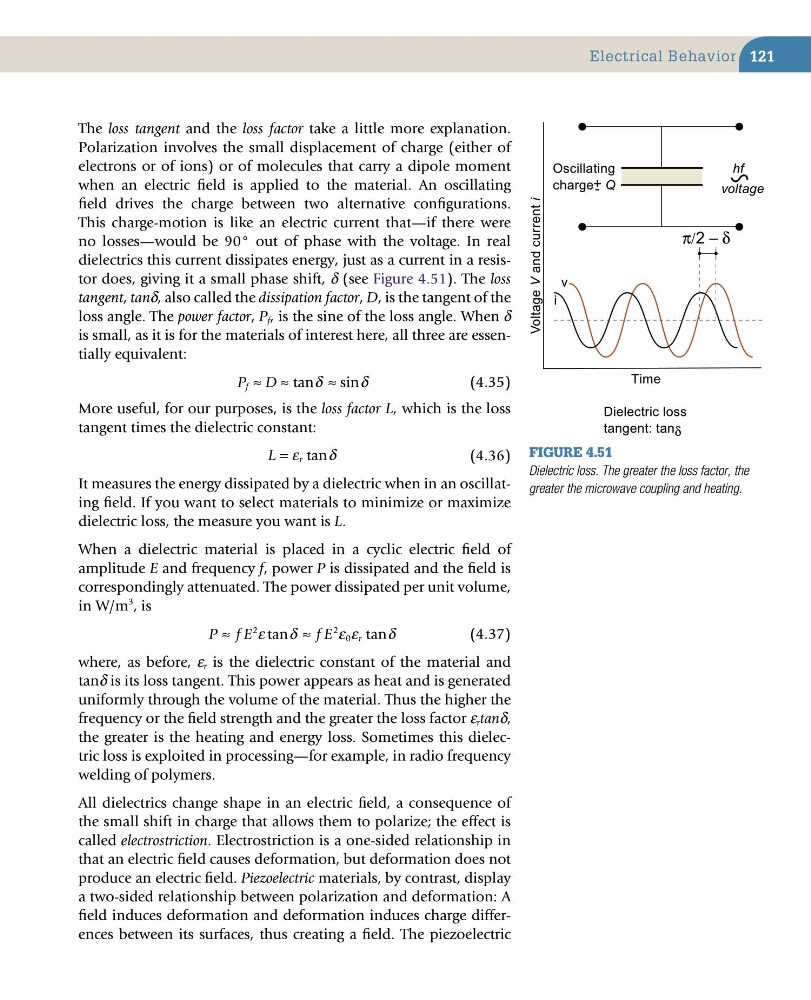
dielectrics this current dissipates energy, just as a current in a resistor does, giving it a small phase shift, δ (see Figure 4.51). The loss
tangent, tanδ, also called the dissipation factor, D, is the tangent of the
loss angle. The power factor, P f , is the sine of the loss angle. When δ
is small, as it is for the materials of interest here, all three are essentially equivalent:
P D
f ≈ ≈
≈
tan
sin
δ
δ
(4.35)
More useful, for our purposes, is the loss factor L, which is the loss
tangent times the dielectric constant:
L
r
= ε
δ
tan
(4.36)
It measures the energy dissipated by a dielectric when in an oscillating field. If you want to select materials to minimize or maximize
dielectric loss, the measure you want is L.
When a dielectric material is placed in a cyclic electric field of
amplitude E and frequency f, power P is dissipated and the field is
correspondingly attenuated. The power dissipated per unit volume,
in W/m
3 , is
P f E
f E
r
≈
≈
2
2
0
ε
δ
ε ε
δ
tan
tan
(4.37)
where, as before, ε r is the dielectric constant of the material and
tanδ is its loss tangent. This power appears as heat and is generated
uniformly through the volume of the material. Thus the higher the
frequency or the field strength and the greater the loss factor ε r tanδ,
the greater is the heating and energy loss. Sometimes this dielectric loss is exploited in processing—for example, in radio frequency
welding of polymers.
All dielectrics change shape in an electric field, a consequence of
the small shift in charge that allows them to polarize; the effect is
called electrostriction. Electrostriction is a one-sided relationship in
that an electric field causes deformation, but deformation does not
produce an electric field. Piezoelectric materials, by contrast, display
a two-sided relationship between polarization and deformation: A
field induces deformation and deformation induces charge differences between its surfaces, thus creating a field. The piezoelectric
Figure 4.51
Dielectric loss. The greater the loss factor, the
greater the microwave coupling and heating.
Voltage V and current i
Dielectric loss
tangent: tan δ
Oscillating
charge Q
hf
voltage
+ -
v
i
π/2 − δ
Time
Electrical Behavior
The loss tangent and the loss factor take a little more explanation.
Polarization involves the small displacement of charge (either of
electrons or of ions) or of molecules that carry a dipole moment
when an electric field is applied to the material. An oscillating
field drives the charge between two alternative configurations.
This charge-motion is like an electric current that—if there were
no losses—would be 90° out of phase with the voltage. In real
dielectrics this current dissipates energy, just as a current in a resistor does, giving it a small phase shift, δ (see Figure 4.51). The loss
tangent, tanδ, also called the dissipation factor, D, is the tangent of the
loss angle. The power factor, P f , is the sine of the loss angle. When δ
is small, as it is for the materials of interest here, all three are essentially equivalent:
P D
f ≈ ≈
≈
tan
sin
δ
δ
(4.35)
More useful, for our purposes, is the loss factor L, which is the loss
tangent times the dielectric constant:
L
r
= ε
δ
tan
(4.36)
It measures the energy dissipated by a dielectric when in an oscillating field. If you want to select materials to minimize or maximize
dielectric loss, the measure you want is L.
When a dielectric material is placed in a cyclic electric field of
amplitude E and frequency f, power P is dissipated and the field is
correspondingly attenuated. The power dissipated per unit volume,
in W/m
3 , is
P f E
f E
r
≈
≈
2
2
0
ε
δ
ε ε
δ
tan
tan
(4.37)
where, as before, ε r is the dielectric constant of the material and
tanδ is its loss tangent. This power appears as heat and is generated
uniformly through the volume of the material. Thus the higher the
frequency or the field strength and the greater the loss factor ε r tanδ,
the greater is the heating and energy loss. Sometimes this dielectric loss is exploited in processing—for example, in radio frequency
welding of polymers.
All dielectrics change shape in an electric field, a consequence of
the small shift in charge that allows them to polarize; the effect is
called electrostriction. Electrostriction is a one-sided relationship in
that an electric field causes deformation, but deformation does not
produce an electric field. Piezoelectric materials, by contrast, display
a two-sided relationship between polarization and deformation: A
field induces deformation and deformation induces charge differences between its surfaces, thus creating a field. The piezoelectric
Figure 4.51
Dielectric loss. The greater the loss factor, the
greater the microwave coupling and heating.
Voltage V and current i
Dielectric loss
tangent: tan δ
Oscillating
charge Q
hf
voltage
+ -
v
i
π/2 − δ
Time
Electrical Behavior