

C hapter 4 Material Classes, structure, and properties
116
a
λ1
λ2
λ3
(a)
(b)
(c)
(d)
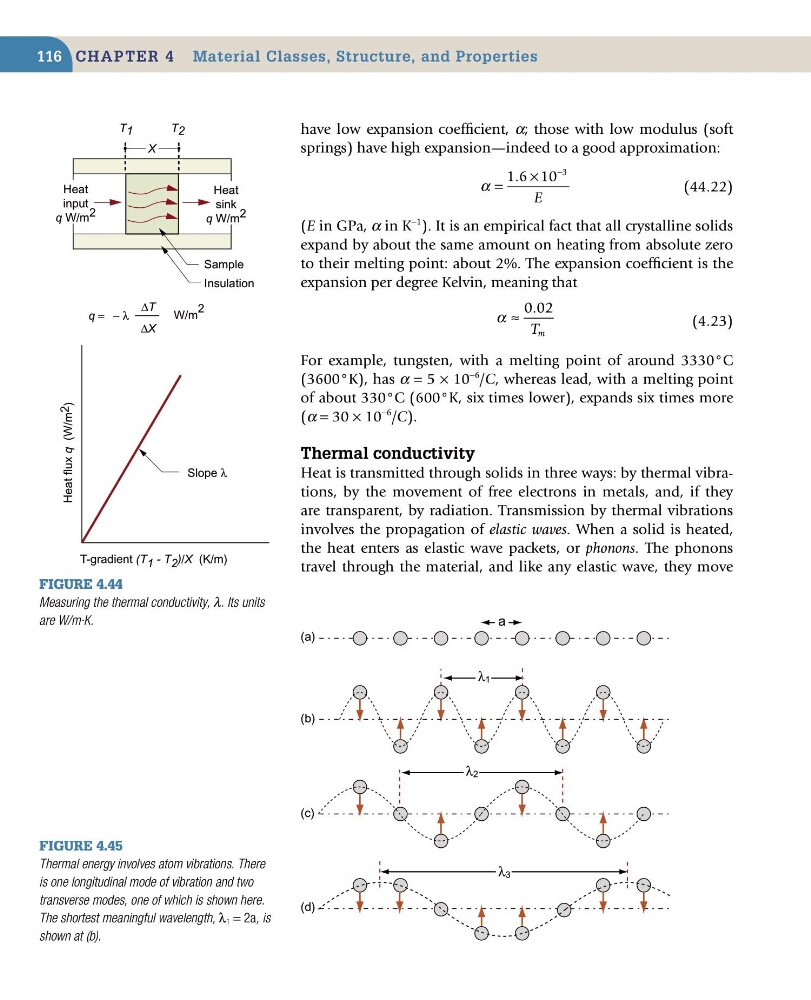
Figure 4.45
Thermal energy involves atom vibrations. There
is one longitudinal mode of vibration and two
transverse modes, one of which is shown here.
The shortest meaningful wavelength, λ 1 = 2a, is
shown at (b).
Figure 4.44
Measuring the thermal conductivity, λ. Its units
are W/m·K.
Heat flux q (W/m 2
)
T-gradient (T 1 - T 2 )/X (K/m)
Slope λ
Insulation
Sample
Heat
input
q W/m 2
Heat
sink
q W/m 2
T 1
T 2
X
∆T
q = − λ
∆X
W/m
2
have low expansion coefficient, α; those with low modulus (soft
springs) have high expansion—indeed to a good approximation:
α =
×
−
1 6 10
3
.
E
(44.22)
(E in GPa, α in K
−1 ). It is an empirical fact that all crystalline solids
expand by about the same amount on heating from absolute zero
to their melting point: about 2%. The expansion coefficient is the
expansion per degree Kelvin, meaning that
α ≈
0 02
.
T m
(4.23)
For example, tungsten, with a melting point of around 3330°C
(3600°K), has α = 5 × 10
−6 /C, whereas lead, with a melting point
of about 330°C (600°K, six times lower), expands six times more
(α = 30 × 10
−6
/C).
thermal conductivity
Heat is transmitted through solids in three ways: by thermal vibrations, by the movement of free electrons in metals, and, if they
are transparent, by radiation. Transmission by thermal vibrations
involves the propagation of elastic waves. When a solid is heated,
the heat enters as elastic wave packets, or phonons. The phonons
travel through the material, and like any elastic wave, they move
116
a
λ1
λ2
λ3
(a)
(b)
(c)
(d)
Figure 4.45
Thermal energy involves atom vibrations. There
is one longitudinal mode of vibration and two
transverse modes, one of which is shown here.
The shortest meaningful wavelength, λ 1 = 2a, is
shown at (b).
Figure 4.44
Measuring the thermal conductivity, λ. Its units
are W/m·K.
Heat flux q (W/m 2
)
T-gradient (T 1 - T 2 )/X (K/m)
Slope λ
Insulation
Sample
Heat
input
q W/m 2
Heat
sink
q W/m 2
T 1
T 2
X
∆T
q = − λ
∆X
W/m
2
have low expansion coefficient, α; those with low modulus (soft
springs) have high expansion—indeed to a good approximation:
α =
×
−
1 6 10
3
.
E
(44.22)
(E in GPa, α in K
−1 ). It is an empirical fact that all crystalline solids
expand by about the same amount on heating from absolute zero
to their melting point: about 2%. The expansion coefficient is the
expansion per degree Kelvin, meaning that
α ≈
0 02
.
T m
(4.23)
For example, tungsten, with a melting point of around 3330°C
(3600°K), has α = 5 × 10
−6 /C, whereas lead, with a melting point
of about 330°C (600°K, six times lower), expands six times more
(α = 30 × 10
−6
/C).
thermal conductivity
Heat is transmitted through solids in three ways: by thermal vibrations, by the movement of free electrons in metals, and, if they
are transparent, by radiation. Transmission by thermal vibrations
involves the propagation of elastic waves. When a solid is heated,
the heat enters as elastic wave packets, or phonons. The phonons
travel through the material, and like any elastic wave, they move