

117
with the speed of sound, c o ( c
E
o =
ρ ). If this is so, why does heat
not diffuse at the same speed? It is because phonons travel only a
short distance before they are scattered by the slightest irregularity
in the lattice of atoms through which they move, even by other
phonons. On average they travel a distance called the mean-free path
m before bouncing off something, and this path is short: typically
less than 0.01 microns (10
−8 m).
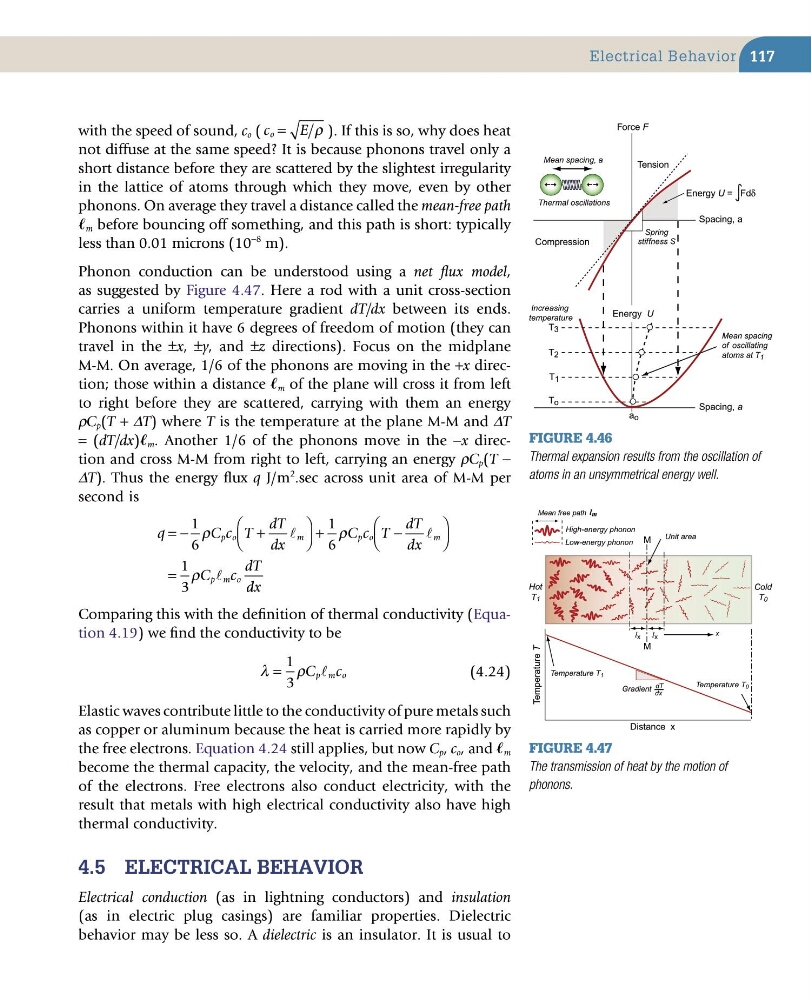
Phonon conduction can be understood using a net flux model,
as suggested by Figure 4.47. Here a rod with a unit cross-section
carries a uniform temperature gradient dT/dx between its ends.
Phonons within it have 6 degrees of freedom of motion (they can
travel in the ±x, ±y, and ±z directions). Focus on the midplane
M-M. On average, 1/6 of the phonons are moving in the +x direction; those within a distance m of the plane will cross it from left
to right before they are scattered, carrying with them an energy
ρC p (T + ΔT) where T is the temperature at the plane M-M and ΔT
= (dT/dx) m . Another 1/6 of the phonons move in the −x direction and cross M-M from right to left, carrying an energy ρC p (T −
ΔT). Thus the energy flux q J/m
2
.sec across unit area of M-M per
second is
q
C c T
dT
dx
C c T
dT
dx
C c
dT
p o
m
p o
m
p m o
= −
+
+
−
=
1
6
1
6
1
3
ρ
ρ
ρ
d dx
Comparing this with the definition of thermal conductivity (Equation 4.19) we find the conductivity to be
λ
ρ
=
1
3
C c
p m o
(4.24)
Elastic waves contribute little to the conductivity of pure metals such
as copper or aluminum because the heat is carried more rapidly by
the free electrons. Equation 4.24 still applies, but now C p , c o , and m
become the thermal capacity, the velocity, and the mean-free path
of the electrons. Free electrons also conduct electricity, with the
result that metals with high electrical conductivity also have high
thermal conductivity.
4.5 eleCtriCal Behavior
Electrical conduction (as in lightning conductors) and insulation
(as in electric plug casings) are familiar properties. Dielectric
behavior may be less so. A dielectric is an insulator. It is usual to
Figure 4.46
Thermal expansion results from the oscillation of
atoms in an unsymmetrical energy well.
Force F
Spacing, a
Spacing, a
a o
Spring
stiffness S
Energy U
Tension
Compression
Thermal oscillations
Energy U = Fdδ
Mean spacing
of oscillating
atoms at T 1
Mean spacing, a
Increasing
temperature
T o
T 1
T 2
T 3
Figure 4.47
The transmission of heat by the motion of
phonons.
High-energy phonon
Low-energy phonon
Mean free path
Unit area
Temperature T1
Distance x
Temperature T0
lx
lx
lm
M
M
Gradient
dT
dx
x
Temperature T
Hot
T1
Cold
T0
Electrical Behavior
with the speed of sound, c o ( c
E
o =
ρ ). If this is so, why does heat
not diffuse at the same speed? It is because phonons travel only a
short distance before they are scattered by the slightest irregularity
in the lattice of atoms through which they move, even by other
phonons. On average they travel a distance called the mean-free path
m before bouncing off something, and this path is short: typically
less than 0.01 microns (10
−8 m).
Phonon conduction can be understood using a net flux model,
as suggested by Figure 4.47. Here a rod with a unit cross-section
carries a uniform temperature gradient dT/dx between its ends.
Phonons within it have 6 degrees of freedom of motion (they can
travel in the ±x, ±y, and ±z directions). Focus on the midplane
M-M. On average, 1/6 of the phonons are moving in the +x direction; those within a distance m of the plane will cross it from left
to right before they are scattered, carrying with them an energy
ρC p (T + ΔT) where T is the temperature at the plane M-M and ΔT
= (dT/dx) m . Another 1/6 of the phonons move in the −x direction and cross M-M from right to left, carrying an energy ρC p (T −
ΔT). Thus the energy flux q J/m
2
.sec across unit area of M-M per
second is
q
C c T
dT
dx
C c T
dT
dx
C c
dT
p o
m
p o
m
p m o
= −
+
+
−
=
1
6
1
6
1
3
ρ
ρ
ρ
d dx
Comparing this with the definition of thermal conductivity (Equation 4.19) we find the conductivity to be
λ
ρ
=
1
3
C c
p m o
(4.24)
Elastic waves contribute little to the conductivity of pure metals such
as copper or aluminum because the heat is carried more rapidly by
the free electrons. Equation 4.24 still applies, but now C p , c o , and m
become the thermal capacity, the velocity, and the mean-free path
of the electrons. Free electrons also conduct electricity, with the
result that metals with high electrical conductivity also have high
thermal conductivity.
4.5 eleCtriCal Behavior
Electrical conduction (as in lightning conductors) and insulation
(as in electric plug casings) are familiar properties. Dielectric
behavior may be less so. A dielectric is an insulator. It is usual to
Figure 4.46
Thermal expansion results from the oscillation of
atoms in an unsymmetrical energy well.
Force F
Spacing, a
Spacing, a
a o
Spring
stiffness S
Energy U
Tension
Compression
Thermal oscillations
Energy U = Fdδ
Mean spacing
of oscillating
atoms at T 1
Mean spacing, a
Increasing
temperature
T o
T 1
T 2
T 3
Figure 4.47
The transmission of heat by the motion of
phonons.
High-energy phonon
Low-energy phonon
Mean free path
Unit area
Temperature T1
Distance x
Temperature T0
lx
lx
lm
M
M
Gradient
dT
dx
x
Temperature T
Hot
T1
Cold
T0
Electrical Behavior