

115
it takes for a temperature pulse to traverse a specimen of known
thickness when a heat source is applied briefly to one side; or it can
be calculated from λ and (ρC p ) via Equation 4.20.
the physics of thermal properties
heat capacity
Atoms in solids vibrate about their mean positions with an amplitude that increases with temperature. Atoms in solids can’t vibrate
independently of each other because they are coupled by their
inter atomic bonds; the vibrations are like standing elastic waves.
Some of these have short wavelengths and high energy, others long
wavelengths and lower energy (see Figure 4.45). The shortest possible wavelength, λ 1 , is just twice the atomic spacing; the other vibrations have wavelengths that are longer. In a solid with N atoms
there are N discrete wavelengths, and each has a longitudinal mode
and two transverse modes, 3N modes in all. Their amplitudes are
such that, on average, each has energy k B T where k B is Boltzmann’s
constant, 1.38 × 10
−23 J/K. If the volume occupied by an atom is
Ω, the number of atoms per unit volume is N = 1/Ω and the total
thermal energy per unit volume in the material is 3k B T/Ω. The heat
capacity per unit volume, ρC p , is the change in this energy per Kelvin
change in temperature, giving
ρC
k J m K
p
B
=
3
3
Ω
(4.21)
The result matches well with measured values of the heat capacity.
thermal expansion
If a solid expands when heated (and almost all do), it must be
because the atoms are moving further apart. Figure 4.46 shows
how this happens. The force-displacement curve is not quite
straight; the bonds become stiffer when the atoms are pushed
together and less stiff when they are pulled apart. Atoms vibrating in the way described earlier oscillate about a mean spacing that
increases with the amplitude of oscillation and thus with increasing temperatures. So thermal expansion is a nonlinear effect; if
the bonds between atoms were linear springs, there would be no
expansion.
The stiffer the springs, the steeper the force-displacement curve and
the narrower the energy well in which the atom sits, giving less scope
for expansion. Thus materials with high modulus, E (stiff springs),
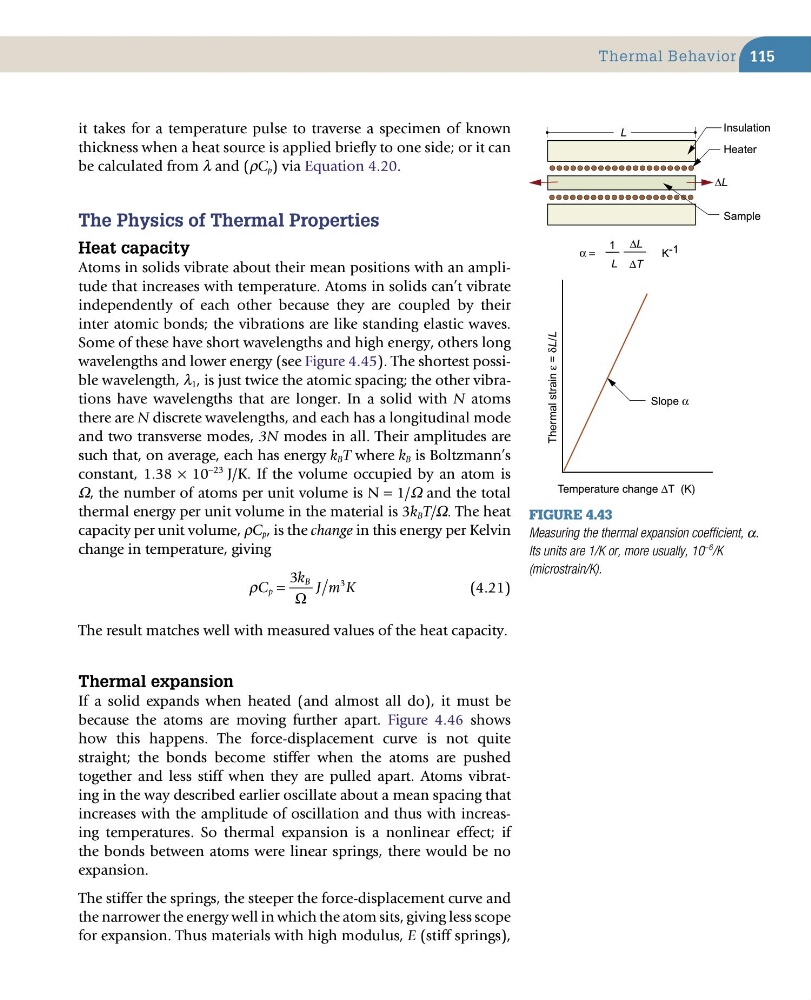
Figure 4.43
Measuring the thermal expansion coefficient, α.
Its units are 1/K or, more usually, 10
−6
/K
(microstrain/K).
L
Temperature change ∆T (K)
Thermal strain
ε =
δL/L
α =
∆L
∆T
L
1
K -1
Insulation
Heater
Sample
∆L
Slope α
Thermal Behavior
it takes for a temperature pulse to traverse a specimen of known
thickness when a heat source is applied briefly to one side; or it can
be calculated from λ and (ρC p ) via Equation 4.20.
the physics of thermal properties
heat capacity
Atoms in solids vibrate about their mean positions with an amplitude that increases with temperature. Atoms in solids can’t vibrate
independently of each other because they are coupled by their
inter atomic bonds; the vibrations are like standing elastic waves.
Some of these have short wavelengths and high energy, others long
wavelengths and lower energy (see Figure 4.45). The shortest possible wavelength, λ 1 , is just twice the atomic spacing; the other vibrations have wavelengths that are longer. In a solid with N atoms
there are N discrete wavelengths, and each has a longitudinal mode
and two transverse modes, 3N modes in all. Their amplitudes are
such that, on average, each has energy k B T where k B is Boltzmann’s
constant, 1.38 × 10
−23 J/K. If the volume occupied by an atom is
Ω, the number of atoms per unit volume is N = 1/Ω and the total
thermal energy per unit volume in the material is 3k B T/Ω. The heat
capacity per unit volume, ρC p , is the change in this energy per Kelvin
change in temperature, giving
ρC
k J m K
p
B
=
3
3
Ω
(4.21)
The result matches well with measured values of the heat capacity.
thermal expansion
If a solid expands when heated (and almost all do), it must be
because the atoms are moving further apart. Figure 4.46 shows
how this happens. The force-displacement curve is not quite
straight; the bonds become stiffer when the atoms are pushed
together and less stiff when they are pulled apart. Atoms vibrating in the way described earlier oscillate about a mean spacing that
increases with the amplitude of oscillation and thus with increasing temperatures. So thermal expansion is a nonlinear effect; if
the bonds between atoms were linear springs, there would be no
expansion.
The stiffer the springs, the steeper the force-displacement curve and
the narrower the energy well in which the atom sits, giving less scope
for expansion. Thus materials with high modulus, E (stiff springs),
Figure 4.43
Measuring the thermal expansion coefficient, α.
Its units are 1/K or, more usually, 10
−6
/K
(microstrain/K).
L
Temperature change ∆T (K)
Thermal strain
ε =
δL/L
α =
∆L
∆T
L
1
K -1
Insulation
Heater
Sample
∆L
Slope α
Thermal Behavior